The global trade of agricultural mechanization: figures and challenges
Published by Mauro Badanelli. .
Food&Beverage Importexport International marketing International marketingIntroduction
During the twenty-first century, agriculture has progressively become one of the strategic sectors for building sustainable development models on a global scale. At the same time, the sector faces a series of structural challenges that test the capacity of the global agricultural system to ensure an adequate food supply for steadily growing demand.
In this context, agricultural mechanization is assuming an increasingly central role: not only as a productive factor that has become indispensable for any type of agriculture, but also as one of the main drivers of technological and organizational innovation in the sector.
Changes in the Demand for Agricultural Products
The steady increase in the world population, together with rising average incomes in many areas of the world, has led over the last fifteen years to a significant increase in the demand for food products. One measure of this trend emerges from the evolution of international trade in food goods, whose value, expressed in real terms, has essentially doubled compared with the beginning of the 2010s. Overall, global trade in food products recorded an average annual growth rate of 2.8% during this period.
Fig.1 – Global Trade in Food Products
(values at constant prices)

Another equally significant aspect is that this trend reflects not only a quantitative change, but also a qualitative shift in food demand. In particular, there has been a growing expansion of higher value-added segments along the supply chain of packaged food products and beverages.
In the packaged food and beverages sector, in fact, the share of products belonging to the high and upper-middle price ranges increased overall from 15% in 2010 to about 35% in the most recent period. This figure highlights how the growth of global demand is accompanied by a gradual premiumization of consumption, linked to rising average incomes, the spread of new dietary models, and greater consumer attention to product quality, safety, and distinctive characteristics.
Fig.2 – Global Trade in Packaged Food: segmentation by price range

However, an expansionary dynamic in food demand will be sustainable only if the supply side is also able to keep pace in the coming years. In this respect, the global agricultural system faces increasingly significant challenges, particularly those related to the effects of climate change and the increasingly efficient management of natural resources, starting with soil and water.
In this scenario, agricultural mechanization confirms itself as a fundamental tool not only as an essential productive factor for every type of agriculture, but above all as a key driver of technological and organizational innovation capable of guiding the evolution of the entire sector and responding to growing challenges.
Evolution of Global Trade
Thanks to the data available in the ExportPlanning Information System, we can outline the key figures of the international trade in agricultural machinery.
In 2025, global trade in the sector reached 87 billion euros, with a slight decline compared with the previous year (-0.5% at current prices). Despite the drop, which confirms what was already recorded in 2024 (-11%), the trend of international trade in the sector remains positive overall. Looking at the period 2009–2025, growth amounted to 3.5% per year at current euro values, equivalent to 2.6% in real terms, and has broadly supported the growth in demand for food products.
Fig.3– Global Trade in Agricultural Machinery

Source: ExportPlanning elaborations
The Main Markets in the Sector
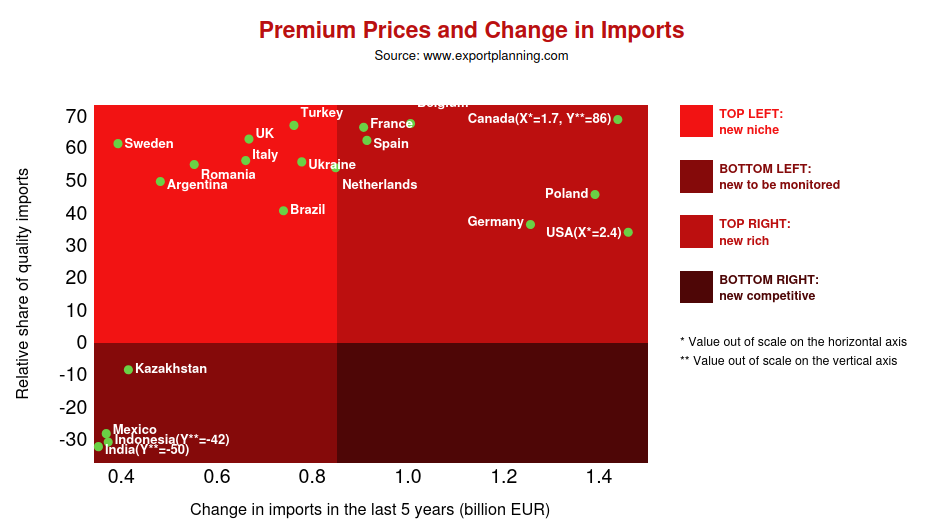
The analysis of the main markets for agricultural machinery highlights the leadership of the United States as the main importing country. In 2025, the value of imported machinery reached 11.3 billion euros. Germany, France, Canada, and the Netherlands follow. The U.S. market remains at the top in terms of the value of imported machinery, with a 12.7% share of the global total. The other countries hold significantly smaller shares, ranging from Germany’s 6.8% to the Netherlands’ 3.6%.
A comparison with 2024 highlights a decline in imports in some of the main markets: USA -27%, France -11%, Canada -14%, and Austria -18%. Conversely, among the top ten markets in the sector, a significant increase in imports is observed in Poland (+22%) and Germany (+16%).
The ExportPlanning analysis also provides an assessment of the greater or lesser propensity of different markets to pay a premium price for higher quality. In the agricultural machinery sector, this indicator is particularly useful for identifying markets where demand is more strongly oriented toward advanced technological solutions. In this respect, in addition to the consolidated markets of Canada and the United States, markets of particular interest such as Poland also emerge.
The same analysis also identifies several countries that deserve particular attention for a possible further expansion of imports: among them are Kazakhstan, Mexico, Indonesia, and India. In many cases, these are economies characterized by sustained demographic growth, a gradual increase in average income, and an evolution of food consumption models toward higher value-added products.
These transformations in domestic demand are contributing to accelerating the modernization processes of their respective agri-food supply chains, with a consequent increase in investments in agricultural technologies and machinery necessary to improve productivity and efficiency in the use of resources.
Source: ExportPlanning elaborations
The Competitive Scenario
On the supply side, Germany and China are by far the main exporting countries of agricultural machinery. Together, they account for more than 30% of global exports in the sector. Specifically, German exports exceeded 15 billion euros, while China’s foreign sales totaled 12.5 billion euros. With a 9.8% share of global exports, the United States follows, having exported agricultural machinery worth 8.8 billion euros in 2025. Global trade therefore appears to be highly concentrated in the hands of these three competitors.
It should also be noted that a number of countries, including Italy, are characterized by exports that over the last five years have shown relatively high average prices.
Conclusions
Global trade in agricultural machinery shows a long-term growth trend, closely linked to the expansion of global food demand and the modernization processes of agricultural systems. Despite the recent declines recorded in some markets, the sector continues to represent a fundamental lever for supporting the increase in agricultural productivity and encouraging the adoption of increasingly efficient technologies.
In a context where agriculture is required to respond simultaneously to the growth in food demand and to the challenges posed by climate change and the sustainable management of natural resources, mechanization indeed confirms itself as one of the main enabling factors for innovation in the sector.
In this scenario, the ExportPlanning Information System allows companies to access an updated and comparable information framework, useful for identifying the most promising markets and more effectively guiding international positioning strategies.
You may be interested in:

Machinery for nonwovens production facing the sustainability challenge
Published by Mauro Badanelli. .
Importexport Industrial equipment International marketing International marketingOver the course of the 21st century, the nonwovens sector has experienced solid growth in both production and exports. The driver of this development lies in the features of nonwovens, which have en}... [ Read all ]

Decision-Making Under Uncertainty: The Strategic Value of External Data
Published by Marzia Moccia. .
Planning Internationalisation International marketing Internationalisation toolsA company’s performance largely depends on the quality of the decisions it makes, and the quality of decisions depends on the information available. Effective decisions allow the company to move for}... [ Read all ]

World Exports 2025 of Food & Beverage: a preliminary assessment
Published by Marcello Antonioni. .
Food&Beverage Conjuncture Export AgribusinessProgressive worsening of world exports of Food & Beverage, but with differences at sectoral level and among exporting countries [ Read all ]