Machinery for nonwovens production facing the sustainability challenge
Published by Mauro Badanelli. .
Importexport Industrial equipment International marketing International marketingOver the course of the 21st century, the nonwovens sector has experienced solid growth in both production and exports. The driver of this development lies in the features of nonwovens, which have enabled their application across a wide range of industries.
Versatility, functionality and cost-effectiveness have allowed nonwovens to be used in sectors such as hygiene and medical (e.g. wipes, sanitary products, diapers, gowns, masks), filtration (air and liquid filters), automotive (interior components, acoustic insulation, etc.), as well as construction and geotextiles (products for thermal and acoustic insulation, soil drainage and erosion control).
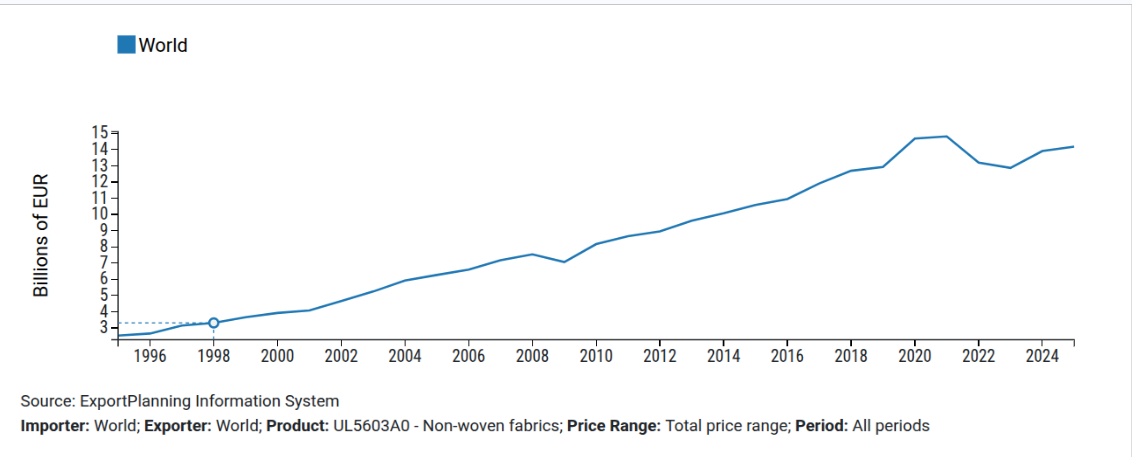
Thanks to this broad range of applications, the nonwovens sector has recorded steady growth in recent years. In particular, international trade dynamics show that the real value of global trade in the sector has more than doubled compared to the first decade of the century. Between 2009 and 2025, the average annual growth rate stood at +4.9%.
Fig.1 – Global trade of nonwovens
(value at constant prices)
In this context of widespread diffusion, nonwovens have evolved: no longer simple commodities, but high value-added products. This trend is confirmed by the comparison of international trade by price segments between 2015 and 2025. The share of high-price products has increased, eroding the lower-end segment (from 23.6% in 2015 to 29.1% in 2025).
The technologies used for nonwovens production also show strong differentiation depending on the processes employed in the three main production stages: web formation, bonding, and finishing. Regardless of the technology, the entire nonwovens value chain is now facing the sustainability challenge, as the traditional textile sector, striving to reduce carbon footprint and develop end-of-life solutions. Technological development is also strongly influenced by European and international regulatory frameworks concerning both environmental impact and product safety.
Global trade in nonwovens machinery
According to data from the Exportplanning information system, international trade in machinery for nonwovens production (HS code 844900) exceeded €547 million in 2025, marking a decline of 8.6% compared to the previous year in current values. Since 2021, global trade has shown a slowdown following years of rapid growth, which peaked in 2020 due to the surge in demand for machinery used to produce disposable products to address the COVID-19 pandemic (protective masks, disposable gowns, etc.).
Main markets for nonwovens machinery
The analysis of international trade flows helps outline the geography of nonwovens production. In Europe, alongside Germany, Turkey has emerged as a major importer of machinery, acting as a highly competitive production hub. Imports exceeded €68.3 million in 2025, showing an increase of €36 million compared to 2024.
Demand for machinery also remains strong in the United States, where nonwovens production is characterized by high value-added and specialization in hygiene and filtration sectors. In 2025 U.S. imports reached €57.7 million, despite a significant decline compared to 2024 (-45% in current values).
In Asia, India continues to be a fast-growing market for machinery manufacturers, surpassing China as the leading importer in the region. In 2025 Indian imports amounted to €56.9 million, with an average annual growth rate of 13.6% over 2009–2025 period.
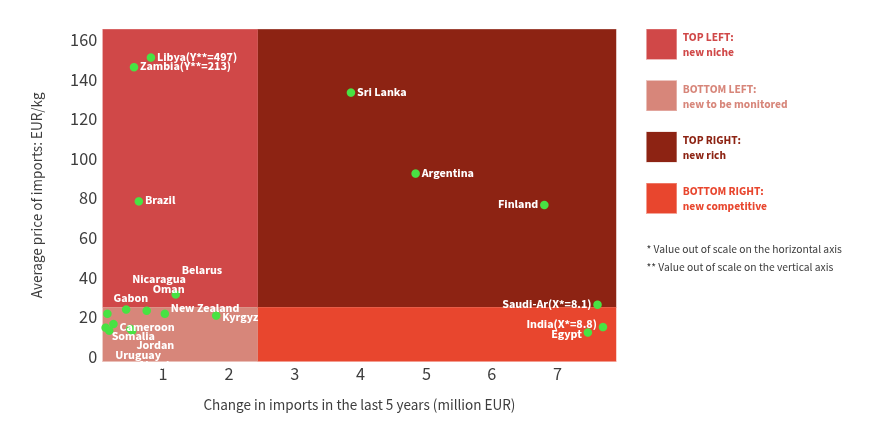
In addition to the most relevant markets, the Exportplanning system also allows analysis of each Country’s propensity to pay a premium price for higher-quality imported products. This indicator is particularly useful for identifying markets oriented toward advanced technological solutions, such as Sri Lanka, Argentina, and Finland.
Fig.2– Premium price analysis in the most dynamic markets
(2020-25)
Source: ExportPlanning elaborations- Reporting Tool
Are you interested in receiving a selection of the most relevant foreign trade news of the week? Subscribe for free to the World Business Newsletter!
Italy’s role in the competitive landscape
On the supply side, Germany and China compete for leadership as the world’s leading exporters, each holding more than 34% of total exports in 2025. Specifically, Chinese exports reached €218.4 million, while German exports totaled €216.2 million.
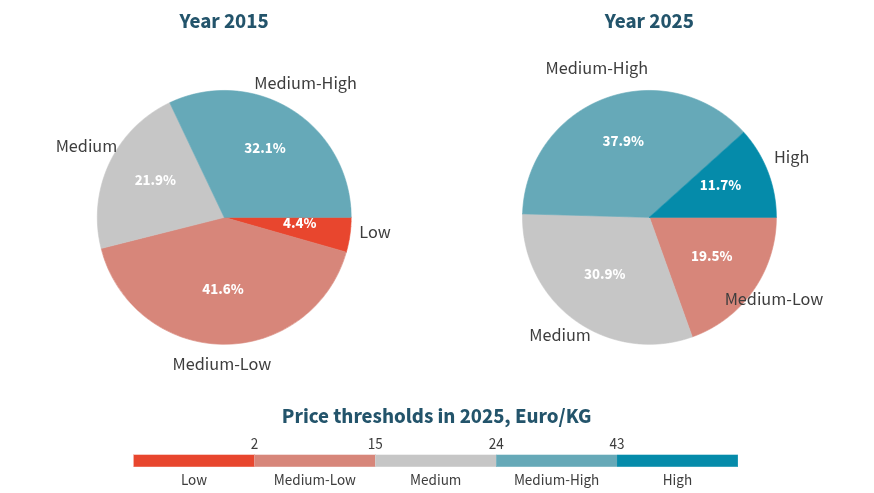
Italy ranks third among the main exporters in 2025, with exports amounting to €41.1 million. The main destination markets for Italian machinery include the United States, Poland and India. Although exports declined in the period 2023–2025, the long-term trend remains positive, with an average annual growth rate of +3.2%.
Fig.3– ITALY: Export segmentation by price range
Source: ExportPlanning elaborations
Conclusions
Global trade in machinery for nonwoven production is expected to maintain a moderately positive trend over the next four years (CAGR 2026–2029: +1.4%), driven primarily by further expansion in nonwovens production.
Demand for machinery will be supported by growth drivers across end-use sectors, all sharing a common factor: the sustainability of production processes. Examples include developments in biodegradable nonwovens, which help reduce the environmental impact of disposable products, and technological solutions enabling the processing of recycled materials into new products.
For manufacturers of nonwovens machinery, the coming years show a dynamic scenario. In this context, careful analysis of external data — such as that provided by the Exportplanning information system — will support companies across the value chain identify and target the most promising markets.
You may be interested in:

The global trade of agricultural mechanization: figures and challenges
Published by Mauro Badanelli. .
Food&Beverage Importexport International marketing International marketingIntroduction During the twenty-first century, agriculture has progressively become one of the strategic sectors for building sustainable development models on a global scale. At the same time, th}... [ Read all ]

Decision-Making Under Uncertainty: The Strategic Value of External Data
Published by Marzia Moccia. .
Planning Internationalisation International marketing Internationalisation toolsA company’s performance largely depends on the quality of the decisions it makes, and the quality of decisions depends on the information available. Effective decisions allow the company to move for}... [ Read all ]

World Exports 2025 of Machinary: a preliminary assessment
Published by Marcello Antonioni. .
Industrial equipment Conjuncture Export Global economic trendsWorld Exports of Machinery continued to grow in 2025, once again more dynamic than European sales alone [ Read all ]