January 2026: the latest data on global trade in goods
Published by Marzia Moccia. .
Slowdown Exchange rate Conjuncture Dollar Euro Foreign markets Uncertainty Global economic trendsThe availability in the ExportPlanning Information System of global trade data for January makes it possible to update the short-term outlook on the most recent dynamics of world trade in goods, within an international context characterized by persistent uncertainty and geopolitical instability. In the current scenario, month-by-month monitoring of global demand conditions becomes crucial to promptly detect signals of slowdown or trend reversals in trade flows and to support informed strategic decisions.
The latest signals from International Trade Data
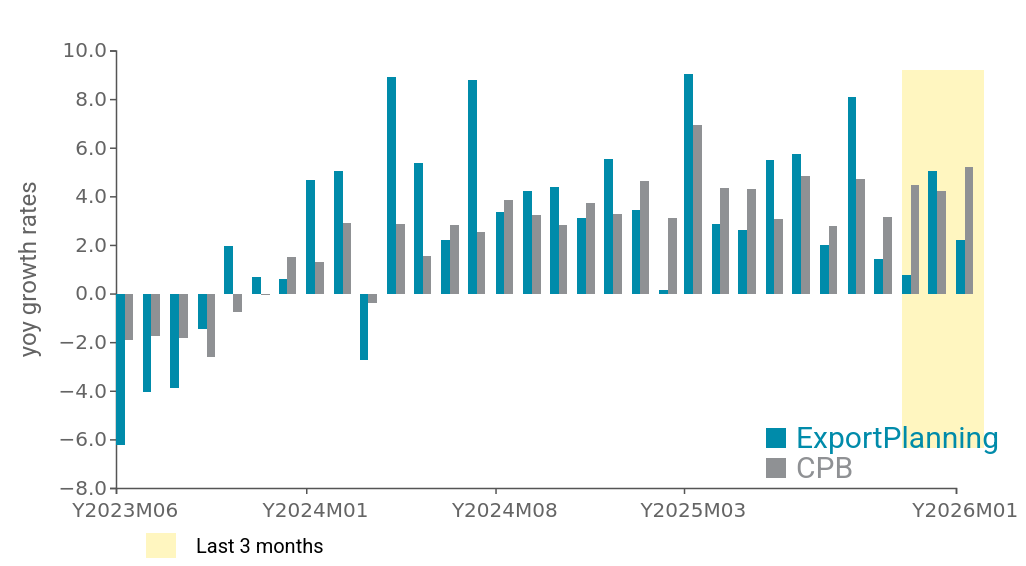
Fig. 1 shows the series of year-on-year changes in monthly data relating to global trade in manufactured goods at constant prices, i.e. net of price and exchange rate fluctuations. The data, collected and systematized by ExportPlanning, are compared with those of the Central Planning Bureau, an institute that also processes information on international trade in goods.
Fig.1 - World trade at constant prices
(year-on-year change on monthly data)
Source: ExportPlanning
Both sources make it possible to robustly document the same trends in global demand for goods at constant prices, i.e. in volume terms. First of all, as repeatedly highlighted, 2025 was a year of substantial resilience for global trade in goods. Despite an international scenario marked by the breakdown of the multilateral system imposed by US tariffs, an overall growth of around 5% was estimated for last year.
Although data for the months from August to November had shown some signs of slowdown, the figures for December and January instead show relative continuity compared to the pace of growth recorded throughout 2025. Overall, year-on-year growth of 4% is estimated on average for December and January. This trend is confirmed in both data series, testifying to the consistency and robustness of the evidence collected.
Between Resilience and Risks
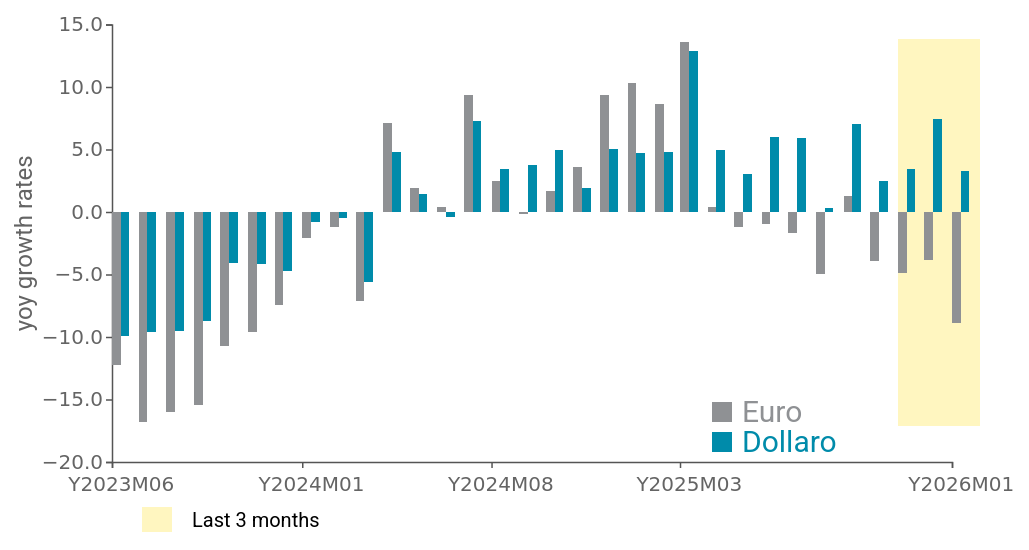
While the substantial resilience of global trade in goods in real terms represents a positive element in the international economic outlook and is confirmed at the beginning of the new year, a first shadow factor emerges from the analysis of trade dynamics in value terms, expressed in dollars and euros. The depreciation of the dollar, which intensified throughout 2025, is in fact causing a significant divergence between the dynamics of global trade measured in the two currencies, substantially affecting the interpretation of nominal performance in international trade.
As shown in Fig.2, global trade dynamics have maintained a positive tone in nominal terms when measured in dollars throughout the entire period. Measurement in euros, on the other hand, shows a markedly weaker performance, reflecting the effects of the strengthening of the European currency against the dollar. Overall, while growth of 5% is estimated in dollars for the December–January period, a decline of 6% is observed in euros over the same period. Global trade dynamics measured in euros have been steadily in negative territory for several months, highlighting the impact of exchange rate movements on the interpretation of nominal changes.
Fig.2 - World trade at current prices Euro vs Dollar
(year-on-year change on monthly data)
Source: ExportPlanning
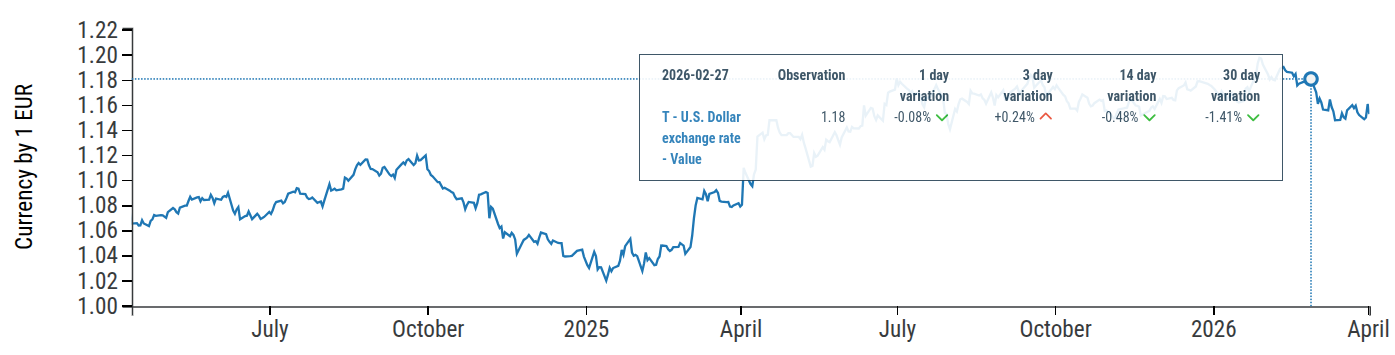
Looking at the monthly series of bilateral exchange rate fluctuations, in the January–February 2026 period the USD/EUR exchange rate experienced one of its highest moments of depreciation, reaching 1.17 in January and 1.18 in February. These levels reflect an overall depreciation of the dollar against the euro of more than 13% compared to early 2025 values.
Fig.3- Dollar/Euro exchange rate
(year-on-year change on daily data)
Source: PricePedia
On the one hand, this trend confirms the importance of analyzing the economic outlook at constant prices, in order to cleanse the data from the effects of exchange rate movements and price changes and obtain a more accurate reading of real global trade trends. On the other hand, the significant divergence between values in dollars and euros signals a highly selective environment for European exporters.
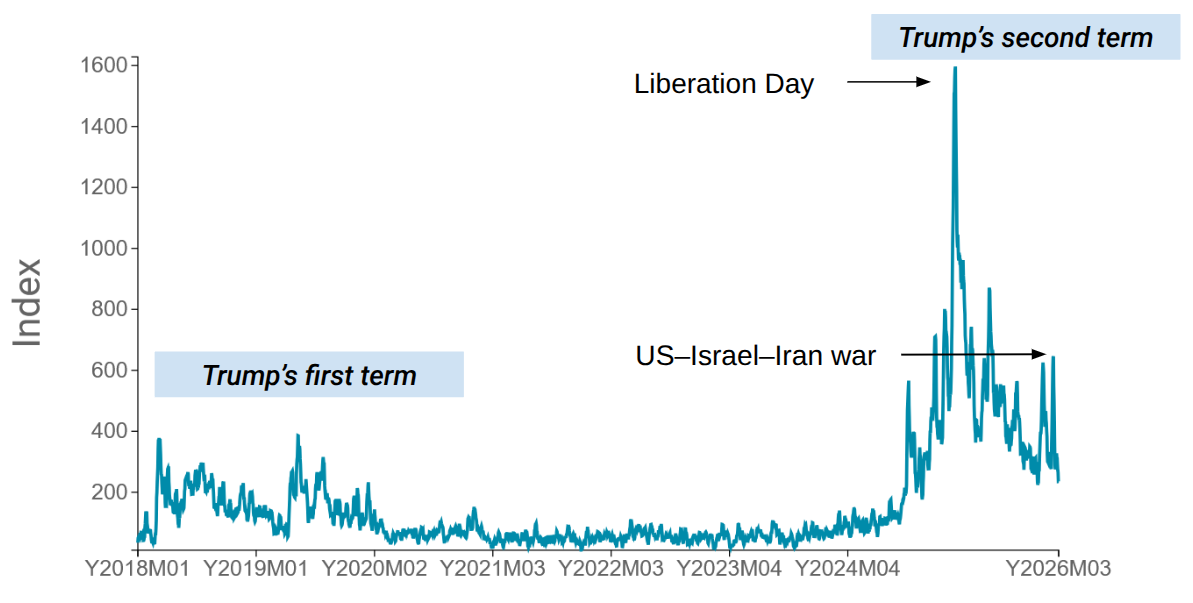
A second risk factor clearly emerges from the geopolitical scenario. The year 2026 has in fact begun under the sign of new geopolitical tensions, with the outbreak of the US–Israel–Iran conflict impacting the global growth outlook and, in particular, the risk scenario especially on the energy supply front. Although the overall level of uncertainty is, for the moment, significantly lower than that experienced last spring following the so-called “Liberation Day,” the future evolution of the conflict represents a key element to monitor for the economic outlook of 2026.
Source: ExportPlanning
The scenario outlined above highlights how the international context is characterized by a growing and persistent level of uncertainty and geopolitical instability, with direct impacts on business operations and strategic choices. In this framework, it becomes essential to equip oneself with effective monitoring tools capable of supporting a timely reading of ongoing dynamics with a high frequency of updates.
For an exporting company, it is increasingly strategic to have continuous monitoring of market conditions, particularly demand related to products and key target areas, in order to effectively support its international positioning. With the aim of ensuring constant coverage of foreign markets at a product-specific level, ExportPlanning provides “on-demand” supplies of monthly data, customized according to the products and markets of interest.

You may be interested in:
IMF WEO October 2026: Divergent Resilience and Persistent Pressures
Published by Alba Di Rosa. .
Macroeconomic analysis Conjuncture Uncertainty IMF Global economic trendsOn October 13, the International Monetary Fund released its latest World Economic Outlook, a key publication assessing the state of the global economy and its growth prospects. Compared with }... [ Read all ]

Hollow glass machinery: global trade set to accelerate in 2026
Published by Mauro Badanelli. .
Industrial equipment Conjuncture Foreign markets Global economic trendsThe global trade in machinery for the production and processing of hollow glass1 has shown a marked reversal in the first seven months of 2026, compared with the weakness that characterised the 2022–2}... [ Read all ]

Machinery: International Sales Results to July 2026
Published by Marcello Antonioni. .
Industrial equipment Conjuncture Monthly Market Data Global economic trendsIn July Machinery exports by EU companies remained in positive territory, but with significant differences across sectors [ Read all ]