Nonwovens machinery: a comparison of the Chinese and Indian markets
Published by Mauro Badanelli. .
Internationalisation Industrial equipment Conjuncture Foreign markets International marketingAs highlighted in a recent article published in the magazine, the nonwovens sector has developed significantly in recent decades and experienced an acceleration in global production and trade in 2020, when the Covid-19 pandemic required an intensification of production of hygienic and medical safety devices for the entire population.
Regardless of the pandemic event, the sector’s growth remains solid and largely depends on the versatility of nonwovens, which allows their use in various application fields.
Similarly, global trade in machinery for the production of nonwovens (customs code HS844900) has also grown in recent years, although its development has not been as significant as that observed for the products made with these machines. After the acceleration seen in 2020, trade dynamics cooled in the following years, setting the average annual growth rate at 1% over the 2009–2025 period.
Asia as the preferred destination for nonwovens machinery manufacturers
Among the different geographical areas, Asia represents the main destination for global trade in nonwovens machinery. About 31% of global sales in the sector in 2025 were directed to Asian markets, while 18% went to non-EU European markets and only 17% to EU markets.
In particular, Country-level analysis shows that the two main Asian markets are India and China.
However, over the 2009–2025 period, imports in the two Countries followed different trends.
Chinese imports decreased by an average of 2.5% per year, while Indian imports grew by 13.6% over the same period. In light of the significant downsizing of the Chinese market, since 2024 India has become the leading Asian destination for global trade in nonwovens machinery. In 2025, Indian imports reached €56.9 million, while Chinese imports stood at €28.8 million.
Fig.1 – Imports of nonwovens machinery (HS 844900) - India vs. China
(million euros)
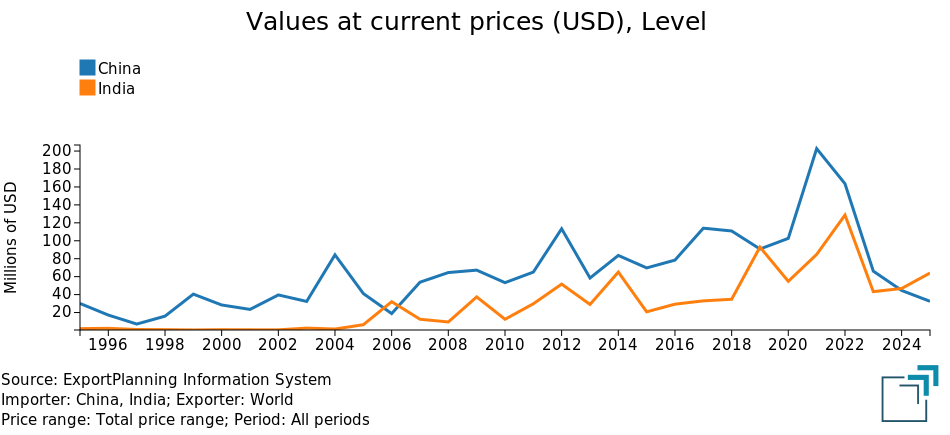
Fig. 1 confirms the natural cyclicality in machinery demand for both countries within an overall growth context. As mentioned, China experienced significant import growth rates in 2020–2021, followed by a sharp slowdown in subsequent years. By contrast, India’s imports, although growing at a less intense pace than China’s, continued to increase up to 2025 (with the exception of the decline in 2023, which was common to all major markets).
The analysis of import trends, supported by data on machinery production estimated by the ExportPlanning information system, highlights a clear shift in China’s production activity related to nonwovens machinery. The growing global demand for hygienic and healthcare safety devices has been a key driver in repositioning China as a leading player also in the production of machinery for the sector.
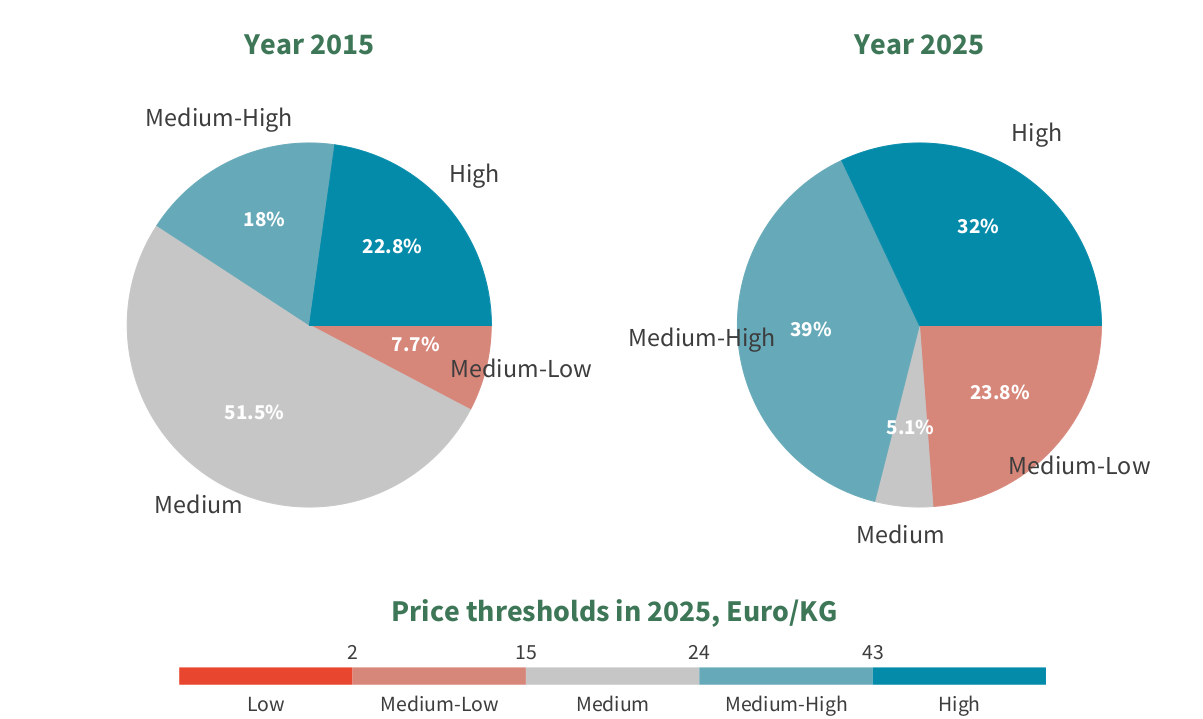
At the same time, China’s machinery imports are shifting toward medium-high and high-end foreign production, as shown by the comparison of the distribution of Chinese imports by price range between 2015 and 2025. The share corresponding to the two highest price ranges increased from 40.8% to 71% over the decade.
Fig.2 – China - Imports of nonwovens machinery by price range
Source: ExportPlanning processing - Reporting Tool
India, on the other hand, still relies on machinery imports to increase the sector’s production capacity. Investments are growing in response to strong demand for nonwoven products, which in turn is driven by demographic growth, increasing urbanization, and the modernization of existing infrastructure.
Demand for disposable products for personal hygiene and medical use, as well as for geotextiles used in infrastructure development, has influenced investments in new foreign technologies by local companies operating in the sector. In the case of the Indian market, unlike what has been observed in China, machinery imports are almost entirely concentrated in the medium and medium-low price ranges, with China accounting for more than 73% of Indian imports.
Are you interested in receiving a selection of the most relevant weekly news on foreign trade? Subscribe for free to the World Business Newsletter!
How the Indian and Chinese markets are evolving in the first months of 2026
The analysis of the first months of 2026 confirms growth in both Indian and Chinese imports for HS844900, relating to nonwovens machinery. Based on data from the monthly customs declarations database, it is possible to monitor imports of the product code broken down by partner Countries for the January–February period in the case of India and for the first three months of the year in the case of China.
The updated and granular data presented in Table 1 provide a breakdown of Indian imports by month and by partner country. China, Germany, and Italy are the main suppliers of machinery for the sector. Their sales on the Indian market show strong positive variations at current prices between the cumulative January–February 2026 data and the same period in 2025.
Table 1 – India - Imports of nonwovens machinery
(% change at current prices)
| Partner | January 2026 (thousand euros) |
February 2026 (thousand euros) |
% change Jan-Feb 2026/2025 |
|---|---|---|---|
| China | 6 133 | 8 568 | +113.5 |
| Germany | 42 | 496 | +247.0 |
| Italy | - | 3935 | +250.4 |
| Bulgaria | 43 | 42 | n.a. |
| United Kingdom | 35 | 34 | n.a. |
Source: ExportPlanning information system
Table 2, on the other hand, shows Chinese import data based on customs declarations for the first three months of the year. Portugal and Taiwan are the main technology suppliers for Chinese companies in the sector, with significant growth in sales compared to the same period in 2025.
Table 2 – China - Imports of nonwovens machinery
(% change at current prices)
| Partner | January 2026 (thousand euros) |
February 2026 (thousand euros) |
March 2026 (thousand euros) |
% change Jan-March 2026/2025 |
|---|---|---|---|---|
| Portugal | 616 | 417 | 326 | +82.5 |
| Taiwan | 516 | - | 600 | +60.3 |
| Germany | 67 | 180 | 117 | +21.9 |
| Japan | 310 | 9 | 1 | n.a. |
| Netherlands | - | 89 | - | n.a. |
Source: ExportPlanning information system
Although the analysis is based on a still limited time horizon—restricted to the first months of the year—and therefore not fully representative of medium-term trends, especially for sectors such as machinery characterized by discontinuous and often concentrated order dynamics, the available short-term signals nevertheless indicate a positive demand outlook in 2026 for the main technology partners of both countries.
The importance of monthly monitoring of target markets
The analysis described above represents a use case of the ExportPlanning On Demand service of the monthly customs declarations database, which allows exporting companies to access high-frequency updated information on demand conditions in the various markets they serve.
Having access to up-to-date monthly data on import trends in key target markets enables machinery exporting companies to promptly detect signals of demand growth or contraction, identify emerging opportunities, and continuously monitor developments in the target markets of their main competitor countries.
```
You may be interested in:

Machinery: International Sales Results to July 2026
Published by Marcello Antonioni. .
Industrial equipment Conjuncture Monthly Market Data Global economic trendsIn July Machinery exports by EU companies remained in positive territory, but with significant differences across sectors [ Read all ]

World Trade: Increasingly Polarized Growth – July 2026 Update
Published by Marzia Moccia. .
Conjuncture Foreign markets Uncertainty Global economic trendsWorld trade continues to grow in 2026, but behind the resilience of the aggregate figures, disparities across sectors and geographic regions are widening [ Read all ]

Leather Machinery: After the 2026 Downturn, the Outlook for World Trade in 2027-2028
Published by Mauro Badanelli. .
Industrial equipment Forecast International marketing2026 is shaping up to be a year of contraction in world trade of machinery for the manufacture or repair of leather or hide articles (HS845380), following the levels reached in 2025. According to Expo}... [ Read all ]