Previsioni di commercio mondiale: incertezza sistemica e dinamiche selettive di crescita
Published by Marzia Moccia. .
Total goods Global demand Forecast Foreign markets Uncertainty Foreign market analysisThe conflict in the Middle East is testing the resilience of the global economy, which so far has been supported by relatively favourable financial and fiscal conditions and by growing demand for technologies linked to artificial intelligence. The disruption of commercial traffic through the Strait of Hormuz and the closure or damage of energy infrastructure are generating a sharp increase in energy prices, particularly oil, and are undermining the global energy supply.
The decisive variable for the formulation of robust forecast scenarios remains the duration of the US-Israel and Iran conflict. The longer geopolitical instability persists, the greater the consolidation of medium-term inflation expectations will be. Upward revisions to inflation expectations in fact reflect the fear that the energy shock is not temporary, but may directly or indirectly affect companies’ production costs. The conflict is therefore representing a clear risk factor, due to its impact on multiple fronts: first and foremost on commodity markets, but also on inflation expectations and financial conditions. The spectre of an energy crisis therefore takes centre stage should hostilities continue.
ExportPlanning world trade forecasts
In light of the scenario described above, the ExportPlanning world trade scenario is strongly influenced by the outcome of the ongoing conflict between the United States, Israel, and Iran. At present, the most likely assumption included in expectations is a conclusion of hostilities by the summer, although the ways in which this might occur remain highly uncertain.
As repeatedly reported, in the early months of the year, before the escalation of the conflict, world trade growth had shown a certain resilience, still strongly supported on the one hand by demand for goods and components linked to the AI sector, and on the other by a progressive accumulation of commodity stocks. However, the resilience of global goods trade is currently being tested by the intensification of the conflict in the Middle East.
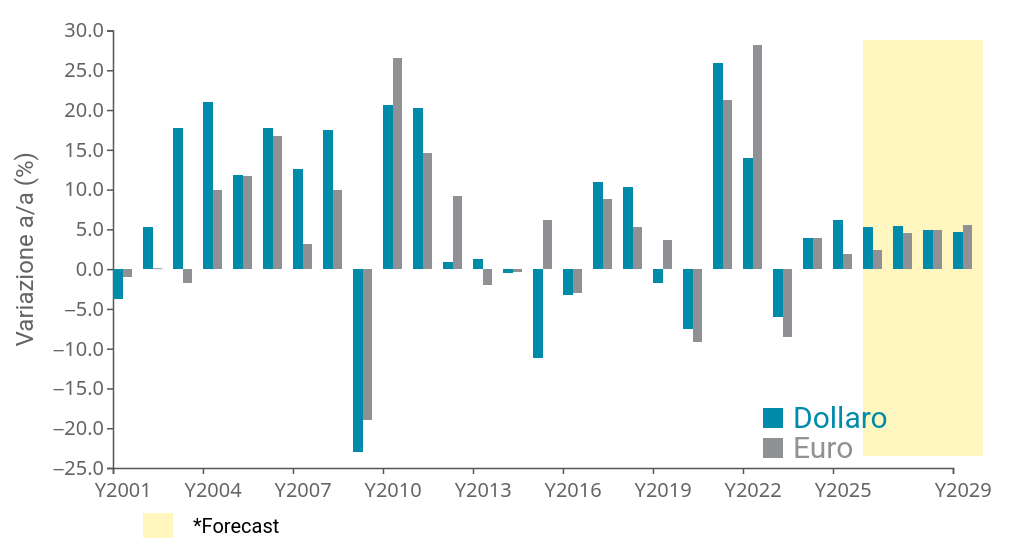
In particular, according to ExportPlanning forecasts, world trade in goods is expected to grow by 5.4% in US dollars in 2026, equal to 2.7% in euros, reflecting the combined effect of a set of factors:
- expectations regarding GDP growth over the forecast horizon, based on the April 2026 scenario published by the International Monetary Fund;
- higher expected nominal increases in world demand prices for commodities (+10%) and consumer goods (+3%);
- the confirmation of an expected depreciation path of the US dollar against the euro: on average in 2026, the USD/EUR exchange rate is expected to reach 1.16 compared to the 1.13 average in 2025.
Fig.1 – Dynamics of world trade in goods: euro vs dollar
Fonte: ExportPlanning
In light of the many uncertainties that continue to weigh on the international context, the forecast scenario remains strongly conditioned by the evolution of geopolitical tensions and will therefore be subject to frequent updates by the ExportPlanning team.
In this context, a particularly relevant element concerns the ability to identify geographical areas with the highest growth potential.
The map of the most dynamic countries 2026–2027
Despite a slowdown in the global economic cycle, economies are emerging that are characterised by above-average growth rates, supported by solid macroeconomic fundamentals, infrastructure investments, and a progressive strengthening of the middle class. For many manufacturing companies, monitoring the opportunities offered by these countries represents a strategic diversification channel, especially in a historical phase in which excessive geographical concentration of exports increases exposure to systemic risks.
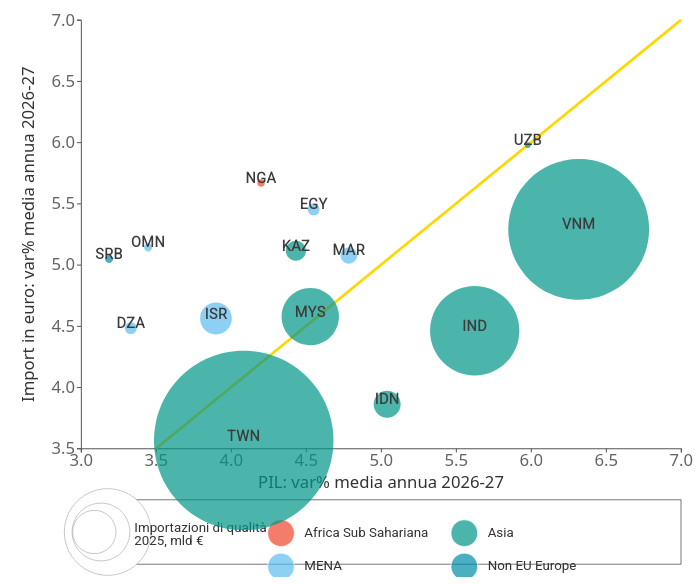
The analysis focuses on certain countries that present a particularly interesting combination of economic growth, import dynamism, and demand for higher value-added premium-priced products.
- a real GDP growth rate above the world average of 3% in the 2026–2027 period;
- import growth rates in euros above 3.5% on average over 2026–2027;
- quality imports exceeding €4.5 billion in 2025.
The map below shows expected GDP growth on the horizontal axis and projected import growth in euros on the vertical axis; bubble size is proportional to quality imports.
Fig.2 – Map of the most dynamic countries 2026–2027
Fonte: ExportPlanning
The first major geographical area is Asia, which continues to be the main engine of global growth. In particular:
- ASEAN economies such as Vietnam, Malaysia, Indonesia, and Taiwan;
- India, characterised by strong growth and expanding middle class.
The absence of China is significant, reflecting slower growth and greater geopolitical complexity.
North Africa (Algeria, Egypt, Morocco) also emerges, supported by development programmes, although with limited high-end import demand.
Finally, Serbia continues to strengthen its role as a regional manufacturing and logistics hub.
Conclusions
Despite the growing uncertainties of the international economic scenario, countries characterised by above-average development dynamics and a rising demand for quality goods are emerging on the global stage. For manufacturing companies, the timely identification of these markets means strengthening resilience, competitiveness, and international growth prospects in an increasingly unstable and selective environment.
In particular, the global area that in the 2026–2027 period will provide the most dynamic contributions to growth for companies operating in high labour-cost economies is represented by India and the more industrialised economies of the ASEAN region.
Among the countries expected to grow the most over the period are also the three main economies of North Africa and Serbia, albeit still with relatively low levels of imports of quality goods.
You may be interested in:

Woodworking machinery: Italian exports grow
Published by Mauro Badanelli. .
Internationalisation Industrial equipment Foreign markets Monthly Market Data International marketingNei primi sette mesi del 2026 le esportazioni italiane mostrano un incremento sul 2025, mentre le vendite all'estero dei principali concorrenti calano [ Read all ]
IMF WEO October 2026: Divergent Resilience and Persistent Pressures
Published by Alba Di Rosa. .
Macroeconomic analysis Conjuncture Uncertainty IMF Global economic trendsOn October 13, the International Monetary Fund released its latest World Economic Outlook, a key publication assessing the state of the global economy and its growth prospects. Compared with }... [ Read all ]

Market Selection: The Value of Territorial Data for Large Markets
Published by Marzia Moccia. .
Foreign markets Made in Italy Foreign market analysisTerritorial Data for Export Strategies: The Furniture and Wood Products Sector [ Read all ]