US Tariffs: Even More Uncertainty?
Published by Marzia Moccia. .
United States of America Uncertainty Trade war Global economic trends
“Tariff is the most beautiful word in the dictionary”, stated Donald Trump during his second campaign for the White House, clearly foreshadowing the central role that tariffs would play in shaping the future economic and trade policy of his administration.
Expectations have certainly not been disappointed: since taking office, President Trump has forcefully promoted a return to a more stringent protectionist policy, while simultaneously pursuing multiple objectives of an economic, political-negotiation, and bilateral foreign relations nature.
However, the February 20 ruling of the United States Supreme Court has set a significant precedent, making it useful to clarify the operational scope of the decision and its practical and economic implications.
The US Supreme Court ruling
The Supreme Court ruling declared inadmissible the so-called “reciprocal” customs duties introduced by the Donald Trump administration in the context of the so-called Liberation Day, adopted by invoking the International Emergency Economic Powers Act (IEEPA).
It is important to clarify a first point right away: the ruling concerns exclusively the generalized measures applied across multiple trading partners. It does not affect sectoral measures, such as those introduced for specific industries (steel, aluminum, automotive, copper, etc.), adopted under other statutory provisions — in particular Section 232 of the Trade Expansion Act — and preceded by in-depth investigations necessary to justify the imposition of tariffs.
In other words, the precedent set by the Court limits the scope of executive powers over "generalized tariffs", without affecting sector-specific duties.
Exclusive taxing authority rests with Congress
The key principle of the decision is that the President does not have the power to impose taxes in the exercise of executive authority: exclusive competence in tax matters remains with Congress, as provided by the United States Constitution. All decisions relating to taxes and duties must therefore fall within the legislative domain.
As repeatedly noted, generalized tariffs are in fact taxes imposed on American importers.
An important clarification is that the party required to pay the duty at customs is the American importer, who is therefore the economic operator bearing the tax burden.
Foreign companies exporting to the US market face an indirect negative effect (through potential declines in demand or reduced margins), but they are not the entities that materially pay the tax.
Not surprisingly, the Trump administration has repeatedly emphasized that tax revenues from tariffs are necessary to address the budget deficit: in 2025 it projected revenues of around 250 billion dollars.
It is estimated that in 2025 tax revenues from tariffs amounted to 260 billion dollars, more than triple the 2024 figure. According to initial estimates, of this total amount, over 130 billion dollars in tax revenue would be attributable specifically to the IEEPA framework.
Fig.1 - US tax revenues from import duties, by trading partner
(billion $, monthly data)
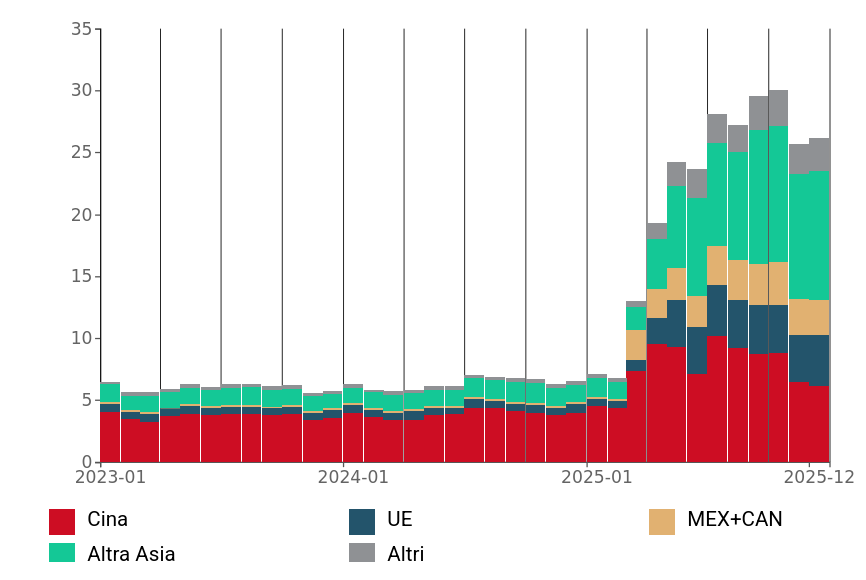
Source: ExportPlanning calculations based on United States International Trade Commission data
The reaction of the Trump administration
Following the ruling of the United States Supreme Court, US Customs and Border Protection announced the suspension of the collection of the revoked tariffs starting from February 24.
However, relying on a different legal basis — Section 122 of the Trade Act — on the same day the Trump administration swiftly responded by introducing a new generalized tariff of 10%, additional to MFN (Most Favoured Nation) conditions, effective from February 24 and subsequently increased to 15%.
The new generalized tariffs are, however, temporary in nature, with a maximum duration of 150 days, extendable only with prior approval from Congress; exemptions for specific product categories provided for in Annex III remain valid.
What consequences for European companies and transatlantic relations?
With the new rates in force, for European companies it might seem that the United States Supreme Court ruling has resulted in much ado about nothing, since the overall level of generalized tariffs appears similar to that in place before the decision.
In reality, the situation is more complex.
The European Union has in fact decided to halt the ratification process of the US-EU agreement reached last summer in Scotland, in light of certain uncertainties that require clarification. In particular:
- the new 15% rate would appear to be added to the pre-existing MFN tariff, with the risk of exceeding, for certain products, the 15% ceiling provided for in the agreement, which had been conceived as an “all-inclusive” limit;
- the regime under Section 122 of the Trade Act is non-discriminatory in nature, authorizing uniform duties for all trading partners, rather than differentiated ones as announced on Liberation Day.
This second element reduces the ability of the Trump administration to use tariffs as a flexible tool for bilateral negotiation. At the same time, the uniformity of rates could encourage countries such as the EU to renegotiate agreements concluded when significantly higher IEEPA duties were in force, in order to preserve their relative competitive positioning. One example is economies that previously benefited from lower rates and might now seek preferential treatment, such as the United Kingdom.
In conclusion, the Court’s ruling has had a significant impact in limiting presidential power to use tariffs as a tool to increase federal revenues without congressional approval, a declared economic objective of the Trump administration (see the previous contribution Trump 2.0: how effective is American tariff policy?
). At the same time, however, the decision has opened a phase of regulatory transition that requires clarification.
The current regulatory uncertainty — between new legal bases, potential cumulative rates, and revision of existing agreements — risks slowing down business decisions, pending a more stable definition of the rules of the game.
You may be interested in:

January 2026: the latest data on global trade in goods
Published by Marzia Moccia. .
Slowdown Exchange rate Conjuncture Dollar Euro Foreign markets Uncertainty Global economic trendsThe availability in the ExportPlanning Information System of global trade data for January makes it possible to update the short-term outlook on the most recent dynamics of world trade in goods, wit}... [ Read all ]

From Sales Attempts to Strategic Planning: The Role of Geopolitics in Shaping Firms’ Internationalization Decisions
Published by Marzia Moccia. .
Planning Conjuncture Foreign markets Uncertainty International marketing International marketingRecent developments have made it increasingly clear that the international environment is characterized by a growing and persistent level of uncertainty and geopolitical instability, directly affecti}... [ Read all ]

World Trade in Capital Goods: Preliminary Results for 2025 and Forecasts for 2026-2029
Published by Marcello Antonioni. .
Metal industry Global demand Forecast Uncertainty International marketingAfter a positive performance in 2025, a widespread deterioration is expected for next year [ Read all ]