The technical textiles sector gets ready for Techtextil Frankfurt: an analysis of global trade
Published by Mauro Badanelli. .
Internationalisation Importexport Industries International marketingThe world of technical textiles will gather at the leading trade fair, Techtextil Frankfurt, taking place from April 21 to 24. The event, which brings together over 1,500 exhibitors from around 50 countries, represents an opportunity to analyze the most recent developments in the sector, based on international trade flows observed across the various markets/application areas in which these products are used.
For this purpose, the classification of application areas proposed by Messe Frankfurt, the organizer of Techtextil, will be used:
- Agrotech: textiles for agriculture, forestry, horticulture and landscape protection;
- Buildtech: solutions for construction and architecture (membrane construction, lightweight and load-bearing structures, earthworks, hydraulic engineering and road construction);
- Clothtech: footwear and technical clothing;
- Geotech: textile products for civil engineering (roads, dams, drainage, soil stabilization);
- Hometech: innovative developments for the production of furniture, padding, flooring and carpets;
- Indutech: solutions for mechanical engineering and industrial applications (filtration, chemicals and electrical industries);
- Medtech: innovative textiles used in the medical and hygiene sectors;
- Mobiltech: textile products for transport, automotive and aerospace sectors (seat covers, car interiors, etc.);
- Oekotech: innovative solutions for environmental protection, recycling and textile waste management (yarns made from recycled materials or plant-based fibers, etc.);
- Packtech: textile products used for packaging (bags, protections, containers);
- Protech: textiles for personal protection and safety (workwear, military, emergency);
- Sporttech: products and solutions for sports, outdoor and leisure.
The evolution of global trade
Thanks to the data available in the ExportPlanning information system, we can analyze the performance of global trade in technical textiles, broken down by application areas in both the medium and short term.
Global exports of technical textiles by application area
(% change at constant prices)
| Sector | 2025/2024 | CAGR 2025/2019 |
|---|---|---|
| Agrotech | +1.8 | +1.8 |
| Buildtech | +0.9 | +1.1 |
| Clothtech | +0.6 | +0.3 |
| Geotech | +0.3 | +0.4 |
| Hometech | +3.2 | +0.6 |
| Indutech | -0.1 | +0.1 |
| Medtech | +1.8 | +1.9 |
| Mobiltech | -2.3 | +0.0 |
| Oekotech | +3.9 | +2.6 |
| Packtech | +5.1 | +2.6 |
| Protech | -0.8 | -0.1 |
| Sporttech | +7.5 | +2.7 |
Source: ExportPlanning
Despite an international scenario characterized by strong geopolitical tensions and significant economic uncertainty, global trade dynamics at constant prices in 2025 show positive performance for most sectors. In particular, exports of technical textiles used in Sporttech and Packtech recorded increases of 7.5% and 5.1% respectively compared to the previous year. Positive trends were also observed for exports in Oekotech (+3.9%), Hometech (+3.2%), Medtech (+1.8%), Agrotech (+1.8%), Buildtech (+0.9%) and Geotech (+0.3%).
In the medium term, the analysis also highlights a broadly positive trend in international trade across nearly all sectors. Over the 2019–2025 period, the average annual growth rate (CAGR) at constant prices was positive for most application areas, with the exception of exports in the Mobiltech and Protech sectors. Sporttech, Packtech, and Oekotech confirm their position as the most dynamic sectors, with average annual export growth rates above 2.5%.
But what are the structural drivers behind the recent development of the sectors with the highest CAGR?
The Sporttech sector is growing, driven by the global expansion of athleisure and the post-pandemic boom in outdoor activities. Demand for high-performance fabrics (thermoregulation, compression, vital data monitoring, etc.) has increased not only in traditional markets but also in Asia and the Middle East.
The acceleration in international trade in Packtech is linked to the replacement of plastic packaging with textile-based solutions, driven by increasingly stringent environmental regulations in Europe and progressively in Asia.
Textiles for environmental protection included in Oekotech (anti-pollution barriers, geomembranes for landfills, as well as recycled fabrics for subsequent technical use) have experienced growth in global trade due to increased public spending on green infrastructure, funding linked to climate targets (European Green Deal, US IRA), and greater awareness of textile waste reuse.
Growth trends in the Medtech and Agrotech sectors are supported by strong fundamentals. For Medtech, which gained strategic importance after 2020, the drivers include population aging in advanced economies and the development of healthcare systems in emerging countries. For Agrotech, global trade growth reflects the spread of protected cultivation techniques (greenhouses, anti-hail nets, mulching films), especially in areas exposed to water stress or extreme weather events.
Finally, it is worth noting that the Mobiltech sector shows a neutral CAGR (+0.0%) with a significant decline in 2025 (-2.3%), consistent with the structural crisis of the European automotive industry.
Are you interested in receiving a selection of the most relevant weekly news on foreign trade? Subscribe for free to the World Business Newsletter!
The competitive landscape
In the technical textiles sector, China holds undisputed leadership both as a producer and exporter across all application areas.
Between 2019 and 2025, Chinese exports recorded higher average annual growth rates than global trade in almost all sectors. In particular, Chinese exports grew significantly in Medtech (+5.6%), Sporttech (+5.3%), and Hometech (+5.1%).
Global exports of technical textiles by application area
(CAGR % 2025/2019 at constant prices)
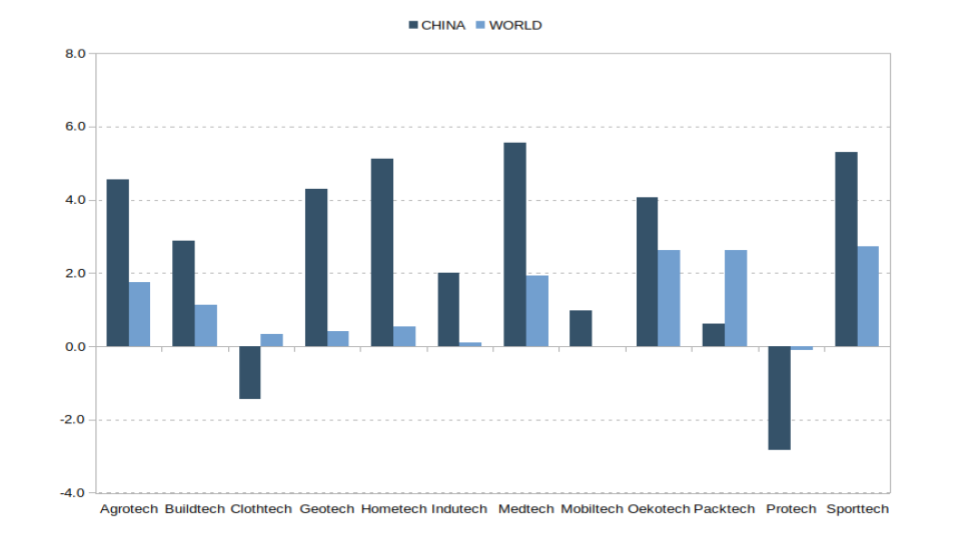
Source: ExportPlanning analysis
Among the main exporters are also the United States, Germany and Italy. It is also important to highlight the growing role of India and Vietnam as producers and exporters of technical textiles. Vietnam, in particular, ranks just behind China in 2025 in global trade for the Clothtech, Protech, and Sporttech sectors. Vietnamese export growth rates over the 2019–2025 period are especially notable: CAGR reached 11.2% in Protech, 10.8% in Clothtech, and 8.2% in Sporttech.
Conclusions
Although Techtextil Frankfurt is taking place in a period marked by deep concern, the technical textiles supply chain appears to be in good health, as evidenced by global trade dynamics. The analysis of global trade by application area presented in this article confirms significant sector growth, especially compared to other textile/apparel segments. However, differences remain among products, requiring continuous monitoring by companies operating in international markets.
In a scenario characterized by uncertainty for supply chain operators—whether producers of intermediate goods, finished products, or technology providers—mapping the many application areas represents a key strategic tool.
Especially for machinery manufacturers, having a detailed understanding of end-use segments allows for better calibration of technological offerings across markets and helps identify new business opportunities.
With the aim of enabling continuous monitoring of target foreign markets at a “product-specific” level, ExportPlanning offers the Customs Declarations Database service, an on-demand supply of monthly market data tailored to specific products and markets of interest.
```
You may be interested in:

Extrusion machinery: global trade in slows in the second quarter of 2026
Published by Mauro Badanelli. .
Industrial equipment Conjuncture Industries Global economic trendsBased on the preliminary estimates of international trade data for Q2 2026 available in ExportPlanning, international trade of extrusion machinery recorded a year-on-year decline of -7.8% in constant-}... [ Read all ]

Footwear: a mapping of global production
Published by Mauro Badanelli. .
Industries Foreign markets International marketingAs highlighted in a previous article published in Magazine International, export figures for the first half of 2026 show different performances among the main footwear-producing Countries. These res}... [ Read all ]

Footwear: how are the manufacturing Countries performing in the first half of 2026?
Published by Mauro Badanelli. .
Conjuncture Industries Foreign markets International marketingAfter analyzing the dynamics of global trade in footwear machinery in a previous article, attention now shifts to the finished product, in order to examine the most recent performance of the main foot}... [ Read all ]