The Global Market for Hollow Glass Manufacturing Machinery: Trade Trends and Italy’s Competitive Position
Published by Mauro Badanelli. .
Internationalisation Industrial equipment International marketingFrom everyday food and beverage bottles to high-performance pharmaceutical containers, hollow glass products have undergone a remarkable technological transformation over the past decades. Growing requirements for sustainability, product safety, design and preservation have strengthened the strategic role of glass across a wide range of industries.
Thanks to its chemical inertness, full recyclability, and ability to preserve product quality, glass remains a preferred packaging material for food, beverages, cosmetics and pharmaceuticals. At the same time, manufacturers are under increasing pressure to improve productivity, product quality and operational flexibility.
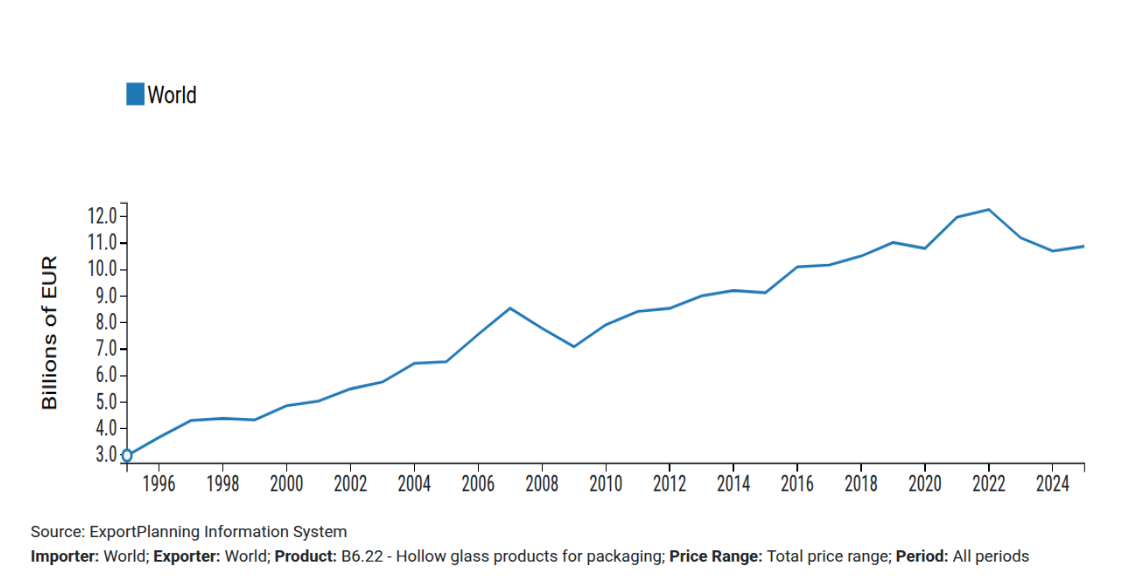
The expansion of hollow glass applications has been accompanied by steady growth in international trade. Between 2009 and 2025 global trade in hollow glass packaging products increased at an average annual rate (CAGR) of 2.7% in real terms, highlighting the resilience and long-term development potential of the sector.
Fig. 1 – World Trade in Hollow Glass Packaging Products
(values at constant prices)
Against this backdrop, machinery and technologies used in hollow glass manufacturing play a crucial role. International trade flows in these technologies provide valuable insights into investment trends, the geographical distribution of production capacity and the competitive positioning of the Countries involved in the global glass value chain.
Global Trade in Hollow Glass Manufacturing Machinery
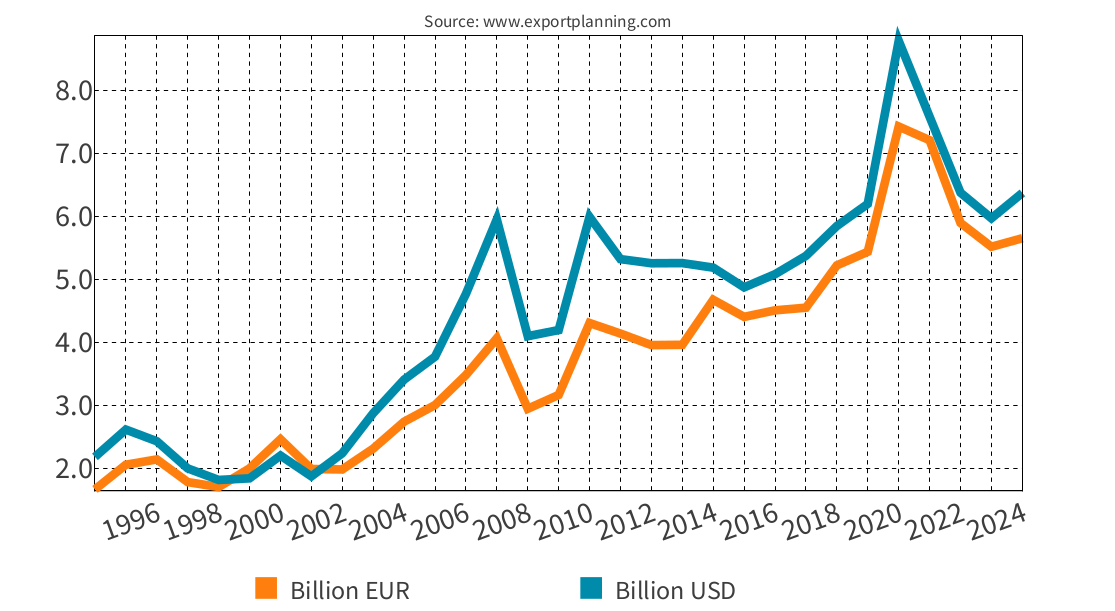
According to data from the ExportPlanning Information System, global trade in hollow glass manufacturing machinery reached €5.7 billion in 2025, up 2.5% from the previous year at current prices. Although still below the record level of €7.4 billion recorded in 2021, the latest figures point to a gradual recovery in international demand.
Over the longer term, trade growth has remained relatively moderate, with an average annual increase (CAGR) of 2.0% between 2009 and 2025.
Fig. 2 – Machinery for Hollow Glass Processing - Global Trade Value
Leading Markets for Hollow Glass Manufacturing Machinery
An analysis of international trade flows helps shed light on the geography of hollow glass production worldwide. In 2025 Taiwan emerged as the largest importer of hollow glass manufacturing technologies, with imports totaling €550 million and accounting for 9.9% of global demand.
Other major importing markets include Singapore (€535 million), the United States (€372 million), Belgium (€292 million) and South Korea (€225 million).
The prominent position of Belgium and Singapore among the world's leading importers does not necessarily reflect equally significant domestic production capacities. In both cases, their role as major international logistics and trading hubs has a substantial impact on customs statistics, making it important to distinguish between genuine industrial demand and flows related to re-export activities.
China and India also rank among the most important importing countries. However, the evolution of import demand in these two Asian economies has followed markedly different paths. In China, imports of hollow glass manufacturing machinery declined from €425 million in 2008 to €198 million in 2025, reflecting the Country's growing ability to replace imported equipment with domestically produced technologies. This trend is consistent with the strong expansion of Chinese exports over the same period.
India, by contrast, has continued to strengthen its dependence on imported technologies. Between 2019 and 2025 imports of machinery for hollow glass production increased at a CAGR of 9.7%, highlighting the rapid development of the Country's manufacturing base.
Beyond identifying the largest importing markets, the ExportPlanning Information System also makes it possible to assess each country's propensity to pay a premium price for higher-quality imported technologies. This indicator is particularly valuable for identifying markets where demand is concentrated in advanced and high-performance solutions. Among the most quality-oriented destinations are Taiwan, the United Arab Emirates and the United Kingdom.
Fig. 3 - Machinery for Hollow Glass Processing - Distribution of International Trade by Price Segment
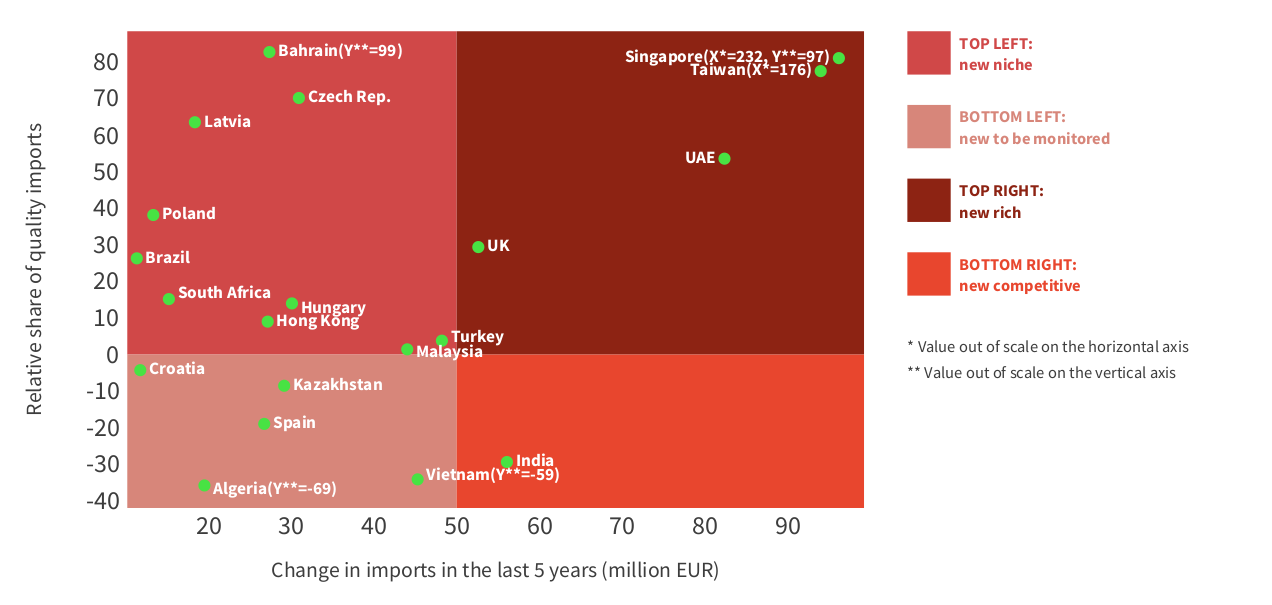
Source: ExportPlanning elaborations - Reporting Tool
The Competitive Landscape and Italy's Position
On the supply side, China has established itself as the world's leading exporter of hollow glass manufacturing machinery. In 2025, Chinese exports reached €1.09 billion, representing 18.4% of global trade, compared with just 7.1% in 2008.
China is followed by Singapore, whose export performance is largely linked to its role as a regional trading hub, and by the traditional manufacturing leaders Germany, Japan and Italy.
German exports totaled €563 million in 2025, down 24.5% compared with the previous year. Over the 2019–2025 period Germany recorded a slightly negative CAGR of -0.5%.
Japan, on the other hand, posted a strong recovery. Exports reached €506 million in 2025, an increase of 24% compared with 2024, corresponding to a CAGR of 1.4% over the 2019–2025 period.
Italian exports amounted to €452 million in 2025. Although this represented a decline of 14% compared with the previous year, Italy still achieved a CAGR of 2.1% between 2019 and 2025.
A closer look at the composition of Italian exports reveals a significant upgrading of the country's competitive positioning. The share of medium-high and high-end products increased from 37.7% in 2015 to 49.5% in 2025, highlighting the growing importance of technology-intensive and higher-value-added solutions within Italy's export portfolio.
Fig. 4 – ITALY - Distribution of Exports by Price Segment
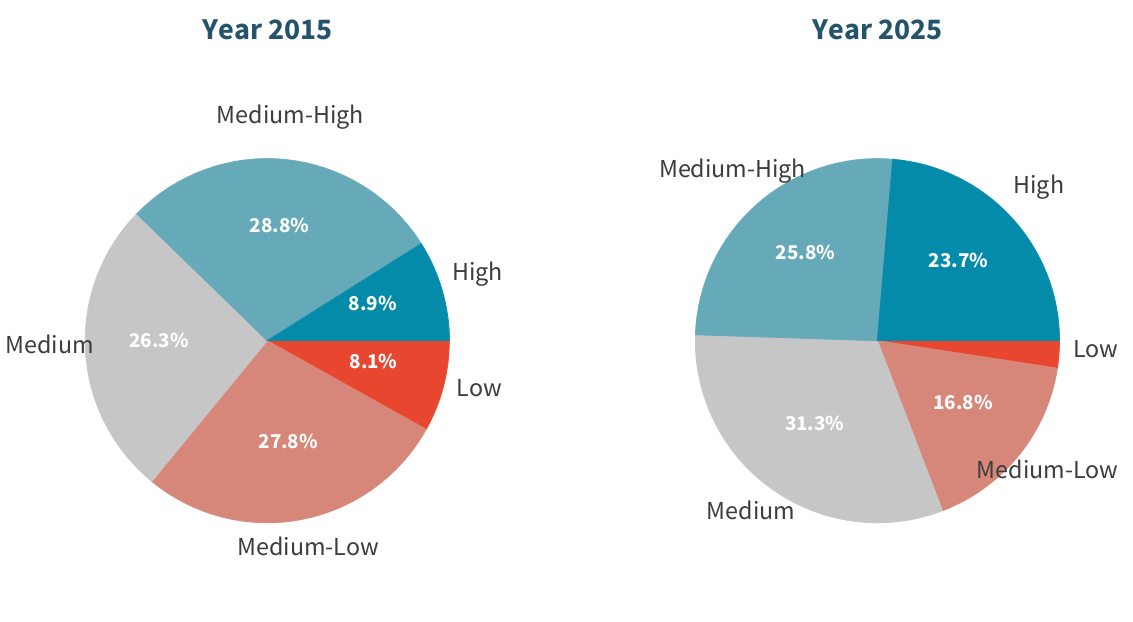
Source: ExportPlanning elaborations
Among the leading exporting countries, Taiwan and France recorded particularly strong performances during the 2019–2025 period, with average annual export growth rates of 9.1% and 14.9%, respectively. By contrast, exports from the United States declined by 22.7% over the same period.
Developments in the First Quarter of 2026
Trade data for the first quarter of 2026 provide an updated picture of current market dynamics and suggest that the sector has entered a new growth phase.
Recent evidence points to a broad-based recovery in global demand. Following several years of contraction, international demand returned to growth in 2025 and the positive trend strengthened further during the opening months of 2026.
While exports from the main geographic regions and from China benefited from this recovery, Italian exports continued to weaken, extending the decline already recorded during 2025.
As a result, the first months of 2026 reveal a growing divergence between the evolution of global demand and the performance of Italian exports. Whether this gap represents a temporary phenomenon or a more structural shift will become clearer as additional customs data become available over the coming quarters.
Table 1 – Machinery for Hollow Glass Processing - Comparative Dynamics
year-on-year percentage changes at current prices
| 2023 | 2024 | 2025 | Q1-2026 | |
| Global Demand | -25.7% | -12.0% | +1.5% | +22.0% |
|---|---|---|---|---|
| EU Exports | -23.8% | -10.7% | -7.2% | +21.2% |
| Italian Exports | -3.3% | +3.3% | -12.6% | -52.4% |
| Asian Exports | -22.3% | -25.3% | +14.4% | +152.0% |
| Chinese Exports | -3.7% | -8.8% | +17.1% | +53.0% |
Source: ExportPlanning Information System
Conclusions
After a period of slowdown between 2022 and 2024, global trade in machinery and technologies for hollow glass manufacturing returned to growth in 2025. The recovery has been particularly beneficial for Asian suppliers, with Chinese manufacturers emerging as the main beneficiaries of the renewed expansion in international demand.
In an increasingly competitive environment, timely access to foreign trade intelligence is becoming a critical factor for companies operating along the hollow glass value chain. The data and analytical tools available through the ExportPlanning Information System can help firms identify the most promising markets, monitor changes in competitive positioning and anticipate emerging opportunities across the global industry.
You may be interested in:

Machinery: International Sales Results to July 2026
Published by Marcello Antonioni. .
Industrial equipment Conjuncture Monthly Market Data Global economic trendsIn July Machinery exports by EU companies remained in positive territory, but with significant differences across sectors [ Read all ]

Leather Machinery: After the 2026 Downturn, the Outlook for World Trade in 2027-2028
Published by Mauro Badanelli. .
Industrial equipment Forecast International marketing2026 is shaping up to be a year of contraction in world trade of machinery for the manufacture or repair of leather or hide articles (HS845380), following the levels reached in 2025. According to Expo}... [ Read all ]

Leather goods machinery: Italian leadership in the world trade
Published by Mauro Badanelli. .
Industrial equipment Conjuncture Foreign markets International marketingThe international trade fair for machinery and technologies for footwear, leather goods and tanning, Simac Tanning Tech, will take place from September 15 to 17 at the Rho Fiera exhibition centre, b}... [ Read all ]