Global trade in nonwovens: an analysis by application sector
Published by Mauro Badanelli. .
Internationalisation Importexport Industries International marketingThe nonwovens sector has experienced strong growth over the past decades, driven by the wide range of applications enabled by the key characteristics of this product: versatility, functionality and cost-effectiveness. These features have allowed for extensive use of nonwoven fabrics across various application fields.
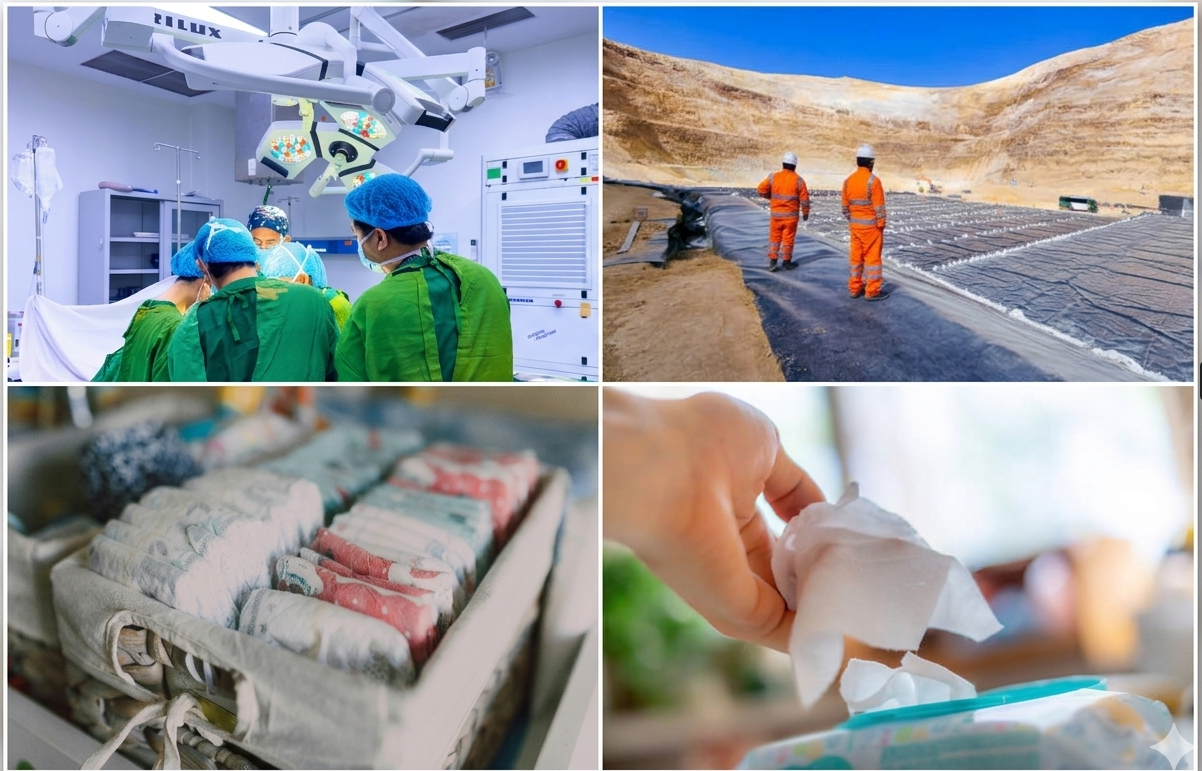
In this article the analysis of global trade will focus on some of the main sectors in which nonwoven products are used:
- Filtration: air filters (HVAC, automotive, clean rooms), water and liquid filters, industrial filters, face masks;
- Food & Beverage: products for food packaging and for the preservation of food and beverages;
- Textiles & Furnishings: interlinings for jackets and coats, padding wadding, nonwoven bags, upholstery linings, etc.;
- Medical & Healthcare: disposable devices for operating rooms, dressings, protective suits, etc.;
- Automotive: interior components (seats, door panels), acoustic and thermal insulation, trunk and underbody components;
- Hygiene: baby diapers and incontinence products, sanitary napkins, disposable wipes, etc.;
- Geotextiles & Infrastructure: products for soil drainage, soil stabilization and reinforcement, erosion control, etc.;
- Agriculture: mulching fabrics, protective crop covers, irrigation and drainage systems, etc.;
- Construction & Building: products for thermal and acoustic insulation, roofing membranes and vapor barriers, waterproofing materials, etc.
For nonwovens manufacturers, mapping the many applications represents a key strategic tool. Having a detailed understanding of usage segments — from automotive to construction, from agriculture to healthcare — makes it possible to accurately identify the geographic areas where demand is strongest and where nonwoven solutions can generate the greatest value. This approach not only helps optimize production and commercial planning, but also enables companies to capture new growth opportunities.
The evolution of global trade
The 2025 preliminary figures for global trade in nonwovens show overall stability compared to the previous year across the different application sectors. In particular, the data summarized below help to outline the medium- and short-term dynamics that have characterized the sector, providing a clear overview of recent trends.
The table below shows the performance of global nonwovens exports, broken down by the main sectors in which they are used.
Global exports of nonwovens by application sector
| Sector | Values 2025 (million €) | % change in euros | % change at constant prices | ||
|---|---|---|---|---|---|
| 2025-2024 | CAGR 2025-2019 |
2025-2024 | CAGR 2025-2019 |
||
| Filtration | 61 947 | -1.1 | +4.5 | -0.7 | +1.9 |
| Food & Beverage | 57 362 | 0.0 | +5.0 | +2.7 | +2.0 |
| Textiles & Furnishings | 28 797 | -1.9 | +4.4 | -1.0 | +3.8 |
| Medical & Healthcare | 26 870 | -0.3 | +4.5 | +2.2 | +1.9 |
| Automotive | 22 481 | -0.3 | +3.1 | +2.3 | +1.9 |
| Hygiene | 21 207 | +1.7 | +2.9 | +2.3 | +1.9 |
| Geotextiles & Infrastructure | 8 913 | +1.6 | +4.3 | +0.7 | +1.2 |
| Agriculture | 8 913 | +4.0 | +4.3 | +5.2 | +3.5 |
| Construction & Building | 7 075 | +2.1 | +4.7 | +4.1 | +3.6 |
Source: ExportPlanning
Over the period 2019–2025, global trade recorded positive dynamics across all sectors, as evidenced by the compound annual growth rate (CAGR) at constant prices. In particular, stronger growth at constant prices is observed for exports of nonwovens used in the Textiles & Furnishings, Agriculture and Construction & Building sectors.
In particular, the growth of applications in the Agriculture sector is driven by the increasing need to protect crops in response to the intensification of extreme weather events, a structural factor expected to strengthen over the long term. Similarly, the Construction & Building sector benefits from growing urbanization, especially in emerging Countries, as well as from the spread of energy-efficiency and sustainable building solutions, which favor the use of innovative insulation materials. Over the past six years, the use of nonwovens has also grown in the Textiles & Furnishings sector, thanks to their versatility, lightness and durability, which allow their use in linings, padding, and coverings. Demand has been supported by increased consumption in emerging markets, the search for more cost-effective and sustainable solutions and the ability to create functional and easily customizable products.
A closer look at the dynamics of the past year shows that, at constant prices, global trade continues to grow across all sectors using nonwoven products, with the exception of Filtration and Textiles & Furnishings, also reflecting the challenging economic conditions in downstream sectors such as Automotive and Home & Personal Goods.
In nominal terms, however, growth in 2025 appears more differentiated, with continued expansion in exports in the Agriculture sector.
Are you interested in receiving a selection of the most relevant weekly news on foreign trade? Subscribe for free to the World Business Newsletter!
The competitive landscape
The analysis of the competitive landscape over recent years confirms a solid leadership of China as the largest exporter across the various sectors considered.
Behind China are Germany and the United States as other major exporting countries. This situation is observed in the Filtration, Medical & Healthcare, Automotive, Geotextiles & Infrastructure, and Food & Beverage sectors.
In the Hygiene sector the Czech Republic stands out as the second-largest exporter after China, while Vietnam holds this position in the Textiles & Furnishings sector. Japan is the third-largest exporter in the Construction & Building and Agriculture sectors, while exports from Poland are growing in products for the Automotive sector.
Main importing countries by sector
As for the main importing countries, the following performances are observed in 2025:
- In Filtration sector, the main importing countries are the United States and Germany. Imports in these two markets showed different trends: U.S. imports decreased by 11.1%, while German imports increased (+11.5%).
- In Food & Beverage sector, the leading importing country, the United States, recorded a decline of 7.7%, while imports in other key markets, Germany and France, increased by 13.4% and 9.1% respectively.
- In Textiles & Furnishings sector, the United States, Japan, and Germany are the main importing countries. In 2025, import trends were negative for the U.S. (-6.6%) and Japan (-2%), while German imports increased (+11.7%).
- In Medical & Healthcare, Automotive, and Hygiene sectors, the United States and Germany again emerge as the largest importing countries, with performances similar to those described above, showing differing import dynamics between the two countries. In Automotive, a sharp decline in China’s imports is also noted, with China ranking as the third-largest importing country (-23.8%).
- In the remaining sectors - Geotextiles & Infrastructure, Agriculture, and Construction & Building - the United States remains the main importing market, with negative performance compared to 2024. In both the Agriculture and Construction & Building sectors, Vietnam ranks behind the United States in terms of import value.
Conclusions
The 2025 dynamics describe a scenario of moderate growth for global trade in nonwoven fabrics, especially when measured at constant prices.
However, the sectoral landscape shows greater differentiation at the market level, with clearly varied performance across Countries.
This situation suggests that exporting companies should adopt a strategic approach based on continuous monitoring of market conditions - particularly demand for their specific products or strategic business areas - in order to effectively support their international positioning.
With the aim of enabling continuous monitoring of target foreign markets at a “product-specific” level, ExportPlanning provides the service Customs Declarations Database, an “on-demand” supply of monthly market data tailored to products and markets of interest.
```
You may be interested in:

How to identify the product sectors with the highest potential in a market: the Mercosur agreement and the case of Brazil
Published by Veronica Campostrini. .
Planning Free trade agreements Internationalisation Made in Italy Foreign market analysisAfter more than twenty years of negotiations, marked by periods of stalemate and subsequent reopenings, on December 6, 2024 the European Union and the Mercosur countries reached a political agreement }... [ Read all ]
Machinery for nonwovens production facing the sustainability challenge
Published by Mauro Badanelli. .
Importexport Industrial equipment International marketing International marketingOver the course of the 21st century, the nonwovens sector has experienced solid growth in both production and exports. The driver of this development lies in the features of nonwovens, which have en}... [ Read all ]

The global trade of agricultural mechanization: figures and challenges
Published by Mauro Badanelli. .
Food&Beverage Importexport International marketing International marketingIntroduction During the twenty-first century, agriculture has progressively become one of the strategic sectors for building sustainable development models on a global scale. At the same time, th}... [ Read all ]