Dyeing machinery: innovation and sustainability at the heart of a changing supply chain
Published by Mauro Badanelli. .
Industrial equipment Export Foreign markets International marketingDenim is one of the cornerstones of the global apparel industry. Every year, billions of garments are produced and sold worldwide, fueling demand from fast fashion brands, premium manufacturers, and companies specializing in workwear. At the heart of this global supply chain lies a highly strategic production stage: yarn dyeing, the process that creates the iconic blue color that has made jeans a timeless fashion staple.
Denim dyeing machines represent the technological core of this process. In recent years, the industry has undergone profound transformation, driven by the growing demand for more sustainable manufacturing processes, the need to reduce water, energy, and chemical consumption, and the introduction of new digital technologies for production control. Alongside traditional indigo dyeing lines, innovative solutions are emerging that improve product quality, increase plant efficiency, and reduce environmental impact.
In this context, international trade in dyeing machinery (HS845140) provides an insightful indicator of industrial investment trends and the competitiveness of the world's leading textile machinery manufacturers. An analysis of trade flows makes it possible to identify the industry's global leaders and the markets investing most heavily in upgrading their production facilities.
The current state of the global trade for dyeing machinery
Global trade in dyeing machinery has experienced significant volatility in recent years, alternating between periods of sharp contraction and rapid recovery.
The industry was heavily affected by the pandemic, with trade declining by 25.4% in current euro values in 2020, falling to €532.6 million. This downturn was followed by a solid recovery in 2021 (+11.8%) and a remarkable peak in 2022, when global trade reached €754 million, recording growth of 26.6%. However, most of the 2022 increase was driven by higher prices, as export volumes expanded by only 2.2%.
Fig. 1 – Dyeing machinery – Global trade
(current values)
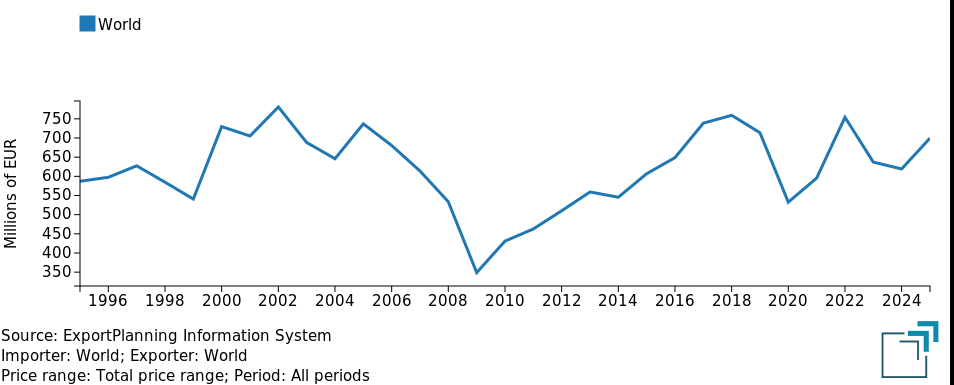
Following the all-time high reached in 2022, the market entered a correction phase. In 2025, however, growth resumed at a sustained pace, with a 13% increase, bringing global trade to €699.6 million.
Looking at the longer-term trend, the compound annual growth rate (CAGR) for the 2009–2025 period stands at +1.6% in current euro values. This positive trend is expected to remain unchanged (+1.6%) over the 2026–2029 period.
The leading markets for dyeing machinery
Global import flows are highly concentrated in Asia. Bangladesh ranks as the world's largest import market, with imports totaling €111.9 million, accounting for a 15.3% global market share. It is closely followed by Vietnam, with imports worth €103.6 million (14.2% of the global market).
Other major import markets include India, with imports valued at €66.2 million (9.1%), Egypt (€44.3 million and a 6.1% global share), and Indonesia (€36.9 million, representing 5.1% of the global market).
The ExportPlanning information system also makes it possible to assess the varying willingness of different markets to pay a premium price for higher-quality imported products. Overall, the 2020–2025 period has seen the center of gravity shift toward Asian markets—particularly India, Vietnam, and Bangladesh—which, despite being high-volume markets, have shown a growing willingness to pay premium prices compared with traditionally more price-sensitive markets such as Egypt.
Fig. 2 – Dyeing machinery – Premium price analysis in the most dynamic markets
(2020–2025)
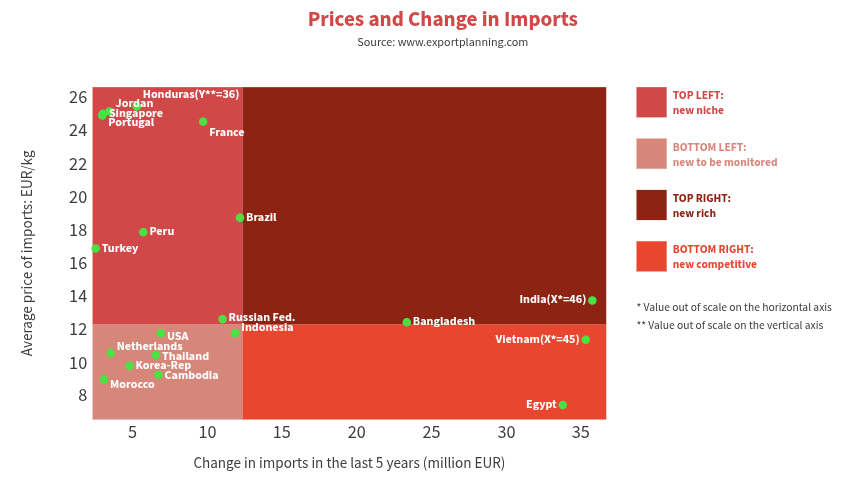
Source: ExportPlanning analysis – Reporting Tool
Interested in receiving a selection of the week's most relevant international trade news? Subscribe to the World Business Newsletter free of charge!
Competitive scenario: key players and emerging trends
The global supply of dyeing machinery is dominated by a limited number of major players. China remains the world's leading exporter, with exports totaling €201.1 million, corresponding to a 28.1% global market share. It is followed by Italy, whose exports reached €125.4 million, accounting for 17.6% of the global market.
Ranking behind the two leading suppliers in 2025 were Germany and Turkey, with very similar export values of €86.8 million and €86.2 million, respectively.
A combined analysis of the compound annual growth rate (CAGR) for the 2022–2025 period and export performance during the first four months of 2026 highlights a rapidly evolving competitive landscape among the world's leading exporters of dyeing machinery.
Table 1 – Dyeing machinery – Global trade performance of the main exporting Countries
(current values)
| Rank | Country | Exports 2025 € million |
CAGR 2022–2025 |
Year-on-year change January–April 2026 |
|---|---|---|---|---|
| 1 | China | 201.1 | +9.0% | -19.5% |
| 2 | Italy | 125.4 | -4.9% | +44.3% |
| 3 | Germany | 86.8 | -8.1% | +45.3% |
| 4 | Turkey | 86.2 | -4.8% | -5.7% |
| 5 | Taiwan | 53.8 | -0.7% | -42.3% |
| 6 | Spain | 23.1 | -4.6% | -10.4% |
| 7 | Greece | 19.4 | -8.1% | -40.1% |
| 8 | South Korea | 13.8 | -12.7% | +8.4% |
| 9 | India | 10.9 | -10.7% | -26.7% |
| 10 | United States | 9.5 | -5.4% | -41.4% |
Source: ExportPlanning analysis
During the 2022–2025 period, China was the only major exporter to record significant structural growth, posting a CAGR of +9.0% and further strengthening its global leadership. By contrast, all other leading competitors reported negative average annual growth rates. These figures confirm that, following the 2022 peak, China was the only country able to consolidate sustained export growth.
However, short-term data for the first four months of 2026 paint a different picture. Germany (+45.3% compared with January–April 2025) and Italy (+44.3%) are leading the recovery among the major exporters, reflecting a strong rebound in international demand for European textile machinery.
The performance of Asian suppliers appears weaker. Although China continues to hold the leading global position, its exports declined by 19.5% compared with the same period in 2025.
Overall, comparing these two perspectives suggests that while the 2022–2025 period primarily rewarded China's structural expansion, the first months of 2026 point to a partial rebalancing of the competitive landscape. European manufacturers—particularly those in Italy and Germany—have regained momentum, whereas several Asian exporters are currently experiencing a slowdown.
Conclusions
The global dyeing machinery market is undergoing a period of gradual transformation. Following the marked volatility of recent years, the recovery recorded in 2025 and the moderately positive outlook for the 2026–2029 period indicate that international demand will continue to be supported by investments in the modernization and upgrading of production facilities.
Demand continues to shift toward Asia's leading manufacturing hubs, with Bangladesh, Vietnam, and India ranking among the most important destination markets. At the same time, the growing willingness of some of these countries to invest in higher-end machinery suggests that competition is increasingly driven not only by price, but also by production efficiency, equipment reliability, and the ability to reduce water, energy, and chemical consumption.
On the supply side, China has consolidated its structural leadership over recent years. Nevertheless, the first data for 2026 indicate a partial rebalancing of the market, supported by the strong recovery in exports from Italy and Germany. In this context, the ability of European manufacturers to deliver technologically advanced, high-value-added solutions is likely to represent a key competitive advantage.
Looking ahead, the future evolution of the industry will depend on manufacturers' ability to support the transformation of the textile sector by combining automation, digitalization, and environmental sustainability. Companies capable of addressing these priorities will be well positioned to capture investment opportunities in emerging markets and strengthen their role within an increasingly efficient and sustainable global textile value chain.
You may be interested in:

Machinery: International Sales Results to July 2026
Published by Marcello Antonioni. .
Industrial equipment Conjuncture Monthly Market Data Global economic trendsIn July Machinery exports by EU companies remained in positive territory, but with significant differences across sectors [ Read all ]
World Trade: Increasingly Polarized Growth – July 2026 Update
Published by Marzia Moccia. .
Conjuncture Foreign markets Uncertainty Global economic trendsWorld trade continues to grow in 2026, but behind the resilience of the aggregate figures, disparities across sectors and geographic regions are widening [ Read all ]
Leather Machinery: After the 2026 Downturn, the Outlook for World Trade in 2027-2028
Published by Mauro Badanelli. .
Industrial equipment Forecast International marketing2026 is shaping up to be a year of contraction in world trade of machinery for the manufacture or repair of leather or hide articles (HS845380), following the levels reached in 2025. According to Expo}... [ Read all ]