Blue jeans, shifting geographies: the challenge faced by new manufacturing Countries to China and Bangladesh
Published by Mauro Badanelli. .
Fashion Export Foreign markets International marketingBlue jeans: an iconic fashion product
Blue jeans are one of the iconic products of the apparel industry, with a well-established presence in markets around the world and demand spanning generations, income groups and consumer lifestyles. Behind what appears to be a simple garment lies an extremely complex global supply chain involving denim fabric manufacturers, garment producers, international brands and a commercial network connecting Asia's main manufacturing hubs with consumer markets in Europe and North America.
In recent years, global trade in blue jeans has undergone profound changes. The reorganization of global value chains, evolving trade policies, increasing attention to sustainability and the diversification of sourcing strategies are reshaping the competitive landscape of the industry.
In this context, analyzing global blue jeans trade flows makes it possible to identify the most dynamic markets, Countries gaining market share and the key trends that will shape the industry's evolution in the coming years, providing valuable insights for companies operating across the entire denim value chain.
Global trade in blue jeans
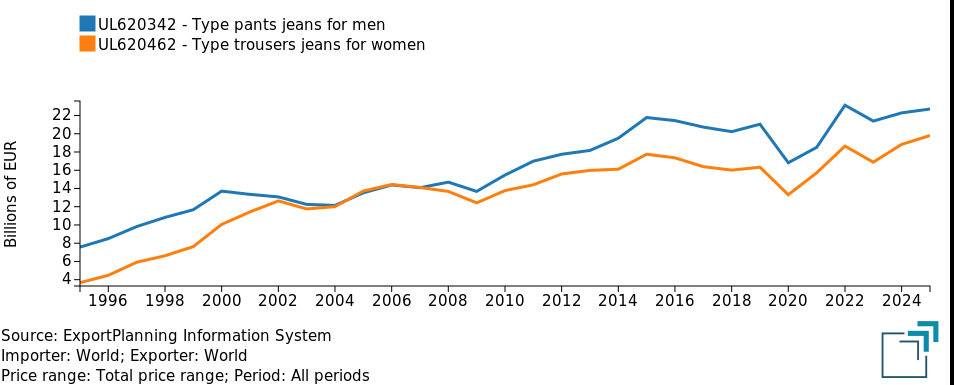
The blue jeans industry remains a cornerstone of the global textile sector, with international trade valued at EUR 42.5 billion in 2025. In recent years, global trade declined in 2020 due to the pandemic and again in 2023. Over the 2009–2025 period, the compound annual growth rate (CAGR) of international trade reached +2.4% at current prices. Focusing on the 2022–2025 period, the average annual growth rate stood at +0.6%.
The supply structure, analyzed through global export dynamics, reveals a clear segmentation by gender:
- Men's blue jeans: the dominant segment, characterized by greater product standardization, accounting for 53% of international trade, with a value of EUR 22.7 billion in 2025.
- Women's blue jeans: a segment characterized by greater stylistic diversity and faster replacement cycles, accounting for 47% of global trade, with a value of EUR 19.8 billion in 2025.
The two segments followed similar long-term trends, with a CAGR of +2.6% for men's blue jeans and +2.2% for women's blue jeans over the 2009–2025 period. In recent years, however, the women's segment has shown stronger momentum: between 2022 and 2025 it recorded a CAGR of +2.0%, compared with -0.6% for men's blue jeans.
Fig. 1 – Blue Jeans – Global Trade
(current prices)
Leading exporting Countries
The analysis of the industry's leading players is based on the trade balance and, more specifically, on the normalized trade balance, an indicator that identifies the countries most specialized in blue jeans production.1
The table below presents the Countries with the highest trade surpluses. Their ranking reflects the dominance of Asian manufacturing hubs and the presence of several nearshoring production centers. China and Bangladesh operate on a scale far exceeding that of their competitors: their trade surpluses are more than six times larger than that of Vietnam, which ranks third. Bangladesh, in particular, records a normalized trade balance of +1.00, indicating that virtually all of its trade flows in this sector consist of exports.
Table 1 – Blue Jeans – Leading exporting Countries (2025)
| Exports | Trade Balance | |||
| # | Country | EUR million | EUR million | Normalized (-1/+1) |
| 1 | China | 9 136 | 8 711 | + 0.91 |
|---|---|---|---|---|
| 2 | Bangladesh | 8 312 | 8 296 | + 1.00 |
| 3 | Vietnam | 1 686 | 1 456 | + 0.76 |
| 4 | Turkey | 1.874 | 1.437 | + 0.62 |
| 5 | Pakistan | 911 | 910 | + 1.00 |
| 6 | Cambodia | 895 | 893 | + 0.97 |
| 7 | India | 771 | 43 | + 0.54 |
| 8 | Tunisia | 507 | 489 | + 0.93 |
| 9 | Morocco | 499 | 377 | + 0.86 |
| 10 | Mexico | 800 | 331 | + 0.26 |
Source: ExportPlanning - Data Hub - Annual Trade Data, Ulisse Datamart
Interested in receiving a selection of the week's most relevant international trade news? Subscribe to the World Business Newsletter free of charge!
An analysis of the 2022–2025 period, based on the compound annual growth rate of the world's ten largest net exporters, reveals a market undergoing profound transformation, where long-established leaders are struggling to maintain their positions as more dynamic and competitive manufacturing hubs gain ground.
The world's two leading net exporters, operating on a much larger scale than all other countries, have shown signs of stagnation or decline. China, despite posting a trade surplus exceeding EUR 8.7 billion, recorded an average annual decline of 3.3% between 2022 and 2025. Bangladesh, with a trade surplus of approximately EUR 8.3 billion, experienced a more moderate decline, posting a CAGR of -1.4%, indicating broad stability accompanied by a slight erosion of exports.
In sharp contrast to the leading exporters, several Asian manufacturing hubs recorded particularly strong growth, confirming their increasing competitiveness. Pakistan posted the fastest growth among the major players, with a CAGR of +9.9%. Cambodia, Vietnam, and India also expanded their exports between 2022 and 2025.
By contrast, particularly weak performances were recorded by several countries that have traditionally served as direct suppliers to European and U.S. markets, suggesting a loss of market share in favor of Asian competitors. This is the case for Mexico, Turkey, and Morocco.
Table 2 – Blue Jeans – Global trade dynamics of the leading net exporting Countries
(current prices)
| Rank | Country | CAGR 2022–2025 | Year-on-year change January–April 2026 |
|---|---|---|---|
| 1 | China | - 3.3% | - 13.8% |
| 2 | Bangladesh | - 1.4% | - 13.5% |
| 3 | Vietnam | + 3.2% | - 7.5% |
| 4 | Turkey | - 10.9% | - 19.4% |
| 5 | Pakistan | + 9.9% | - 1.8% |
| 6 | Cambodia | + 6.3% | - 9.0% |
| 7 | India | + 2.3% | - 9.1% |
| 8 | Tunisia | - 4.1% | - 10.0% |
| 9 | Morocco | - 0.8% | - 1.8% |
| 10 | Mexico | - 10.9% | - 21.3% |
Source: ExportPlanning calculations
The performance recorded during the first four months of 2026, analyzed through the year-on-year growth rate for the January–April period, points to widespread weakness among the world's leading production hubs, with significant export declines affecting nearly all market leaders. In particular, exports from China and Bangladesh fell by more than 13%.
Pakistan, which had experienced strong export growth during the previous three years, also recorded a decline in the first four months of 2026 compared with the same period in 2025. Particularly sharp decreases were also observed for Mexico (-21.3%) and Turkey (-19.4%).
Conclusions
The analysis of global blue jeans trade highlights how the sector is undergoing a profound reshaping of its competitive landscape. On the one hand, denim remains one of the most resilient and globalized segments of the apparel industry; on the other, traditional manufacturing geographies are increasingly influenced by changes in production costs, supply chain diversification strategies, and evolving international trade policies.
China and Bangladesh continue to dominate the industry in absolute terms, but the slowdown observed both during the 2022–2025 period and in the first months of 2026 suggests a gradual rebalancing in favor of other Asian countries such as Pakistan, Vietnam, Cambodia, and India, which are strengthening their competitiveness through productive investments, greater supply chain integration, and increased manufacturing flexibility.
At the same time, the difficulties experienced by major nearshoring hubs serving Western markets, such as Mexico, Turkey, and Morocco, demonstrate that geographical proximity alone is no longer sufficient to ensure competitive advantage. Companies increasingly require suppliers capable of combining cost competitiveness, delivery reliability, product quality, and growing attention to environmental and social standards.
For companies operating along the denim value chain, continuous monitoring of international trade flows is therefore becoming strategically important. Understanding changes in market shares, promptly identifying emerging specialization hubs, and anticipating the effects of geopolitical and trade transformations are essential for shaping sourcing, internationalization, and business development strategies in a market that, while mature, continues to offer significant opportunities for growth and competitive repositioning.
1) The “simple” trade balance (Exports − Imports) is strongly influenced by market size. The normalized version, however, allows more meaningful comparisons: between different countries; across industries of different sizes; and over time. The normalized trade balance (calculated as [Exports − Imports] / [Exports + Imports]) is a widely used indicator in studies of international competitiveness and trade specialization analyses.
You may be interested in:
World Trade: Increasingly Polarized Growth – July 2026 Update
Published by Marzia Moccia. .
Conjuncture Foreign markets Uncertainty Global economic trendsWorld trade continues to grow in 2026, but behind the resilience of the aggregate figures, disparities across sectors and geographic regions are widening [ Read all ]

Monthly market data: a planning tool in a context of growing commercial uncertainty
Published by Mauro Badanelli. .
Planning Conjuncture Foreign markets Global economic trendsThe case of textile machinery in India shows how to turn monthly market data into Competitive Intelligence [ Read all ]
Leather goods machinery: Italian leadership in the world trade
Published by Mauro Badanelli. .
Industrial equipment Conjuncture Foreign markets International marketingThe international trade fair for machinery and technologies for footwear, leather goods and tanning, Simac Tanning Tech, will take place from September 15 to 17 at the Rho Fiera exhibition centre, b}... [ Read all ]