Footwear Machinery: the map of Growing and Slowing markets in Q2 2026
Published by Mauro Badanelli. .
Industrial equipment Conjuncture Foreign markets International marketingFor exporting companies, the international context is changing increasingly rapidly. Relying on consolidated year-end data often means arriving too late. Having indicators updated to the second quarter of 2026, on the other hand, makes it possible to identify early signs of market growth or slowdown and support more informed business decisions.
The availability in ExportPlanning of preliminary estimates of international trade data for the 2nd quarter of 2026 makes it possible to document the performance of the footwear machinery market (HS845320) during this period compared with the same quarter of 2025.
As highlighted in a previous article dedicated to the sector, international trade began to deteriorate as early as the 1st quarter of the current year and continued to weaken in the following period. Thus, after the -14.3% decline in current euros recorded between January and March 2026 compared with the same period in 2025, world trade registered a further decrease of -12.2% in the 2nd quarter.
Which markets are growing and which are declining in the 2nd quarter of 2026
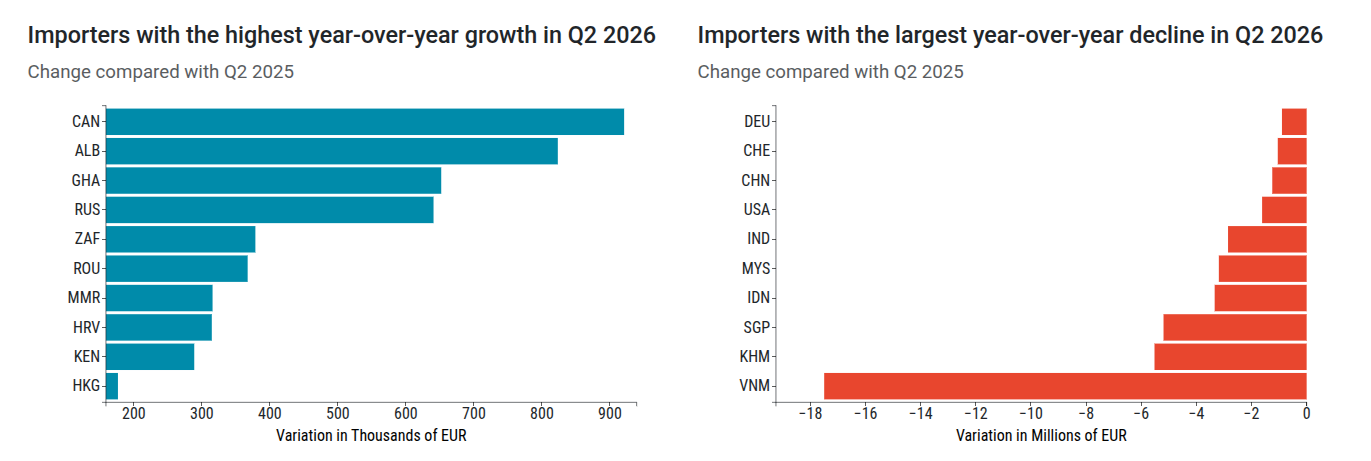
Using the dashboard available in the Report environment of the ExportPlanning platform, it is possible to identify, as shown in Figure 1, the markets experiencing the strongest growth and those showing the largest declines in the 2nd quarter of 2026.
Fig. 1 – Footwear Machinery - World: performance of importing Countries
Source: ExportPlanning calculations
The dashboard makes it possible to move quickly from an overall view of world trade to the identification of the most dynamic markets, highlighting where growth opportunities are concentrating and where, instead, signs of weakening demand are emerging.
Would you like to receive a selection of the most relevant news of the week on foreign trade? Subscribe for free to World Business Newsletter!
Leading markets
Figure 1 shows that among the importing Countries with the strongest growth, the change in value compared with the 2nd quarter of 2025 did not exceed one million euros. The leading growing importers include:
- Canada, with a positive delta of +€921 thousand compared with the same period of 2025;
- Albania, which recorded an increase of +€823 thousand;
- Ghana, which recorded a positive change of +€652 thousand.
Among the top ten importing Countries with the strongest growth during the period under consideration, only one market was among the top 10 main importers in 2025: Russia, which recorded a change of +€651 thousand.
Declining markets
Conversely, Figure 1 shows that among the importing Countries with the largest negative changes compared with the 2nd quarter of 2025, many were among the sector's main markets in 2025:
- Vietnam (the leading market in 2025) recorded a negative delta of -€17.5 million;
- Cambodia (the fourth-largest market in 2025) recorded a negative difference of -€5 million compared with the same period in 2025;
- Indonesia (the second-largest market in 2025) recorded a decrease of -€3.3 million in value;
- India (the third-largest market) recorded a negative change of -€2.8 million.
Focus on the Italian market
An analysis of Italian exports in the 2nd quarter of 2026 reveals a geographical reconfiguration compared with what was observed in 2025.
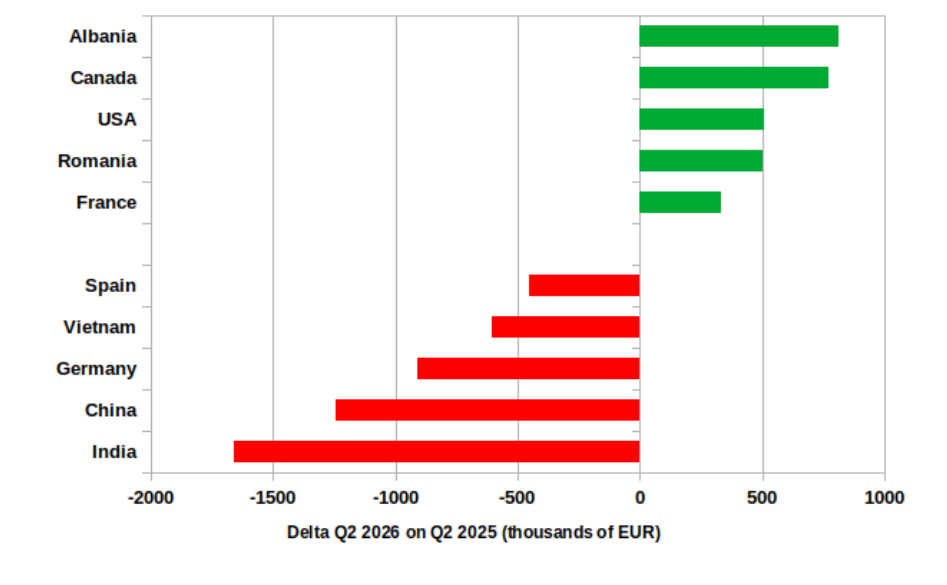
Fig. 2 – Footwear Machinery - Italy: performance of importing Countries
Source: ExportPlanning calculations
Most of the markets that ranked among the top positions in 2025 experienced the most significant declines in value:
- India was the leading market for Italian companies in 2025 (€4.1 million). In the 2nd quarter of 2026, it recorded the largest decline in absolute value, with a loss of -€1.66 million;
- China, the seventh-largest market in 2025, with a value of €1.7 million, recorded the second-worst performance in the 2nd quarter of 2026, with a decrease of -€1.24 million;
- Germany, the sixth-largest market in 2025 (€2.5 million), saw imports from Italy decrease by €909 thousand during the quarter;
- Vietnam, which ranked ninth among the main destinations for Italian exports in 2025 (€1.6 million), recorded a negative delta of -€603 thousand compared with the 2nd quarter of 2025;
- finally, Spain, the fourth-largest market in 2025 (€2.7 million), recorded a decline in machinery imported from Italy amounting to -€454 thousand.
Other strategic markets partially offset these losses with significant increases in value:
- the United States, the third-largest market in 2025 (€3.3 million), confirmed its role as a key market, growing by +€505 thousand in the 2nd quarter of 2026, demonstrating that the tariffs imposed by the Trump administration were not sufficient to prevent imports of premium machinery;
- Romania, the fifth-largest market in 2025 (€2.7 million), recorded an increase in value of +€500 thousand.
Some markets that were not among the top five destinations for Italian exports in 2025 became the main generators of value in the 2nd quarter of 2026. Albania generated the largest increase in value during the quarter (+€812 thousand). Canada was the second-largest market in terms of export growth, with a positive delta of +€769 thousand.
Conclusions
The 2nd quarter of 2026 confirms the weakness affecting world trade in footwear machinery. Behind this generalized contraction, however, there is a partial geographical reconfiguration of demand. The main Asian production hubs, which represented the largest destination markets in 2025, recorded the most significant declines: Vietnam, Cambodia, Indonesia and India account for a significant share of the contraction in world trade.
At the same time, some smaller markets are showing positive dynamics. Canada, Albania and, to varying degrees, other emerging markets or regional hubs are recording increases which, although insufficient to offset the losses in the larger markets, point to a greater geographical diversification of demand.
For the Italian industry, this reconfiguration is particularly significant. The contraction in some traditionally important markets – India, China, Germany, Vietnam and Spain – was partially offset by growth in the United States, Romania and France, as well as by the performance of Albania and Canada.
The picture emerging from the 2nd quarter of 2026 is therefore not simply one of a uniform contraction in demand, but rather of a market undergoing transformation. In a still weak environment, it is becoming increasingly important to identify promptly the markets showing a greater capacity to invest, with the aim of diversifying the Countries reached.
Explore market dynamics in greater detail
Which markets are growing? Which, on the other hand, are recording a decline in footwear machinery imports? And where are new opportunities emerging for Italian manufacturers?
To explore these dynamics and compare the performance of different markets, you can directly consult the ExportPlanning dashboard. The dashboard makes it possible to move from an aggregated reading of the data to an analysis of individual markets, in order to identify changes, trends and development opportunities more quickly.
You may be interested in:

THE EU EXPORTS OF CAPITAL GOODS IN Q3-2026
Published by Marcello Antonioni. .
Metal industry Conjuncture Export Global economic trendsThe growth in European sales of capital goods (+6.9% year-on-year in euro) was driven by Tools and Equipment for ICT and Services and Electrical Engineering [ Read all ]

Woodworking machinery: Italian exports grow
Published by Mauro Badanelli. .
Internationalisation Industrial equipment Foreign markets Monthly Market Data International marketingNei primi sette mesi del 2026 le esportazioni italiane mostrano un incremento sul 2025, mentre le vendite all'estero dei principali concorrenti calano [ Read all ]

IMF WEO October 2026: Divergent Resilience and Persistent Pressures
Published by Alba Di Rosa. .
Macroeconomic analysis Conjuncture Uncertainty IMF Global economic trendsOn October 13, the International Monetary Fund released its latest World Economic Outlook, a key publication assessing the state of the global economy and its growth prospects. Compared with }... [ Read all ]