US Trade Deficit Put to the Test by Tariffs: Evidence from First-Half 2026 Data
Published by Marzia Moccia. .
Slowdown Conjuncture United States of America Uncertainty Trade war Foreign market analysis
Amid uncertainty that has now become the new normal, international geopolitical tensions, and the reshaping of the rules governing global trade, the United States undoubtedly remains a key focus of the global economic landscape.
The latest update of U.S. foreign trade data available through the ExportPlanning information system makes it possible to capture the most recent trends in U.S. trade flows and provides an initial assessment of overall trade performance during the first half of the year.
U.S. Trade Balance: Signs of a Correction?
Let us begin with one of the central themes of the Trump administration's economic narrative: the trade deficit.
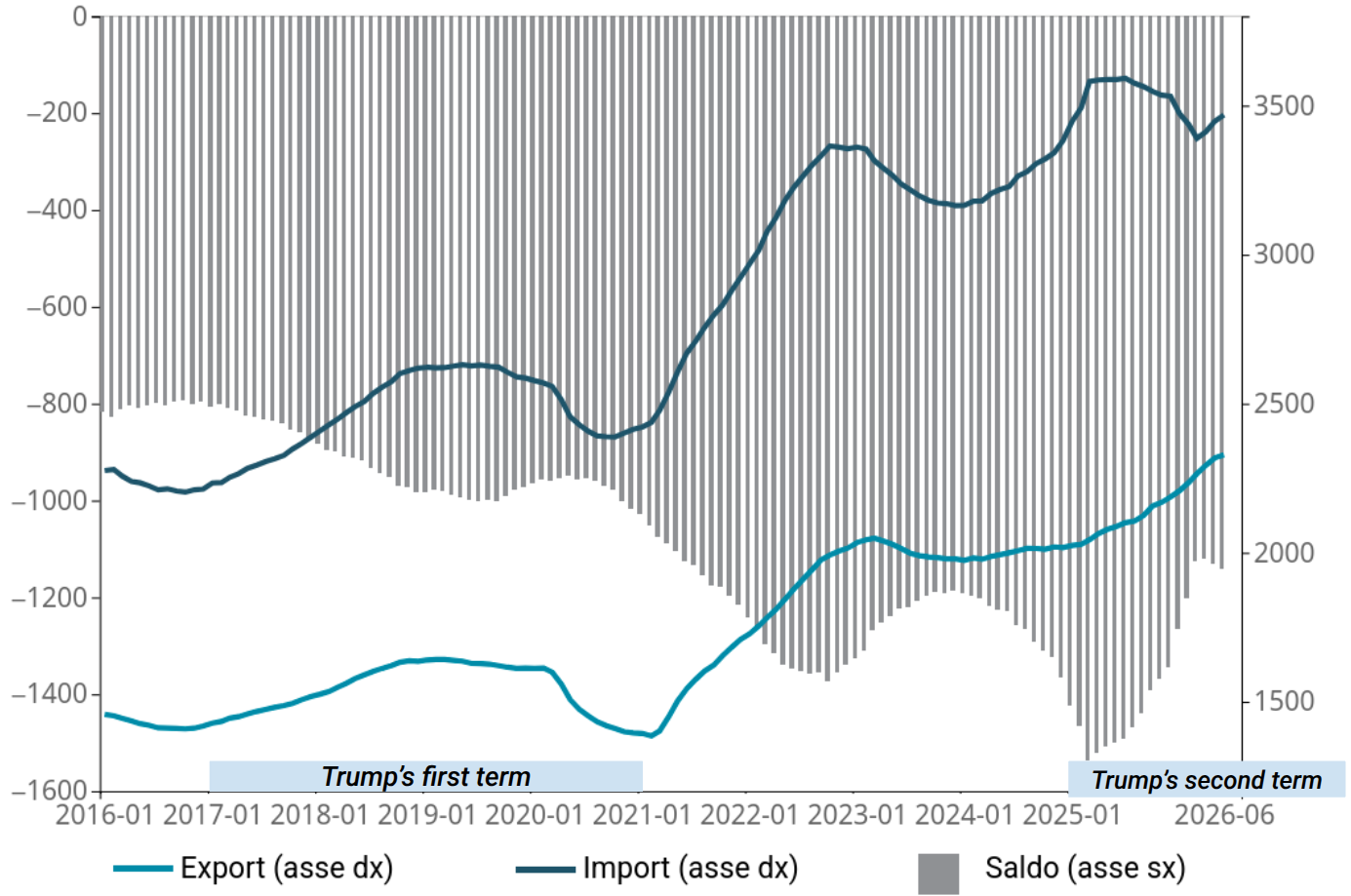
The chart below shows the twelve-month cumulative balance of U.S. merchandise trade, based on monthly data and updated with the preliminary estimate for June 2026. Using a rolling annual total removes much of the volatility typically associated with monthly data and highlights more clearly the underlying trend of the trade deficit in recent months.
From a long-term perspective, the chart shows that during Trump's first term, the U.S. merchandise trade deficit fluctuated around USD 1 trillion. The deficit then deteriorated significantly during the 2021–2023 period before stabilizing at levels close to USD 1.2 trillion.
Fig. 1 – U.S. Merchandise Trade Balance
(USD billions, 12-month rolling total based on monthly data)
Source: ExportPlanning
Focusing on the most recent period, developments in U.S. trade have displayed different dynamics depending on the prevailing economic conditions.
Beginning in the final months of 2024, alongside Trump's re-election and the growing expectation of a new round of tariffs, the trade deficit started widening again, reaching a peak in the first months of 2025. To correctly interpret this trend, it is necessary to consider the so-called front-loading effects. Anticipating the introduction of new tariffs, many firms accelerated purchases from abroad, leading to a significant increase in imports and, in the absence of a corresponding acceleration in exports, a wider trade deficit.
Once this phase had run its course, U.S. imports embarked on a gradual path of normalization and slowdown (blue line), reaching a low in March 2026. The latest data, however, point to an initial reversal: after several months of contraction, imports appear to have halted their downward trend, showing signs of stabilization and a partial recovery.
On the other hand, U.S. exports have followed a strong growth trajectory since the second half of 2025, further supported in recent months by the sharp increase in oil prices and, more broadly, energy commodity prices.
Overall, while the merchandise trade deficit remained broadly unchanged in 2025 compared with 2024—at levels exceeding USD 1.3 trillion—data for the first six months of 2026 point to the beginning of a gradual reduction in the trade deficit.
Nevertheless, these early signs should be interpreted with caution. The observed improvement still appears to be largely driven by cyclical factors, as highlighted by the analysis by macro-sector, which identifies the main drivers behind the recent evolution of U.S. trade.
U.S. Trade Balance: The Changing Composition of Trade
The table below compares the trade balance recorded at the end of 2024 with that of the latest twelve-month period, highlighting developments across the main macro-sectors that make up U.S. trade.
Table 1 – U.S. Trade Deficit by Macro-Sector – 2024 vs. Latest 12 Months
| Sectors | Trade Balance 2024 |
Trade Balance Latest 12 Months (Jun 2025–Jun 2026) |
|---|---|---|
| Raw Materials | 129 | 288 |
| Intermediate Goods | -338 | -275 |
| Consumer Goods | -625 | -469 |
| Capital Goods | -486 | -609 |
| Total | -1 320 | -1 065 |
Source: ExportPlanning
Raw Materials remain the only macro-sector in which the United States records a structurally positive trade balance, while the country continues to post deficits in Intermediate Goods, Capital Goods, and, above all, Consumer Goods, which account for the largest share of the trade deficit.
Recent developments only partially confirm the picture observed at the end of 2024, highlighting several noteworthy trends:
- Raw Materials. The trade surplus has more than doubled compared with just a few years ago, thanks primarily to strong growth in oil exports and, more broadly, energy products. The improvement recorded in recent months reflects both the rise in international energy prices, which boosted the value of exports, and the increase in the physical volume of U.S. supplies to selected trading partners under the new bilateral agreements promoted by the Trump administration.
- Intermediate Goods and Consumer Goods. Within manufacturing, the improvement in the trade balance has been relatively modest for Intermediate Goods, while it has been more significant for Consumer Goods, consistent with the effects of the new tariff measures and the gradual unwinding of the front-loading phenomenon that had supported imports in previous months.
- Capital Goods. However, the improvement in Consumer Goods has been almost entirely offset by the deterioration of the trade balance in Capital Goods. This trend reflects the sharp increase in imports of products linked to artificial intelligence development—particularly electronic components, semiconductors, and digital infrastructure—which continue, at least for the time being, to benefit from the absence of tariffs.
Conclusions
Overall, the data suggest that the reduction in the U.S. trade deficit observed during the first part of 2026 is not the result of a broad-based rebalancing of trade. Instead, the improvement appears to be highly concentrated, while the growing demand for artificial intelligence-related technologies continues to sustain the deficit in capital goods.
This therefore remains only a partial rebalancing, whose durability will need to be confirmed over the coming months to determine whether it marks the beginning of a genuine reversal in the U.S. trade deficit or simply reflects an adjustment driven by specific cyclical factors.
You may be interested in:

THE EU EXPORTS OF CAPITAL GOODS IN Q3-2026
Published by Marcello Antonioni. .
Metal industry Conjuncture Export Global economic trendsThe growth in European sales of capital goods (+6.9% year-on-year in euro) was driven by Tools and Equipment for ICT and Services and Electrical Engineering [ Read all ]

IMF WEO October 2026: Divergent Resilience and Persistent Pressures
Published by Alba Di Rosa. .
Macroeconomic analysis Conjuncture Uncertainty IMF Global economic trendsOn October 13, the International Monetary Fund released its latest World Economic Outlook, a key publication assessing the state of the global economy and its growth prospects. Compared with }... [ Read all ]

Hollow glass machinery: global trade set to accelerate in 2026
Published by Mauro Badanelli. .
Industrial equipment Conjuncture Foreign markets Global economic trendsThe global trade in machinery for the production and processing of hollow glass1 has shown a marked reversal in the first seven months of 2026, compared with the weakness that characterised the 2022–2}... [ Read all ]