B-READY 2025: the World Bank’s new compass for economic development
Published by Veronica Campostrini. .
Macroeconomic analysis Foreign markets Economic policy Central banks Foreign market analysisWith the publication of the Business Ready 2025 report, the World Bank introduces the new B-READY (Business Ready) index, intended to permanently replace the previous Doing Business, which was suspended in 2021. This edition represents the intermediate phase of a three-year rollout: after analyzing 50 economies in 2024, the current report extends coverage to 101 economies, aiming to reach over 160 countries by the end of 2026.
From Doing Business to B-READY: The Employment Perspective
The transition is not only methodological but strategic. While the old index focused on bureaucratic ease for individual firms, B-READY 2025 adopts a "Jobs Perspective", assessing whether economies are truly ready to generate more and better jobs. The new framework goes beyond the purely regulatory approach (de jure), integrating the real-world experience of businesses (de facto) and the effectiveness of public services.
Index Structure: Three Pillars and Ten Areas
The new World Bank B-READY index evaluates the business lifecycle through three fundamental pillars, which together provide a more complete and realistic view of the business environment.
- Regulatory Framework (Pillar I): Formal rules and laws.
The first pillar analyzes the set of formal rules and laws governing economic activity. This includes assessing the quality of the regulatory framework, the clarity of provisions, and their consistency. Among the countries analyzed, the Czech Republic leads the ranking with a score of 80.7, highlighting a solid and well-structured regulatory system; - Public Services (Pillar II): Institutions and infrastructure that support compliance.
The second pillar focuses on the role of public institutions and infrastructure in supporting businesses. Good rules alone are not enough: efficient services must exist to enable their implementation. This includes, for example, the quality of public administration, digital services, and the functioning of judicial systems. In this dimension, South Korea emerges as the top country globally, with a score of 80.2, thanks to high administrative efficiency and strong digitalization; - Operational Efficiency (Pillar III): The actual ease of daily operations.
The third pillar measures the concrete ease with which a business operates on a day-to-day basis. Here, the focus shifts to the real experience of companies: actual processing times, operating costs, predictability and duration of procedures, and the absence of bureaucratic obstacles. Singapore remains the highest-performing economy in this pillar, with 79.3 points, due to a highly efficient and business-oriented environment.
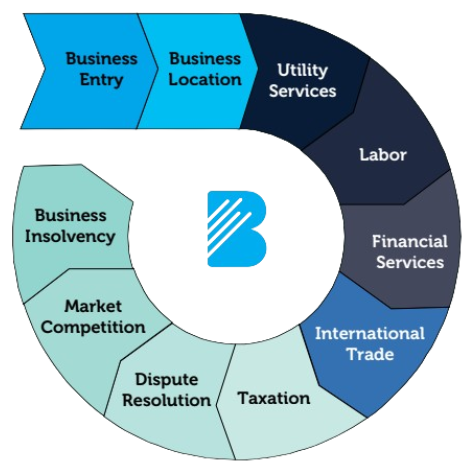
The assessment of the entire business lifecycle is also divided into 10 thematic areas, covering all stages of business activity: from company creation to access to essential services, operational management, and closure. This approach allows a systemic understanding of the different dimensions that influence business operations.
Pic.1 – B-READY Thematic Topics: The Business Lifecycle
Source: B-READY project
Overall, this new architecture represents a significant advancement over Doing Business. Unlike the past, measurement is not limited to individual moments or isolated regulatory aspects but focuses on the entire business lifecycle, with greater attention to operational realities and the actual quality of the economic environment.
Early Results: A World Only 60% “Business Ready”
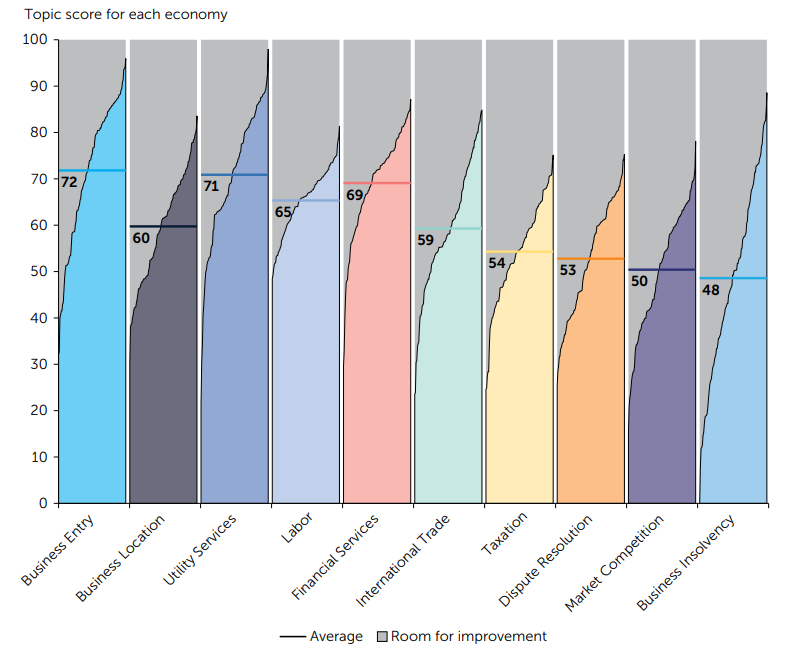
The main finding of the 2025 report confirms that the analyzed economies are, on average, only 60% “business ready”.
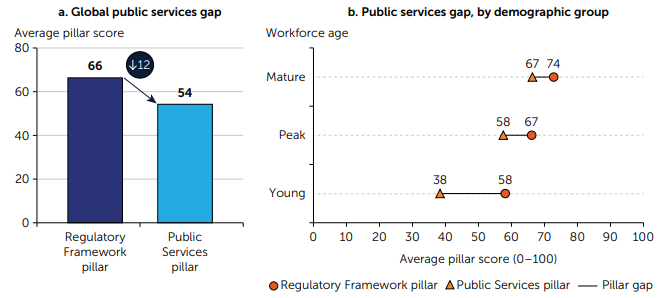
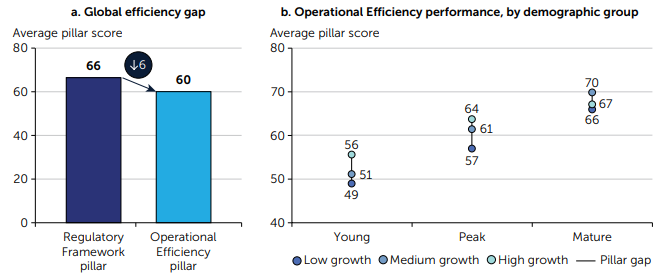
Significant gaps also exist between regulatory theory and operational practice. On average, the score for the regulatory pillar is 66.3, while operational efficiency drops to 60.0 and public services to just 54.0 points.
Pic.2 – B-READY Thematic Topics: Distribution and Average Scores*
Source: B-READY project
*Note: The figure shows the score distribution for 101 economies for each theme, with scores ranging from 0 to 100. Each theme is represented by a solid color, allowing easy comparison between themes. Within each box, the lowest score appears on the left and the highest on the right. The gray shaded area indicates the gap between each economy’s score and the maximum possible score, highlighting potential for improvement. The colored line shows the mean position within the distribution.This data suggests significant global room for improvement and confirms that regulatory progress must be implemented, and that strong structural inefficiencies still exist.
Critical “Gaps”: Public Services and Efficiency
The report highlights two main bottlenecks:
- Public Services Gap: there is a gap of about 12 points between the quality of laws and the services provided by the state to enforce them. This gap is nearly three times larger in economies with a young workforce compared to mature ones.
Pic.3 – Public Services Gap
Source: B-READY project
- Efficiency Gap: even with good rules, businesses face excessive costs and delays (average operational efficiency ~60 versus regulatory framework ~66), showing that bureaucracy remains a tangible obstacle to growth.
Pic.4 – Efficiency Gap
Source: B-READY project
Demographics and Vulnerability: The Challenge of Youth
One of the most alarming aspects concerns demographics. The report defines "Young workforce economies" as countries where more than 31% of the population is under 15 years old.
The report highlights that, paradoxically, the countries that most need to create jobs for new generations are the least “business ready”: these economies achieve an average readiness score of only 49 points, compared to 69 for mature economies.
This could create a macroeconomic risk due to high labor market pressure and the insufficient capacity of the private sector to absorb new workforce.
Differences Across Countries and Income Levels
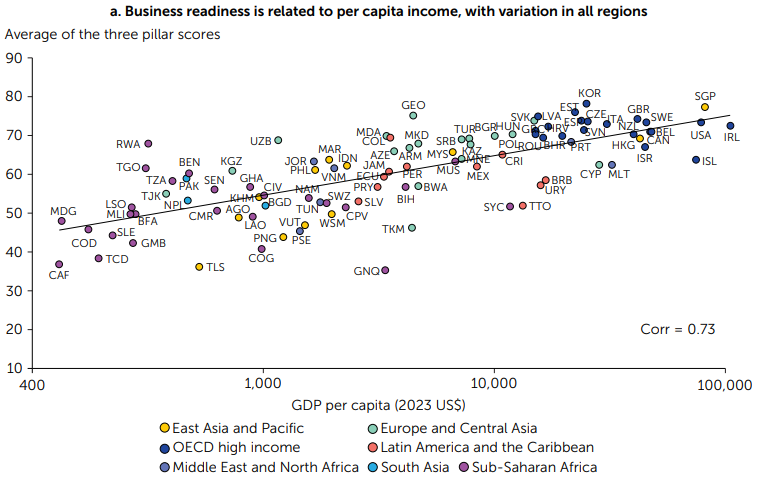
The report also highlights a clear correlation between income level and the quality of the business environment.
In particular, high-income economies dominate the highest scores and show greater consistency across pillars. Conversely, low-income economies perform weaker, especially in public services and efficiency.
However, there are exceptions, such as Georgia, Rwanda, and Uzbekistan, showing that targeted reforms can produce results even in less developed contexts.
Pic.5 – High-Income Economies Have a Better “Business Environment”
Source: B-READY project
Policy Implications and Conclusions
To improve "business readiness", the World Bank suggests focusing on digitalization of services, transparency, and strengthening institutions. The main message of 2025 is clear: reforms "on paper" are not enough. The real challenge to support development and employment lies in the ability of states to translate rules into efficient and accessible services, reducing uncertainty for the private sector.
In conclusion, the new World Bank B-READY index is designed to offer a more accurate, credible, and useful assessment of the global business environment. It does not merely rank countries but aims to become a tool to support public policies, helping governments identify concrete weaknesses and areas for improvement across the entire business lifecycle.
Key objectives include: improving regulatory quality, strengthening the effectiveness of public services, promoting transparency and predictability of the regulatory environment, and supporting digitalization and sustainability of economic systems.
You may be interested in:

From Sales Attempts to Strategic Planning: The Role of Geopolitics in Shaping Firms’ Internationalization Decisions
Published by Marzia Moccia. .
Planning Conjuncture Foreign markets Uncertainty International marketing International marketingRecent developments have made it increasingly clear that the international environment is characterized by a growing and persistent level of uncertainty and geopolitical instability, directly affecti}... [ Read all ]
EU–China: the evolution of the trade relationship and new sectoral balances
Published by Veronica Campostrini. .
Importexport Trade balance Foreign markets Foreign market analysisThe evolution of the trade balance in goods between the European Union and China today represents one of the most relevant lenses through which to understand the new asymmetries of international trade}... [ Read all ]

Objective: market diversification. Evidence from the CETA agreement
Published by Simone Zambelli. .
Free trade agreements Export Foreign markets Foreign market analysisIn the new global order, diversification has become the key concept guiding the European Union’s trade policy [ Read all ]