Canada: where to export packaging machinery?
ExportPlanning Market Selection tool allows you to identify the provinces with the greatest commercial potential by combining market size, demand trends and characteristics
Published by Mauro Badanelli. .
Marketselection Foreign markets Foreign market analysisWith imports worth 453 million euros in 2025, Canada represents a significant market for manufacturers of packaging machinery1, ranking eleventh worldwide by import value. Demand is strongly oriented towards high-end products, which account for more than 60% of total imports.
In this market, Italy is the third-largest supplier, with a market share of 14.1%, behind only the United States (33.6% of total imports) and Germany (16.8%).
Data for the first half of 2026 show a sharp acceleration in Canadian imports, accompanied by significant growth in Italian sales. Canada's total imports surged from 231.5 million euros in the first half of 2025 to 964.8 million euros in the corresponding period of 2026. At the same time, imports from Italy increased from 38.0 million euros to more than 178.4 million euros.
This expansion is particularly pronounced in Ontario and Quebec, which account for most of the demand, but also extends to provinces such as British Columbia, Alberta and Manitoba.
Where are the greatest business opportunities for Italian companies?
Answering this question requires looking beyond the size of individual provincial markets. It also means assessing growth prospects, demand characteristics and the competitive positioning of Italian suppliers.
Territorial Market Selection: what determines the ranking?
ExportPlanning's Territorial Market Selection tool allows users to compare Canadian provinces through a composite market potential index that combines sector-specific and macroeconomic indicators.
For packaging machinery, the ranking was developed using seven indicators grouped into four main dimensions:
- Market size and demand dynamics: import value in 2025, average growth over the past two years and year-on-year change in the latest six-month period.
- Price positioning: the extent to which demand is oriented towards higher-end machinery.
- Italian market presence: the market share held by Italian manufacturers in each province in 2025.
- Economic and industrial environment: real GDP growth and the contribution of manufacturing value added to the provincial economy.
Each indicator is assigned a weight that determines its contribution to the overall score. In this analysis, greater importance was given to market size and the underlying growth trend in imports.
The result is a composite index ranging from 0 to 100, which ranks provinces according to their relative market potential.
Ranking Canadian provinces by market potential
Applying Market Selection to Canada's packaging machinery market produces a ranking that differs in several significant respects from one based solely on import value.
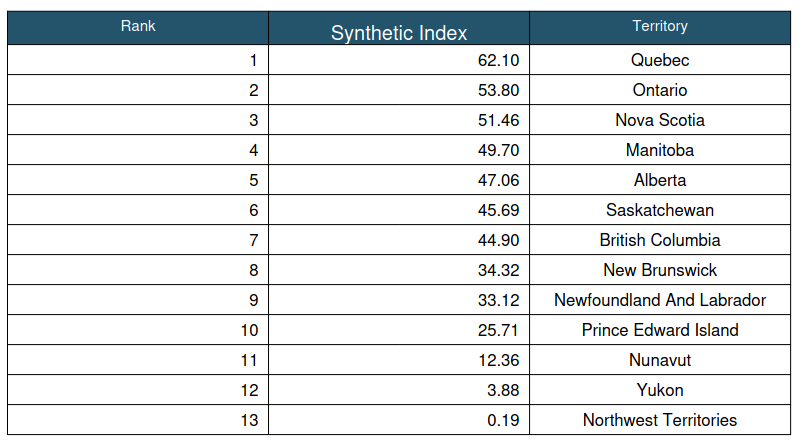
Table 1 - Packaging machinery - Market potential ranking of Canadian provinces
Source: ExportPlanning
Quebec and Ontario: two priority markets with different characteristics
Quebec ranks first, with a market potential score of 62.10, despite recording lower import values than Ontario.
Its leading position is primarily driven by strong demand for high-end machinery, a 24.7% market share for Italian suppliers and a substantial manufacturing sector, which accounts for 11.6% of provincial GDP.
Ontario ranks second, although it is Canada's largest provincial import market, with imports worth 223 million euros in 2025. Compared with Quebec, its demand is less oriented towards higher-priced machinery, while Italian suppliers have a smaller market presence, with a share of 11.8%.
This comparison highlights how the largest market is not necessarily the one with the greatest overall potential.
Opportunities in other provinces
Nova Scotia ranks third. Despite its relatively small market size, the province benefits from strong demand for higher-end machinery, an Italian market share exceeding 34% and particularly robust GDP growth.
Next comes Manitoba, supported by positive import trends and a strong manufacturing base, followed by Alberta, which combines a sharp recent acceleration in demand with an Italian market share approaching 30%.
Saskatchewan stands out for its high import growth rate over the past two years, while British Columbia, despite being Canada's third-largest provincial market by import value, ranks only seventh in the overall assessment.
Conclusions
The ranking results demonstrate that market size is not the only factor to consider when assessing business opportunities. While Ontario is the leading destination in terms of import value, Quebec emerges as the province offering the strongest combination of market size, price positioning, Italian supplier presence and industrial characteristics.
At the same time, provinces with smaller markets, such as Nova Scotia, Manitoba and Alberta, achieve high positions in the ranking for different reasons: from strong demand for high-end machinery to import growth and the established presence of Italian manufacturers.
The ranking therefore helps distinguish between large markets, provinces characterized by higher-value demand and territories showing signs of growth. These represent different types of opportunities, whose relevance depends on each company's product offering and commercial objectives.
Rather than identifying a single ideal destination, the ranking provides a comparative assessment of regional market potential, helping companies set geographic priorities, investigate the most promising markets and guide their business development activities.
From ranking to strategy: a customizable Market Selection tool
The proposed ranking provides a starting point for identifying the territories on which to focus business development efforts.
ExportPlanning's Territorial Market Selection tool allows companies to customize the ranking by adjusting indicator weights according to their strategic priorities.
A manufacturer of premium machinery may place greater emphasis on price positioning and the strength of the local manufacturing sector. A company seeking to increase sales volumes may prioritize import market size, while businesses looking for emerging opportunities may focus more heavily on growth indicators.
The analysis of Canadian provinces thus demonstrates the value of an approach that goes beyond simply comparing trade volumes, bringing together multiple dimensions of market potential.
With the new territorial Market Selection functionality, ExportPlanning extends this analytical capability to Canada, the United States, Brazil and China, providing companies with a tool to identify and compare business opportunities within individual national markets.
1 The Harmonized System (HS) codes considered in this analysis are HS842220, HS842230 and HS842240.
You may be interested in:

Market Selection gets an upgrade: regional analysis and presets for smarter, more targeted market selection
Published by Luca Surace. .
Marketselection Export markets Internationalisation toolsExportPlanning expands its analytical capabilities, enabling businesses to explore commercial opportunities within major international markets. [ Read all ]

Italian Metalworking Machine Tools: Map of Chinese territories
Published by Mauro Badanelli. .
Industrial equipment Conjuncture Foreign markets Foreign market analysisJiangsu was the leading destination for Chinese imports from Italy in the first nine months of 2026. Zhejiang and Shanghai saw strong growth in the same period [ Read all ]

World Trade September 2026: Growth at Different Speeds
Published by Marzia Moccia. .
Conjuncture Global demand Foreign markets Uncertainty Global economic trendsIl commercio internazionale conferma una crescita sostenuta anche nel terzo trimestre, ma permangono le divergenze settoriali [ Read all ]