Home Textiles: Global Trade Set to Recover from 2027
After a stable 2026, global home textiles trade is set to resume growth in 2027–2028, driven also by expanding demand in emerging markets.
Published by Mauro Badanelli. .
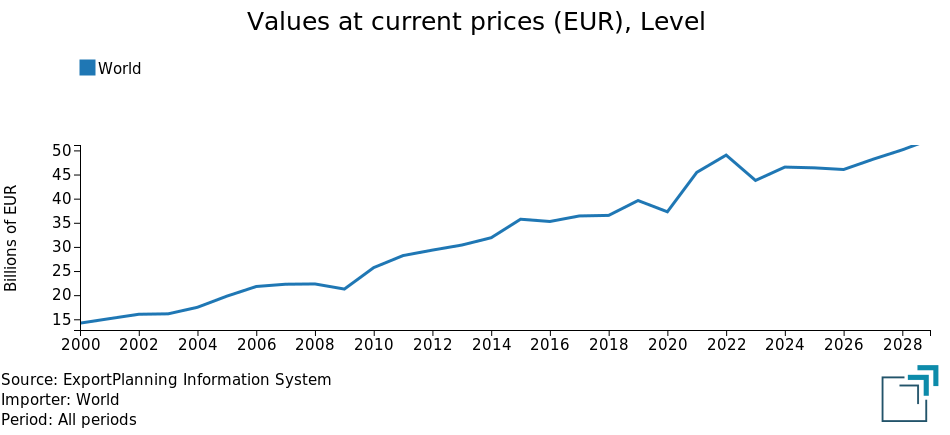
Forecast Export Foreign markets Foreign market analysis2026 is shaping up to be a year of substantial stabilisation for global trade in the Home Textiles sector1, following the record levels reached in 2025. According to estimates from the ExportPlanning Information System, the value of international trade is expected to reach €43.67 billion in 2026, compared with €43.69 billion in 2025, representing virtually no change (-0.04% at current prices).
However, the current period of stagnation represents a temporary setback within a broader structural expansion trend. The forecast scenario points to a strong recovery in trade from 2027, with global demand increasing by 4.6% in current values compared with the previous year, followed by a further rise of 4.1% in 2028. Global trade in the sector is therefore expected to reach a new all-time high of €47.55 billion in 2028, significantly exceeding previous levels.
Fig. 1 – Home Textiles – Global Trade, 2000–2028
(€ billion)
2026: A period of stabilisation across major markets
The relative stability of international trade in 2026 reflects a two-speed geographical landscape, shaped by diverging trends between major mature economies and a selection of highly dynamic emerging markets. Global demand for home textile products remains heavily concentrated in high-income countries.
The main destination markets are experiencing a contraction in import values, following the strong increases recorded in previous years:
- In the United States, the world's leading importer, accounting for almost 22% of the global market, imports are expected to fall to €9.86 billion in 2026, compared with €10.59 billion in 2025 (-6.9%).
- In Germany, the world's second-largest importing market, imports are expected to decline by 4.1% compared with 2025, reaching €3.36 billion.
- Similar decreases are forecast for Japan (€2.02 billion, -6.2%), the United Kingdom (€1.88 billion, -1.6%), France (€1.84 billion, -2.9%) and Canada (€1.07 billion, -3.8%).
In contrast to the slowdown in major mature economies, several European and international markets are showing resilience and growth:
- The Netherlands is recording a 5.3% increase in imports, reaching €1.71 billion.
- Australia is growing by 5.5% (€1.21 billion), while Spain is registering a 2.0% increase (€1.03 billion).
Overall, the short-term analysis reveals a complex picture: the stagnation in 2026 is driven by weaker spending in countries with the greatest purchasing power, while expanding demand across several emerging destinations is helping to sustain global trade.
Interested in receiving a selection of the week's most relevant international trade news? Subscribe to the World Business Newsletter for free!
Global demand is expected to return to sustained growth from 2027
The forecast scenario developed using ExportPlanning's integrated econometric model points to a clear change of pace over the 2027–2028 period. Following the stagnation of 2026, the compound annual growth rate (CAGR) of global home textiles trade is expected to reach 4.3% between 2026 and 2028.
The recovery will be widespread and gradual, allowing almost all major geographical markets to resume their historical growth trajectories.
Table 1 – Home Textiles – Trends in the Main Importing Countries
(current values)
| Rank | Country | 2025 €bn |
2026E €bn |
2028F €bn |
YoY change 2026–25 |
CAGR 2026–28 |
|---|---|---|---|---|---|---|
| 1 | United States | 10.59 | 9.86 | 10.46 | -6.9% | +3.0% |
| 2 | Germany | 3.50 | 3.36 | 3.61 | -4.1% | +3.6% |
| 3 | Japan | 2.15 | 2.02 | 2.21 | -6.2% | +4.5% |
| 4 | United Kingdom | 1.92 | 1.88 | 2.06 | -1.6% | +4.5% |
| 5 | France | 1.89 | 1.84 | 1.95 | -2.9% | +3.0% |
| 6 | Netherlands | 1.63 | 1.71 | 1.89 | +5.3% | +4.9% |
| 7 | Australia | 1.15 | 1.21 | 1.33 | +5.5% | +4.5% |
| 8 | Canada | 1.11 | 1.07 | 1.16 | -3.8% | +4.2% |
| 9 | Spain | 1.01 | 1.03 | 1.13 | +2.0% | +5.1% |
| 10 | Italy | 0.97 | 0.96 | 1.03 | -1.6% | +3.9% |
| 11 | Poland | 0.89 | 0.87 | 0.98 | -2.6% | +6.3% |
| 12 | South Korea | 0.68 | 0.66 | 0.80 | -2.0% | +10.2% |
| 13 | Belgium | 0.65 | 0.69 | 0.72 | +6.3% | +2.3% |
| 14 | Switzerland | 0.66 | 0.67 | 0.71 | +1.7% | +2.9% |
| 15 | Austria | 0.58 | 0.57 | 0.60 | -1.4% | +3.2% |
| 16 | Kazakhstan | 0.47 | 0.48 | 0.58 | +2.0% | +9.9% |
| 17 | Sweden | 0.50 | 0.53 | 0.56 | +6.5% | +3.5% |
| 18 | Chile | 0.48 | 0.51 | 0.56 | +5.9% | +4.7% |
| 19 | Mexico | 0.46 | 0.46 | 0.52 | -1.4% | +6.7% |
| 20 | Brazil | 0.33 | 0.35 | 0.40 | +4.6% | +7.2% |
E: estimates · F: forecasts Source: ExportPlanning elaborations and forecasts (Ulisse Database)
Resilience and recovery across mature markets
The forecast scenario for 2028 confirms the central role of major advanced economies, alongside a gradual geographical reshaping of trade flows in favour of economies experiencing strong demographic and industrial development.
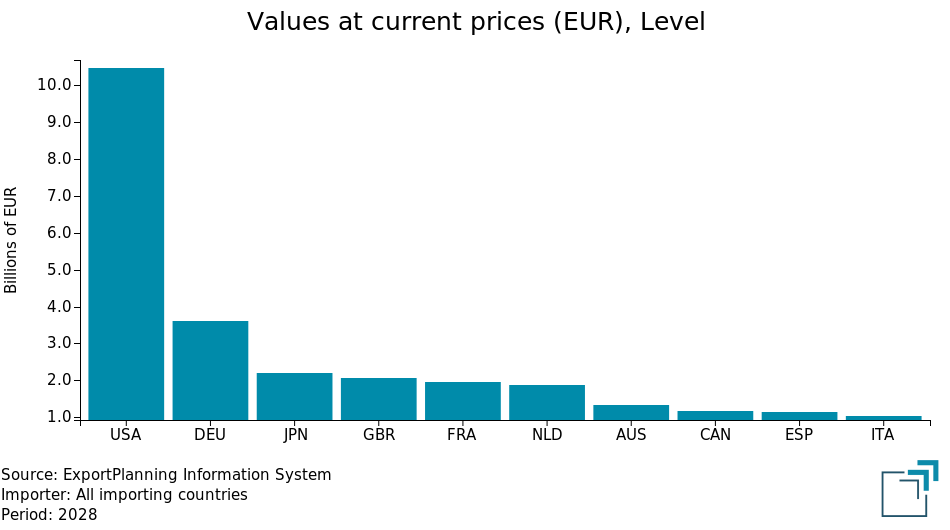
The United States will remain the main pillar of global demand, with imports rising to €10.46 billion in 2028 (accounting for almost 22% of global purchases). In Western Europe, Germany will exceed €3.6 billion in 2028 (CAGR +3.6%), followed by the United Kingdom (€2.06 billion, CAGR +4.5%), France (€1.95 billion, CAGR +3.0%), the Netherlands (€1.89 billion, CAGR +4.9%) and Italy (€1.03 billion, CAGR +3.9%). Japan will retain its third position in terms of import value, reaching €2.21 billion in 2028.
Fig. 2 – Home Textiles – Main Importing Countries in 2028
(forecasts)
The fastest-growing markets in the forecast scenario
Alongside traditional destinations, the 2026–2028 forecasts highlight a group of markets expected to record growth rates significantly above the global average:
- South Korea: following a slight decline in 2026, home textiles imports are expected to grow at an average annual rate (CAGR) of 10.2%, reaching €804.6 million in 2028.
- Central Asia: Kazakhstan is expected to record an average annual growth rate of 9.9%, reaching €578.9 million in 2028. Uzbekistan is forecast to achieve a CAGR of 12.2%, while Tajikistan is expected to grow by 9.3%.
- Latin America: Brazil is expected to record average annual growth of 7.2% (€398.4 million in 2028), followed by Mexico (+6.7%, €520.2 million) and Chile (+4.7%, €560.2 million).
Conclusions
The scenario outlined by ExportPlanning's forecasts points to a resilient sector, characterised by substantial market size (exceeding €47.5 billion by 2028) and a recovery in global demand.
On the one hand, maintaining commercial margins requires an established presence in traditional markets (the United States and Western Europe), where demand favours products with high levels of design, sustainability and material quality. On the other hand, the emergence of high-growth markets, particularly in East Asia, creates significant opportunities for geographical diversification.
For home textiles exporters, the ability to consolidate their presence across distribution channels in mature markets while pursuing targeted strategies in new emerging destinations will be a key factor in achieving competitive success over the 2027–2028 period.
1) See the sector description sheet for the list of products included in this sector.
You may be interested in:

Exports 2027–2030: ExportPlanning Forecast Scenario Updated
Published by Marzia Moccia. .
Total goods Forecast Export markets Foreign markets Uncertainty Foreign market analysisWhich markets are experiencing accelerating international demand? Which markets and sectors offer the most significant opportunities? For exporting companies, identifying these changes}... [ Read all ]

Canada: where to export packaging machinery?
Published by Mauro Badanelli. .
Marketselection Foreign markets Foreign market analysisLa Market Selection territoriale di ExportPlanning permette di individuare le province a maggiore potenzialità commerciale, combinando dimensione del mercato, dinamiche della domanda e caratteristiche [ Read all ]

Italian Metalworking Machine Tools: Map of Chinese territories
Published by Mauro Badanelli. .
Industrial equipment Conjuncture Foreign markets Foreign market analysisJiangsu was the leading destination for Chinese imports from Italy in the first nine months of 2026. Zhejiang and Shanghai saw strong growth in the same period [ Read all ]