World Trade September 2026: Growth at Different Speeds
International trade continues to show strong growth in the third quarter, but sectoral disparities persist
Published by Marzia Moccia. .
Conjuncture Global demand Foreign markets Uncertainty Global economic trendsWorld trade is approaching the final months of 2026 against a backdrop of pronounced divergences across sectors and geographical markets, as already highlighted in the article Increasingly Polarized Growth.
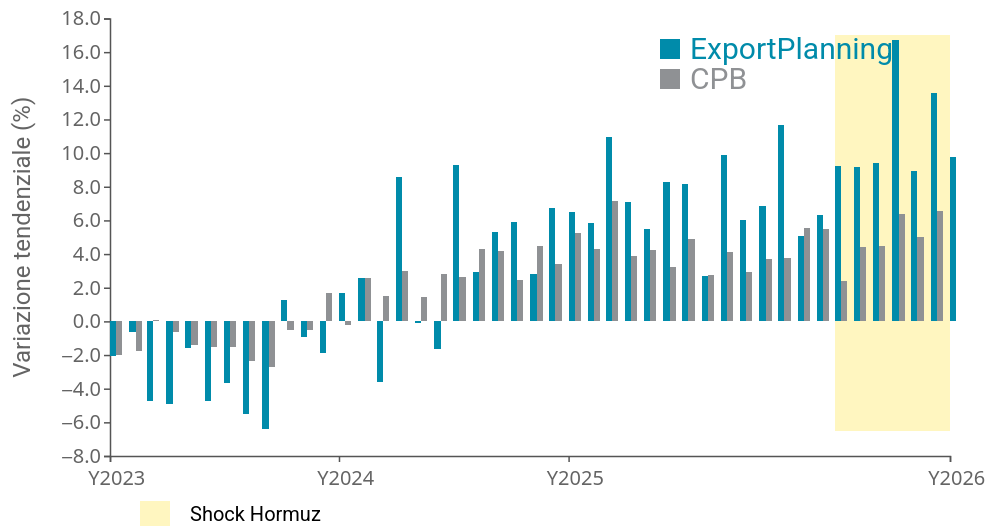
Following a first half of the year marked by stronger-than-expected growth in international trade, primarily driven by the dynamism of technology-related supply chains, third-quarter 2026 data compiled by ExportPlanning from a short-term monitoring sample covering more than 80 countries confirm that global merchandise trade continues to expand at a robust pace.
In particular, preliminary estimates for the third quarter of 2026 point to year-on-year growth in global demand for manufactured goods exceeding 10% at constant prices, thus excluding the effects of price changes and indicating that the expansionary phase of international trade flows is continuing.
Overall, during the first nine months of 2026, global merchandise trade recorded growth exceeding 9% at constant prices, demonstrating considerable resilience in an evolving international economic environment.
Fig.1 - Monthly trends in world trade at constant prices: Jan. 2022 - Sep. 2026
(CPB data vs. ExportPlanning data, year-on-year changes in monthly data)
Source: ExportPlanning
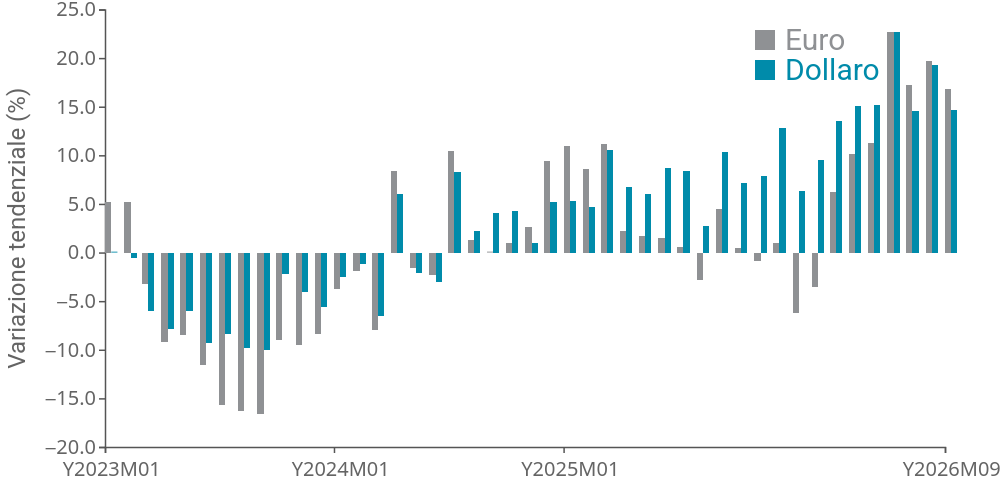
The sustained growth described above translates into nominal growth in international trade of approximately 14% in current US dollars and 10% in euros, confirming that the expansion of world trade is being supported not only by price developments but also by an increase in traded volumes.
In particular, the price component is once again playing a central role in assessing the short-term economic outlook, against a backdrop of deteriorating inflation prospects driven by persistent tensions in energy markets, which have proved more prolonged than initially anticipated.
Fig.2 - Monthly trends in world trade: euro vs. US dollar, Jan. 2022 - Sep. 2026
(year-on-year changes in monthly data)
Source: ExportPlanning
Sectoral trends in the third quarter: growth at different speeds
The resilience of aggregate trade figures confirms that international trade remained dynamic in the third quarter, although global growth continues to be characterized by increasingly polarized sectoral trends.
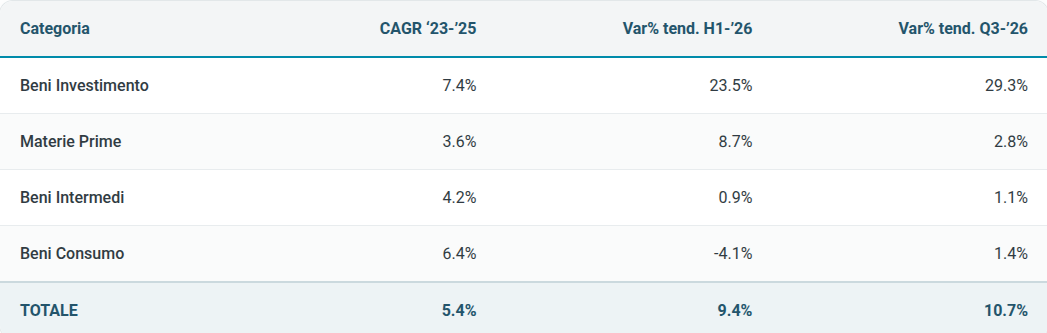
The following table presents the main industry clusters driving international trade, providing an overview of their different growth trajectories by comparing medium-term trends (compound annual growth rate over 2023-2025) with those recorded in the first half of 2026 and the subsequent third quarter.
Tab.1 - World trade at constant prices by major product segment
(changes at constant prices, CAGR 2023-2025 vs. Jan.-Sep. 2026)
Source: ExportPlanning
In the current economic environment, Capital goods, the largest category in international trade, continue to play a key role in supporting global trade growth, recording year-on-year growth of 29.3% in the third quarter. This confirms the strongly expansionary trend already observed in the first half of the year, representing a marked acceleration compared with the medium-term trend.
As repeatedly highlighted, the main contribution to growth remains concentrated in technology and ICT products and electronic components, driven by the rapid expansion of investment in Artificial Intelligence, as well as in Electrical Engineering, supported by growing demand for components and systems used in electricity distribution and power conversion.
Within the same cluster, the recovery in global demand for Transport Equipment and Automotive Products is also continuing. Following the weakness observed over 2023-2025, this segment recorded growth of 6% at constant prices in the third quarter, broadly in line with the 7% rebound registered in the first half of the year.
By contrast, other product categories are showing considerably less favorable trends.
In particular, the most notable development in recent months has been the sharp slowdown in global demand for Raw Materials, with growth declining from 8.7% in the first half of the year to 2.8% in the third quarter. This deceleration appears to reflect the gradual unwinding of inventory accumulation processes that had supported demand during the earlier part of the year.
Demand for Intermediate Goods also remains broadly stagnant, showing a trend comparable to that recorded in the first half of the year, with growth of around 1%.
Meanwhile, signs of a moderate improvement are emerging in Consumer Goods, which returned to positive growth in the third quarter (+1.4%) following the contraction recorded in the first half of 2026. The recovery appears to be mainly attributable to stronger demand in the Fashion and Home Furnishings supply chain, although overall growth remains subdued.
Conclusions
The acceleration in international trade relative to the medium-term trend remains largely concentrated in sectors linked to technology investment and energy infrastructure, which show no signs of a slowdown in their pace of expansion, while the remaining product segments continue to exhibit considerably more moderate growth dynamics.
Against this backdrop, while the strong expansion of technology investment represents an important driver of global trade growth, the increasing polarization of sectoral and geographical trends makes aggregate trade figures progressively less representative of the actual market opportunities available to individual companies.
This highlights the need for exporting companies to complement macroeconomic analysis with systematic and continuous monitoring of international demand conditions, at a level of detail consistent with their product specialization and target geographical markets.
In an environment characterized by increasingly divergent growth trajectories, the ability to promptly identify the most dynamic markets and product segments, anticipate signs of weakening demand, and capture emerging market opportunities is becoming an increasingly important factor in guiding internationalization strategies and sustaining competitiveness in foreign markets.
ExportPlanning is a Market Intelligence platform designed to support companies, consultants, and business associations in analyzing international markets. It provides data, reports, and analytical tools to identify foreign markets with the greatest potential and monitor, month by month, developments in markets where companies are already operating.
Learn more
You may be interested in:

Italian Metalworking Machine Tools: Map of Chinese territories
Published by Mauro Badanelli. .
Industrial equipment Conjuncture Foreign markets Foreign market analysisJiangsu was the leading destination for Chinese imports from Italy in the first nine months of 2026. Zhejiang and Shanghai saw strong growth in the same period [ Read all ]

THE EU EXPORTS OF CAPITAL GOODS IN Q3-2026
Published by Marcello Antonioni. .
Metal industry Conjuncture Export Global economic trendsThe growth in European sales of capital goods (+6.9% year-on-year in euro) was driven by Tools and Equipment for ICT and Services and Electrical Engineering [ Read all ]

Woodworking machinery: Italian exports grow
Published by Mauro Badanelli. .
Internationalisation Industrial equipment Foreign markets Monthly Market Data International marketingNei primi sette mesi del 2026 le esportazioni italiane mostrano un incremento sul 2025, mentre le vendite all'estero dei principali concorrenti calano [ Read all ]