Exports 2027–2030: ExportPlanning Forecast Scenario Updated
Published by Marzia Moccia. .
Total goods Forecast Export markets Foreign markets Uncertainty Foreign market analysis
Which markets are experiencing accelerating international demand?
Which markets and sectors offer the most significant opportunities?
For exporting companies, identifying these changes early is becoming
increasingly important for shaping business development strategies
and uncovering new growth opportunities.
In a global environment marked by rapid change and persistent
uncertainty, relying exclusively on consolidated year-end data
risks providing an already outdated picture of global trade dynamics.
Such data may be useful for understanding past trends, but are less
effective in capturing ongoing shifts in international demand
and anticipating developments in foreign markets.
The new ExportPlanning forecasting scenario incorporates the latest international macroeconomic outlook from the IMF, drawing on the October update of the World Economic Outlook, recent movements in the USD/EUR exchange rate, and evolving inflation expectations. This information is complemented by monthly monitoring of global trade dynamics, updated with preliminary estimates for 2026. Together, these inputs provide a more robust and up-to-date information base for developing forecasts for the next two years and assessing growth prospects in international markets.
The resulting framework helps companies interpret global trade trends, identify high-potential markets, and develop more informed, forward-looking export strategies.
We therefore examine the main developments in the international economic environment compared with the August forecasting scenario, focusing on the most significant changes and future growth prospects.
The dollar continues to appreciate against the euro
As tensions in the Gulf intensify, the USD/EUR exchange rate continues to reverse the strong depreciation trend that began in early 2025. The US dollar has once again assumed its traditional role as a safe-haven currency, strengthening against the euro: the exchange rate declined from an average of 1.18 in February 2026 to 1.12 in October and November.
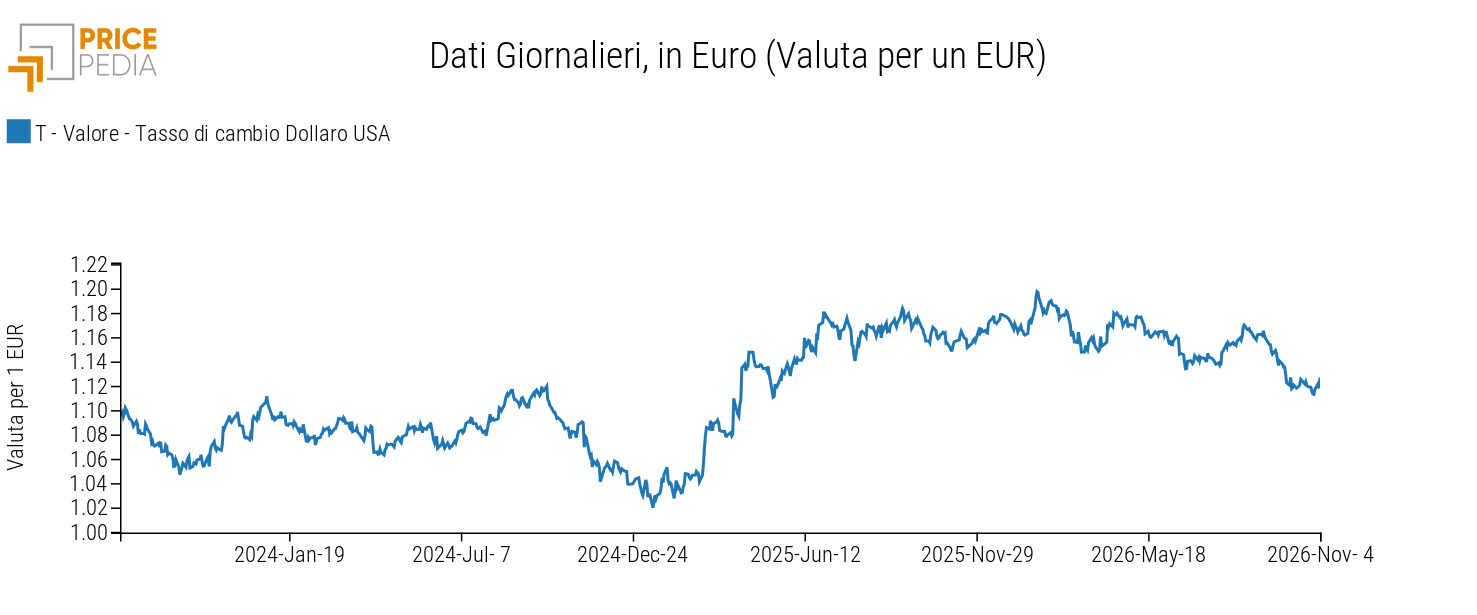
Source: PricePedia
The dollar's recent appreciation does not, however, alter the medium-term outlook, which continues to point towards a gradual weakening of the US currency. This scenario assumes a progressive easing of geopolitical tensions and a renewed prominence of macroeconomic fundamentals in determining exchange rate movements.
Inflation expectations are rising
On the price front, the IMF confirms the acceleration in inflation anticipated in its July update, forecasting global inflation of 4.7% in 2026 and 4.1% in 2027.
These figures represent upward revisions of 0.3 percentage points for 2026 and 0.2 percentage points for 2027 compared with the April 2026 outlook, reflecting greater persistence in inflationary pressures (see the article IMF WEO October 2026: Divergent Resilience and Persistent Pressures ).
World trade forecasts
Despite the complexity of the international environment, global merchandise trade has so far demonstrated significant resilience, maintaining a pace of expansion above expectations, as confirmed by trade data for the first nine months of 2026 (see the article World Trade September 2026: Growth at Different Speeds ).
In light of this evidence, the updated forecasting scenario developed by ExportPlanning points to more favorable growth prospects for international trade over the 2026–2027 period, supported both by the dynamism of global demand and by upward revisions to price expectations.
For 2026, preliminary estimates indicate nominal growth in global merchandise trade of 15.8% in US dollars and 13.5% in euros. A relative normalization of the pace of expansion is expected in 2027, with forecast growth of 6.9% in US dollars and 6% in euros, against a backdrop of gradually easing commodity price pressures and slowing growth in real trade flows.
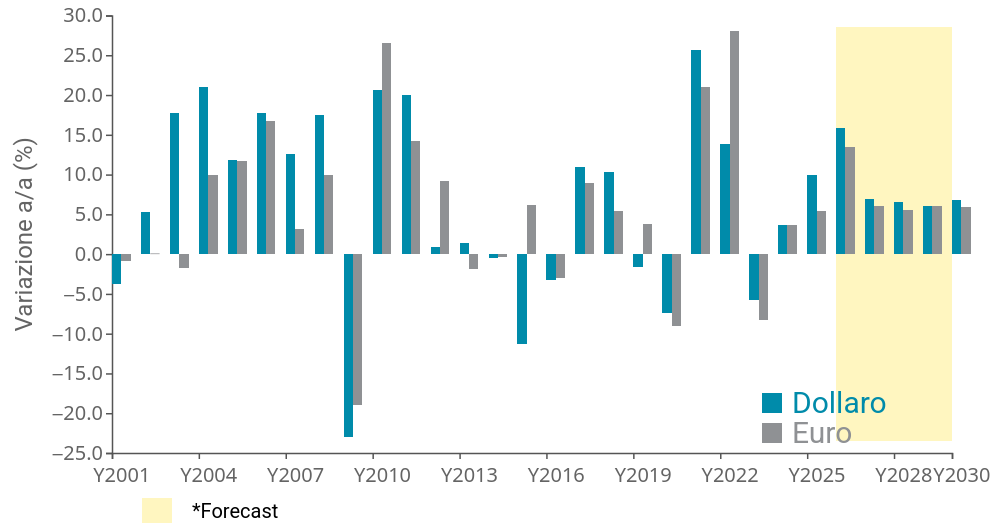
Source: ExportPlanning
Behind the strength of the aggregate figures, however, lie highly differentiated sectoral and geographical dynamics, with nominal international trade growth proceeding at different speeds across sectors and the more than 150 economies monitored by ExportPlanning.
At the geographical level, preliminary estimates for 2026 indicate particularly strong trade growth in Asia (+22.1%), well above the global average (+13.5%). Growth is more moderate, although still significant, in non-EU Europe (+12.1%) and Latin America (+11%), while the European Union (+8.1%) and North America (+7.8%) show relatively slower rates of expansion. The MENA region (-4.7%) stands out as the only major geographical area considered to record a contraction.
Perhaps the most noteworthy feature of the new forecasting scenario is the persistence of nominal trade growth above the rates recorded in the recent past. Although a relative normalization of growth is expected in 2027, partly reflecting the gradual easing of price pressures, the overall outlook remains favorable. Forecast nominal world trade growth for next year (+6%) is higher than the average annual growth rate recorded over the 2023–2025 period (+4.6%).
This pattern is also evident across several geographical areas, particularly Asia, the European Union, and Latin America, where nominal growth rates projected for 2027 remain above those recorded over the 2023–2025 period. The MENA region is also expected to return to growth (+7.2%) following the contraction projected for 2026.
Conclusions: Navigating uncertainty
The updated forecasting scenario confirms an overall favorable
outlook for international merchandise trade, while also highlighting
increasing differentiation in growth opportunities
across markets and sectors.
In an environment where nominal trade growth proceeds
at different speeds, aggregate figures provide only
a starting point for understanding where international
demand will be concentrated in the coming years.
For exporting companies, the challenge is therefore
to move beyond global trends and identify opportunities
specific to their products.
Access to sufficiently detailed and up-to-date forecasts
makes it possible to identify markets with the most
favorable prospects, compare their growth potential,
and allocate resources more selectively
across business development strategies.
This is precisely where ExportPlanning's forecasting scenarios can provide practical support: moving beyond broad geographical and sectoral aggregates, companies can analyze international demand prospects for individual product codes across each of the more than 150 markets monitored. This level of detail makes it possible to translate global trade trends into actionable information for export development decisions.
To explore international market prospects in greater detail, visit the ExportPlanning Report environment and access updated forecasts by product and market, identifying the combinations with the greatest growth potential over the next two years.
```You may be interested in:

Market Selection gets an upgrade: regional analysis and presets for smarter, more targeted market selection
Published by Luca Surace. .
Marketselection Export markets Internationalisation toolsExportPlanning expands its analytical capabilities, enabling businesses to explore commercial opportunities within major international markets. [ Read all ]

Canada: where to export packaging machinery?
Published by Mauro Badanelli. .
Marketselection Foreign markets Foreign market analysisLa Market Selection territoriale di ExportPlanning permette di individuare le province a maggiore potenzialità commerciale, combinando dimensione del mercato, dinamiche della domanda e caratteristiche [ Read all ]

HOME SYSTEM: WORLD TRADE PERFORMANCES IN Q3-2026
Published by Marcello Antonioni. .
Home items Conjuncture Uncertainty Global economic trendsWorld exports in the Home System industry accelerated in the third quarter of 2026 (+5.9% measured at constant prices), with gains spread across most segments [ Read all ]