Tannery machinery: map of Chinese demand by regions
Henan was the leading destination for Chinese imports from Italy in the first nine months of 2026. Jiangsu and Hebei also saw strong growth.
Published by Mauro Badanelli. .
Industrial equipment Conjuncture Foreign markets Foreign market analysisThe machinery industry for preparing, tanning and working hides, skins and leather1 is a highly specialised technology-intensive sector in which Italian manufacturers enjoy a well-established competitive position.
China, one of the world's leading manufacturing hubs in the leather supply chain, is a market where Italian suppliers hold a particularly strong position, accounting for over 90% of Chinese imports in the sector in the first nine months of 2026.
Recent trends in Italian exports
In recent years, Italian exports of tannery machinery have gradually declined. Following the post-pandemic recovery, which peaked between 2023 and early 2024, export flows have shown a predominantly downward trend, which intensified during 2026.
Fig. 1 – Italian exports of tannery machinery
(seasonally adjusted quarterly values at current prices)
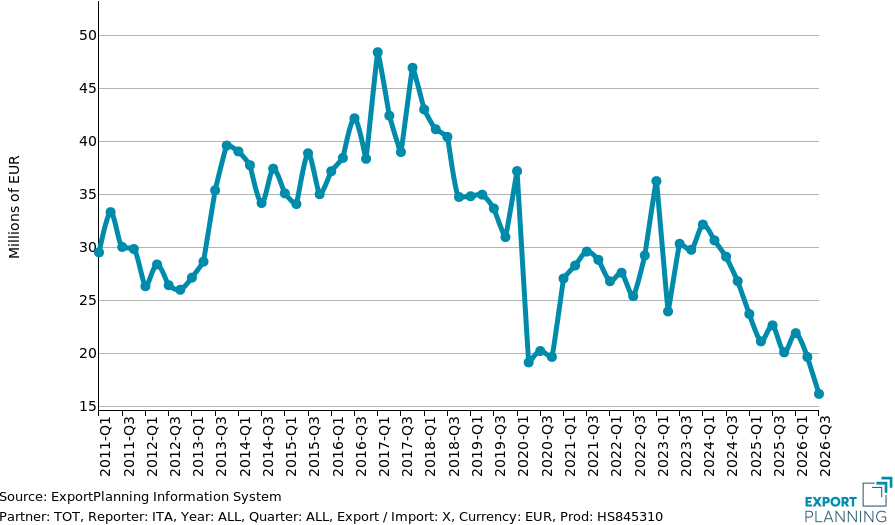
In the third quarter of 2026, Italian exports fell to approximately €16 million in seasonally adjusted terms, the lowest level over the entire period analysed.
Against this backdrop, examining the evolution of Chinese demand is particularly relevant given the strong market penetration achieved by Italian manufacturers in China.
Italian leadership in a shrinking Chinese market
In the first nine months of 2026, Chinese imports of tannery machinery amounted to €8.1 million, down 18.5% compared with the same period in 2025.
Fig. 2 – Chinese imports of tannery machinery from the world
(seasonally adjusted quarterly values at current prices)
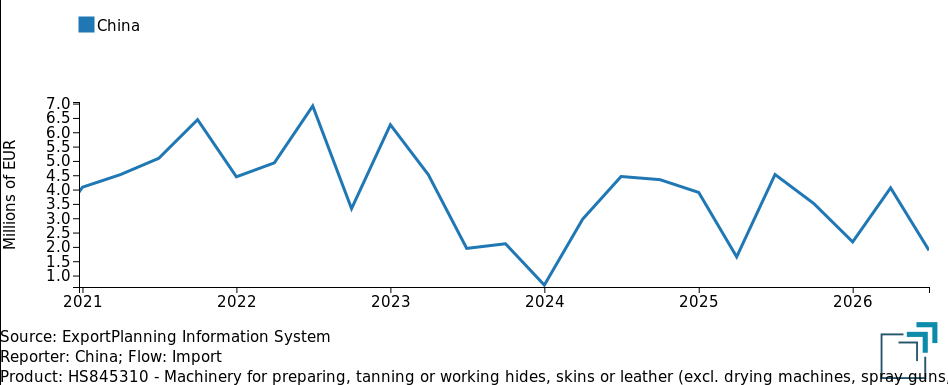
Chinese imports show considerable quarterly volatility, with purchasing levels generally below the peaks recorded between 2021 and 2023.
In the first nine months of 2026, imports of Italian-origin machinery amounted to €7.3 million, down 20% compared with the same period in 2025.
Despite the decline, Italian manufacturers have largely maintained their competitive position, with their share of Chinese imports edging down from 91.8% in the first nine months of 2025 to 90.1% in the corresponding period of 2026.
Would you like to receive a selection of the week’s most relevant international trade news? Subscribe to the World Business Newsletter for free!
Which Chinese regions account for the largest imports of Italian tannery machinery?
Chinese import declarations, recently made available in ExportPlanning with subnational detail, provide insights into the geographical distribution of purchases from abroad, distinguishing between provinces, autonomous regions and municipalities directly administered by the central government.
In the case of tannery machinery, this perspective makes it possible not only to identify the main destinations for Italian supplies, but also to assess their competitive position within individual provincial markets.
Fig. 3 – Chinese imports of tannery machinery from Italy: main destination regions
(January–September 2026)
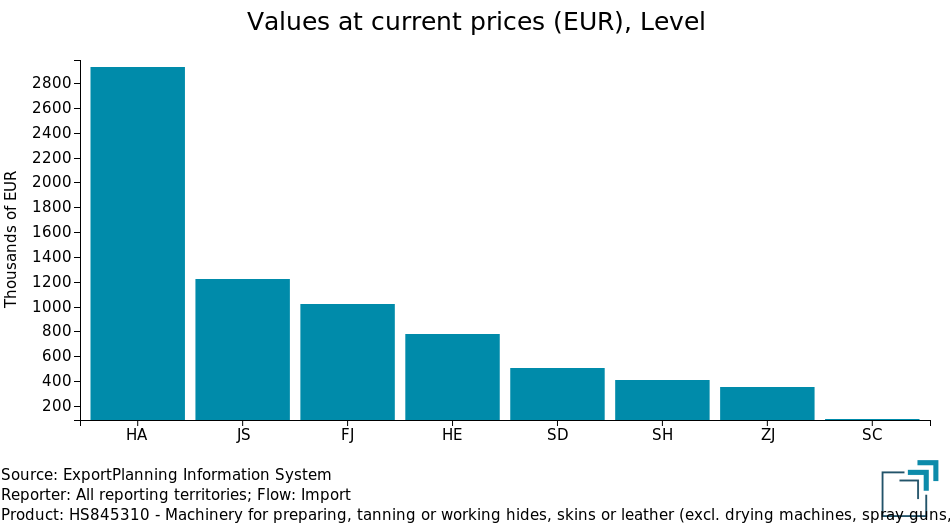
Henan accounts for 40% of Chinese imports from Italy
The regional distribution of Chinese imports of Italian tannery machinery reveals a high degree of geographical concentration.
Henan is the leading destination, with imports worth €2.9 million in the first nine months of 2026, accounting for 40% of China's total purchases from Italy.
Growth compared with the same period in 2025 is particularly noteworthy: imports from Italy increased by 59.8%, compared with a 45.1% increase in the province's total imports.
Italy's share of Henan's imports thus rose from 90.8% to 100%, highlighting how Italian manufacturers have fully benefited from the expansion of import demand in this province.
The expansion in Henan's machinery purchases appears consistent with developments across the province's tanning supply chain: in the first nine months of 2026, imports of raw hides and skins increased by 33.7%, while exports of processed hides and skins rose by 18.4%. This growth in activity lends further support to the interpretation that the province is experiencing a cycle of investment in production capacity.
Strong growth in Jiangsu and Hebei
Alongside Henan, two other Chinese provinces stand out for their particularly positive import trends.
Jiangsu is the second-largest destination market for Italian supplies, with imports worth over €1.2 million in the first nine months of 2026, compared with approximately €53,000 in the same period of 2025.
Hebei, a long-established tanning hub in northern China, also recorded significant growth, with imports from Italy reaching €780,000, compared with €203,000 in the corresponding period of 2025 (+284.4%).
While all imports in the sector originate from Italy in Hebei, Italy's share in Jiangsu stands at 89.3%.
These results are particularly noteworthy when compared with the overall contraction in Chinese imports. However, given the nature of the goods traded and the relatively small size of trade flows, exceptionally high growth rates may also reflect the fulfilment of individual orders.
Other major destination regions
Other leading Chinese destinations for Italian tannery machinery include Fujian, a major manufacturing hub in the footwear supply chain, with imports worth over €1 million in the first nine months of 2026 (-30.6%).
Shandong (-81.5%) and Zhejiang (-68%) recorded particularly sharp declines, although Italy continues to hold market shares close to or equal to 100% in both provinces.
These trends suggest that, in some regions, the decline in Italian supplies is primarily attributable to weaker import demand rather than a loss of competitiveness vis-à-vis other international suppliers.
Italy's competitive position across Chinese regions
Italy's high share of the overall Chinese market masks some significant regional differences, as shown in the following table.
Tab. 1 – Chinese imports of tannery machinery: Italy's market position by region
(January–September 2026)
| Region | Imports from Italy 2026 (€ thousands) | % change 2026/2025 | Italy's share 2026 |
|---|---|---|---|
| Henan | 2 921 | +59.8% | 100.0% |
| Jiangsu | 1 227 | > 1000% | 89.3% |
| Fujian | 1 015 | -30.6% | 86.2% |
| Hebei | 780 | +284.4% | 100.0% |
| Shandong | 501 | -81.5% | 95.1% |
| Shanghai | 412 | -35.6% | 61.8% |
| Zhejiang | 352 | -68.0% | 100.0% |
| Sichuan | 95 | – | 100.0% |
| Guangdong | 0 | -100.0% | 0.0% |
| China total | 7 304 | -20.0% | 90.1% |
Source: ExportPlanning
Shanghai is a particularly interesting case, with Italy accounting for 61.8% of imports, significantly below the national average.
Guangdong also presents a distinctive situation: in the first nine months of 2026, no imports of Italian origin were recorded, while purchases from other countries exceeded €200,000. In the same period of 2025, Italy accounted for over 83% of provincial imports.
Although the values involved are relatively small, monitoring these regions may help identify potential shifts in sourcing preferences and competitive conditions within individual markets.
Conclusions
The analysis of Chinese imports of Italian tannery machinery highlights how trade trends can vary significantly across regions, even in a market where Italy holds a high national market share.
Three practical implications emerge for Italian manufacturers in the sector:
Strengthen their presence in the main growth regions: Henan, Jiangsu and Hebei together account for over two-thirds of Chinese imports from Italy and are growing in contrast to the national market trend.
Monitor changes in competitive positioning: regions such as Shanghai and Guangdong show a stronger presence of competing suppliers than the Chinese average.
Distinguish market trends from competitive developments: comparing total regional imports with imports from Italy makes it possible to assess whether changes in Italian supplies are attributable to developments in local demand or to shifts in market shares.
From this perspective, the subnational data available in ExportPlanning provide a market intelligence tool not only for identifying the fastest-growing regions, but also for monitoring the competitive position of exporting companies within them.
ExportPlanning is a market intelligence system designed to support companies, consultants and business support organisations in analysing international markets, providing data, reports and tools to identify foreign markets with the greatest potential and monitor developments in existing markets on a month-by-month basis.
Find out more
1. The analysis refers to customs code HS845310 - Machinery for preparing, tanning or working hides, skins or leather (excl. drying machines, spray guns, machines for the dehairing of pigs, sewing machines and general purpose presses).
You may be interested in:

Home Textiles: Global Trade Set to Recover from 2027
Published by Mauro Badanelli. .
Forecast Export Foreign markets Foreign market analysisDopo un 2026 di sostanziale stabilità, il commercio mondiale di tessile casa torna a crescere nel biennio 2027-2028, sostenuto anche dai mercati emergenti. [ Read all ]

Exports 2027–2030: ExportPlanning Forecast Scenario Updated
Published by Marzia Moccia. .
Total goods Forecast Export markets Foreign markets Uncertainty Foreign market analysisWhich markets are experiencing accelerating international demand? Which markets and sectors offer the most significant opportunities? For exporting companies, identifying these changes}... [ Read all ]

Canada: where to export packaging machinery?
Published by Mauro Badanelli. .
Marketselection Foreign markets Foreign market analysisLa Market Selection territoriale di ExportPlanning permette di individuare le province a maggiore potenzialità commerciale, combinando dimensione del mercato, dinamiche della domanda e caratteristiche [ Read all ]