Tariffs Over Time: Tracking the U.S. Market Month by Month
The Italian Pasta Case Study: Quantities, Prices, and Market Shares
Published by Marzia Moccia. .
Food&Beverage United States of America Monthly Market Data International marketingIn September 2025, the US Department of Commerce announced a preliminary additional antidumping duty of 91.74% on certain Italian pasta producers. Combined with the across-the-board tariffs then applied to European goods, the measure raised serious concerns for one of Italy's most iconic export products.
The decision came as part of the Department of Commerce's periodic administrative review of US imports of Italian pasta. The two companies selected as mandatory respondents, La Molisana and Garofalo, were investigated over alleged dumping practices, involving sales in the US market at prices considered below normal value.
The preliminary rate of 91.74% was also extended to eleven other Italian producers covered by the review.
In the following months, however, the situation changed dramatically. Following an initial revision of the rates in late 2025, the Department of Commerce published its final results on March 12, 2026, setting the antidumping margin at 2.65% for La Molisana, 7% for Garofalo, and 5.21% for the other eleven companies concerned.
The exceptionally high tariff initially proposed therefore did not materialize at the announced level.
Several months later, US import data provide an important additional perspective: what actually happened to US demand for Italian pasta during this period of considerable trade uncertainty.
The US Durum Wheat Pasta Market
The United States is one of the most important export markets for Italian pasta and its largest destination outside the European Union.
In 2024, Italian exports of durum wheat pasta to the United States approached €500 million. Even more significant is Italy's market position: more than half of US durum wheat pasta imports originate from Italy.
This leadership reflects not only export volumes but also the distinctive positioning of Italian pasta compared with products supplied by competing countries.
It was precisely this characteristic that led us, following the announcement of the new tariffs, to question the extent to which US demand would actually shift away from Italian pasta towards products originating from other countries (see our previous article US Tariffs on Italian Pasta: Risks and Resilience).
What do the 2026 data reveal?
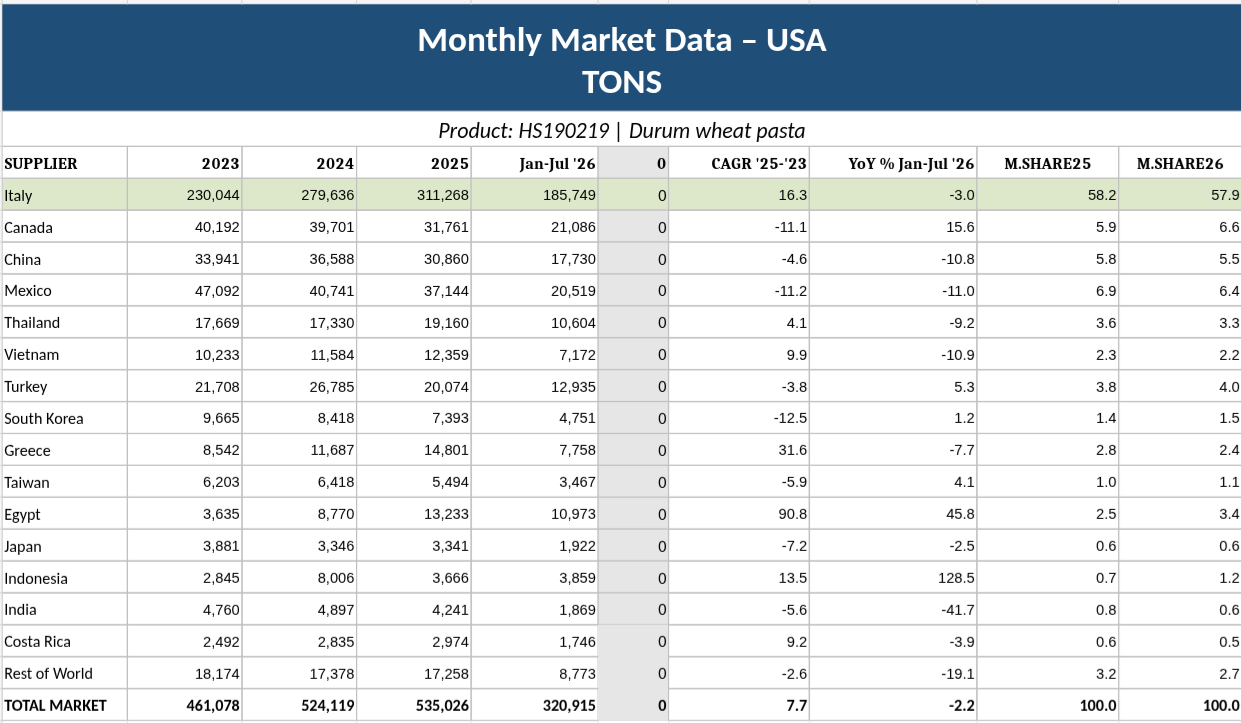
Source: ExportPlanning Monthly Market Data Service — US Imports
The first key finding is the decline in US imports of Italian pasta during the first seven months of 2026, following the strong expansion recorded over the previous three years.
In recent years, Italian pasta had experienced particularly strong growth in the US market. Import volumes increased from approximately 230,000 tonnes in 2023 to nearly 280,000 tonnes in 2024, reaching more than 311,000 tonnes in 2025. Between 2023 and 2025, volumes imported from Italy therefore grew at an average annual rate exceeding 16%, further strengthening Italy's position as the leading supplier to the US market.
During the first seven months of 2026, however, the United States imported approximately 151,000 tonnes of pasta from Italy, representing a 21.0% decline compared with the same period of the previous year. This decrease, slightly more pronounced than the 18.6% contraction recorded for the overall market, also reflects an inventory effect, associated with the high purchasing volumes and front-loading that characterized the preceding period.
Italy's market share also declined slightly, without substantially affecting its leadership. In 2025, Italy accounted for 58.2% of US pasta imports by volume. During the first seven months of 2026, its share stood at 56.7%, down 1.5 percentage points.
Against a backdrop of declining US imports and several months of considerable trade policy uncertainty, Italy's position in the US market therefore remains clearly dominant.
No Significant Substitution Away from Italian Pasta
Developments among competing supplier countries provide further important insights.
The decline in imports was not limited to Italy. During the first seven months of 2026, import volumes from China (-24.2%), Mexico (-21.3%), Thailand (-24.4%), Vietnam (-25.0%), and Greece (-24.1%) also fell significantly. India recorded an even sharper contraction (-49.0%), while Canada (-2.3%) and Turkey (-12.1%) experienced relatively smaller declines.
Despite the contraction in volumes and the slight decline in Italy's market share, there is no evidence of significant substitution of Italian pasta with products from other countries. Italy continues to hold a commanding position in the US market, accounting for 56.7% of total import volumes during the first seven months of 2026. This share remains far above those of its main competitors: Mexico (6.8%), Canada (6.7%), and China (5.6%).
An additional important insight emerges from the analysis of average unit values
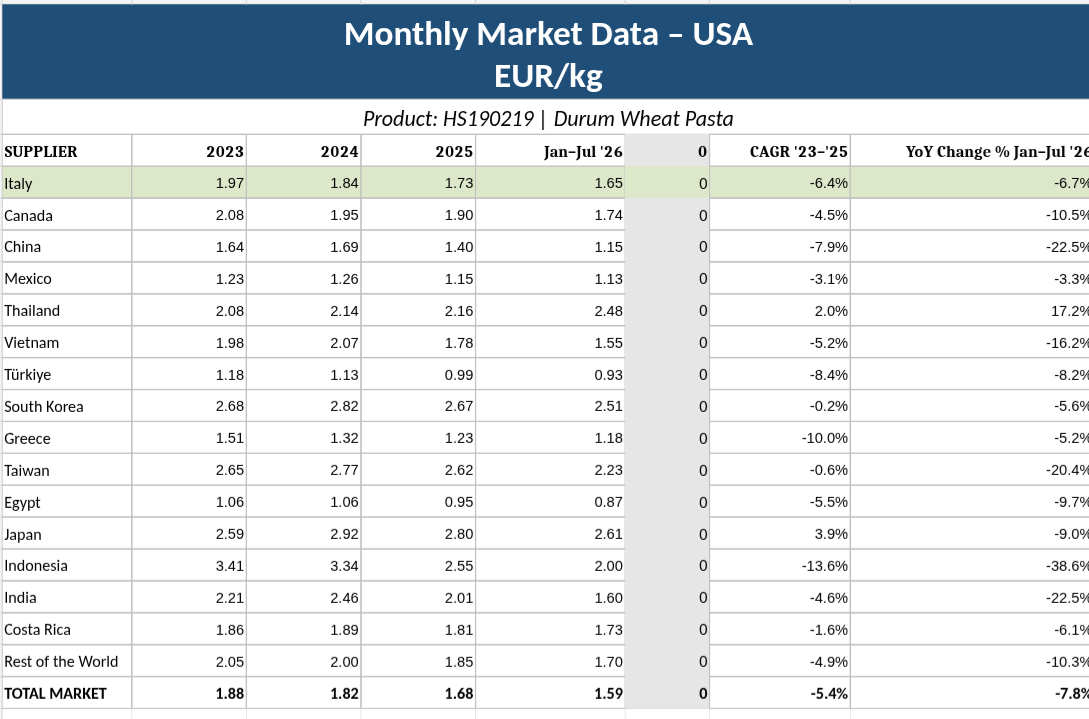
Source: ExportPlanning Monthly Market Data Service — US Imports
The analysis of average unit values provides a more complete picture. During the first seven months of 2026, the average unit value of US imports of Italian pasta stood at €1.65/kg, down 6.8% compared with the same period of the previous year. However, this change must also be interpreted in light of exchange rate movements. The appreciation of the euro against the US dollar, compared with levels observed during much of the corresponding period in 2025, contributed to lowering US import unit values when converted from dollars into euros.
The decline expressed in €/kg therefore cannot be interpreted entirely as a reduction in prices charged in the US market. The presence of an exchange rate component is also suggested by the fact that the decline affected most supplier countries. The average unit value for the overall market fell by 7.9%, compared with a 6.8% decrease for Italy. Among the leading suppliers, unit values also declined for Canada (-10.1%), China (-22.9%), Vietnam (-16.5%), and Turkey (-8.3%), while Thailand was one of the main exceptions, recording an increase of 16.2%.
What the Market Data Reveal
The US case provides a concrete illustration of the value of monthly international trade monitoring that goes beyond tracking Italian exports alone and allows their performance to be systematically compared with that of competing supplier countries. This competitive perspective is essential to determine whether a change in export sales reflects difficulties specific to Italian products or broader developments in the destination market.
In the case of pasta exports to the United States, this comparative approach provides a clearer understanding of the contraction recorded by Italy. During the first seven months of 2026, import volumes from Italy declined by 21.0%, compared with an overall market contraction of 18.6%. However, Italy's decline did not result in a widespread shift in demand towards its main competitors: numerous other supplier countries also recorded lower export volumes to the United States.
Italy's market share decreased moderately, from 58.2% in 2025 to 56.7% during the first seven months of 2026, but remained substantially higher than that of any other supplier country. At least at this stage, the data therefore show no significant substitution effect benefiting Italy's main foreign competitors.
Monthly monitoring thus makes it possible to move beyond simply measuring export growth or decline: it provides a simultaneous view of developments in the destination market and the performance of competing suppliers. This makes it possible to identify which countries are gaining or losing market share and to distinguish the effects of a general market contraction from those of an actual shift in competitive dynamics.
Conclusions
Several months after the most critical phase of the trade dispute, the data reveal a more nuanced picture than the decline in Italian exports alone might suggest. Import volumes have fallen, partly reflecting the inventory effect and front-loading that characterized the preceding period. However, comparison with other suppliers shows that the contraction is affecting the broader US market and, so far, has not resulted in a significant shift in demand towards Italy's main competitors.
This is precisely where the availability of monthly trade data provides added value. Monitoring enables companies not only to understand how their destination markets are evolving, but above all to compare their export performance promptly with that of other countries supplying the same product. A decline in sales has very different implications depending on whether it is accompanied by a loss of market share to competitors or occurs within a broader market contraction.
Joint analysis of import volumes, average unit values, and market shares also helps distinguish between different developments: weakening demand, changes in unit values — which must also be assessed in light of exchange rate movements — or an actual shift in purchases towards alternative suppliers.
The US pasta market provides a concrete example of this approach. Monitoring made it possible to assess not only how much imports from Italy had declined, but also what happened to competing exporters over the same period. This comparison provides a more comprehensive assessment of Italy's competitive position and highlights how, during the first seven months of 2026, declining import volumes did not translate into a substantial advantage for its main competitors.
At a time when market access conditions and competitive dynamics can change rapidly, timely access to trade data becomes an essential tool for analysis and decision-making. It allows companies to identify changes as they emerge, understand their underlying drivers, and obtain more timely insights to guide their international market strategies.
You may be interested in:

Machinery: International Sales Results to July 2026
Published by Marcello Antonioni. .
Industrial equipment Conjuncture Monthly Market Data Global economic trendsIn July Machinery exports by EU companies remained in positive territory, but with significant differences across sectors [ Read all ]

World Trade Trends: International Trade Results in Q2 2026 (Preliminary Estimates)
Published by Marcello Antonioni. .
Home items Fashion Food&Beverage Metal industry Intermediate goods Electronics Chemicals Industrial equipment Conjuncture Automotive Global demand Industries Global economic trendsStrengthening dynamics, driven by AI applications, and the green and digital transitions [ Read all ]

IMF WEO Update July 2026: a (precarious) balance between war and technology
Published by Alba Di Rosa. .
Macroeconomic analysis Asia Emerging markets United States of America Uncertainty IMF Eurozone Global economic trendsPer il 2026 il Fondo ha rivisto lievemente al ribasso le stime di crescita del PIL mondiale, ora previsto al +3% [ Read all ]