How to identify foreign markets with the greatest potential using Market Selection: the case of boneless hams
Published by Mauro Badanelli. .
Marketselection International marketingIdentifying the foreign markets on which to focus commercial resources is a crucial step in the internationalisation process. The choice cannot be based exclusively on the current size of demand or on how well known a market is.
A country may have high import levels, but limited growth prospects; another may be highly dynamic, but difficult to access or characterised by an unfavourable operating environment.
The Market Selection service developed by ExportPlanning is designed precisely to support this decision-making phase by organising a broad set of information in a structured way and enabling markets to be compared across multiple dimensions.
The objective is not simply to identify the countries that import the most, but to build a ranking of the potentially most attractive markets based on the best balance between commercial opportunities, accessibility and reliability.
A data-driven selection process
The logic behind Market Selection can be summarised in three main steps.
The first consists in building a sufficiently broad information set to reduce the knowledge gap that typically characterises entry into a new market. The second involves comparing the indicators collected. The third consists in assigning different weights to these indicators according to the company's characteristics and strategic objectives.
Market Selection therefore makes it possible to move from the simple observation of individual statistics to a genuine market ranking process.
The available indicators can first be divided into product-specific and country-specific indicators. The former describe demand characteristics and the competitive structure relating to the specific product analysed, while the latter measure general characteristics of the country, regardless of the individual product category.
This distinction is important because it allows two different levels of information to be combined. On the one hand, it is possible to assess, for example, how much of a given product a country imports, how rapidly demand is growing or which price segment prevails. On the other hand, factors such as country risk, distance, purchasing power or general market access conditions can also be taken into account.
Opportunity, Accessibility and Reliability
To make the results easier to interpret, the indicators are grouped into three main dimensions: Opportunity, Accessibility and Reliability.
The Opportunity component measures the market's commercial potential. It may include import value, per capita imports, growth forecasts, the market's ability to absorb products in higher price segments and the competitive position already achieved by Italian exporters.
The Accessibility component considers the factors that can make operating in a given country easier or more difficult: tariffs, geographical distance and business distance, logistical constraints and, more generally, the complexity of market access.
Finally, Reliability concerns the quality of the country's economic and operating environment and makes it possible to incorporate risk factors into the ranking. The indicators available include, for example, Business Climate and country risk assessments.
These three dimensions are subsequently combined into an overall potential index, which makes it possible to rank countries and build an initial list of target markets.
A ranking that can change depending on the company
A key feature of the service is the possibility of assigning different weights to the indicators.
There is, in fact, no single combination that is suitable for every company. An exporter already present in the main mature markets may give greater weight to forward-looking indicators and the search for new growth areas. A company with limited commercial resources may instead place greater emphasis on accessibility and reliability. A premium producer may attach more importance to the presence of demand in the high and upper-middle price segments.
For this reason, the resulting ranking should be interpreted as a screening and comparison tool, designed to support rather than replace the decision-making process. Its value lies in combining different indicators within a framework that reflects the company's positioning and strategic priorities.
From a snapshot of the market to its stage of development
Within this framework, the Stage of Import Development indicator is of particular interest.
Its purpose is to answer a different question from that addressed by traditional indicators. Not only: how much does a given market import today?, but also: at what stage is the development of its imports?
The indicator, available within Market Selection for more than 3,000 products in the ExportPlanning classification, assesses the stage of development of imports for a specific product in each country.
From a methodological perspective, the indicator is based on the product life-cycle model and uses cluster analysis techniques applied to international trade data. Markets are mainly classified into three stages: Latency, Growth and Saturation.
The Growth stage is the most relevant from a Market Selection perspective. These are markets in which imports still account for a relatively limited share compared with the size of the country's economy, but are increasing at a rapid pace. For this reason, the indicator assigns a higher score to these markets.
This information therefore adds a dynamic dimension to the analysis: it makes it possible to identify not only the largest markets today, but also those showing signs of structural growth in demand for foreign products.
Would you like to receive a selection of the week's most relevant international trade news? Subscribe to the World Business Newsletter for free!
The case of boneless hams
A practical application of the methodology concerns the international market for boneless hams, represented in the analysis by customs code CN021019.81, which includes boneless meat of domestic swine, dried or smoked, and therefore also raw or cured boneless hams marketed whole, in pieces or sliced.
In 2025, global trade within this product scope reached approximately €2 billion. France, Germany and the United States are among the leading destination markets, while Italy holds a prominent position in international supply, with exports exceeding €1 billion.
To build the market ranking, Market Selection combines several indicators in this case. Those included in the Opportunity component include the Stage of Import Development, the share of high and upper-middle price segments, forecast import growth, import value, per capita imports, Italy's market share and the presence of a population with annual per capita income above €15,000. The Accessibility dimension includes tariffs applied to EU exporters and business distance from Italy, while Coface's Business Climate Assessment contributes to the evaluation of Reliability.
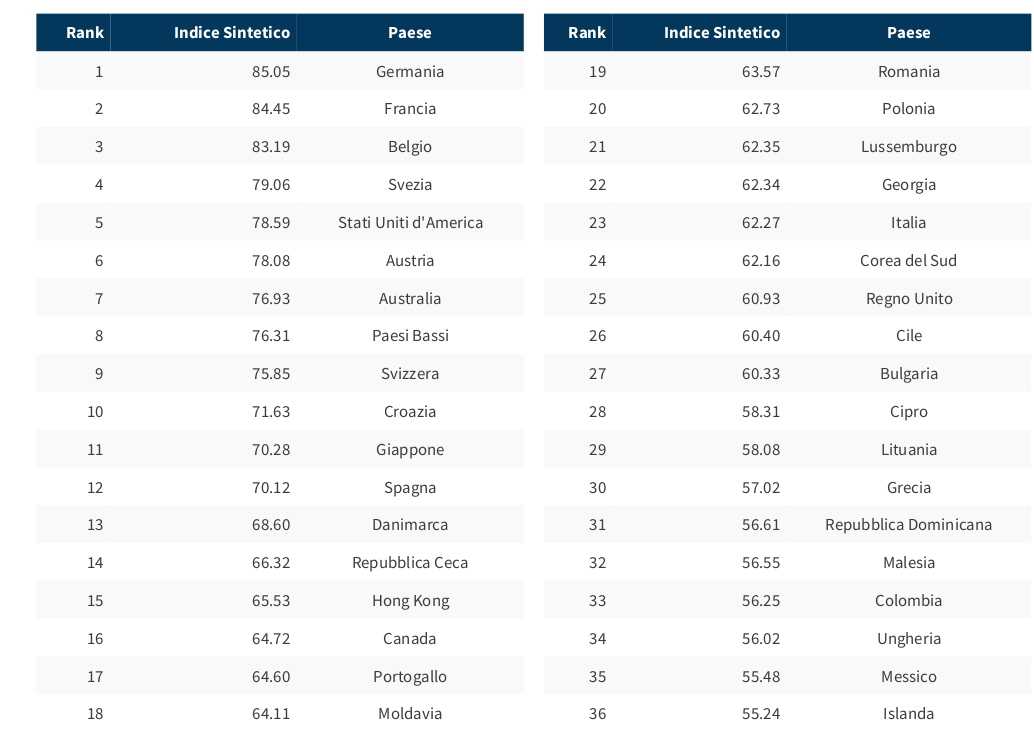
The resulting ranking places Germany, France and Belgium in the top three positions, followed by Sweden and the United States. Germany records an overall index of 85.05, France 84.45 and Belgium 83.19, while the United States ranks fifth with a score of 78.59.
Tab. 1 - Boneless hams - Market potential ranking
Source: ExportPlanning
The presence of Germany, France and Belgium at the top of the ranking does not depend solely on the size of demand.
Their geographical proximity to Italy and their membership of the European single market also contribute to their strong positioning, reducing commercial and logistical complexity. In the case of boneless hams, these markets therefore combine high demand with relatively favourable access conditions.
The highest-ranked market is therefore not necessarily the largest in absolute terms, but the one offering the most favourable balance between opportunity, accessibility and reliability according to the selected indicators and weights.
The United States: high potential, greater access complexity
The case of the United States is particularly useful for understanding the meaning of the ranking.
With an overall index of 78.59, the US market ranks fifth. Compared with the main European markets, greater geographical distance, higher logistics and distribution costs, and the need to manage specific import and marketing requirements make market access more complex. The availability of suitable importers and distributors also becomes a key factor in the market-entry strategy.
These factors reduce the overall score compared with Germany, France and Belgium, but they do not imply that the market is of lesser strategic importance.
On the contrary, analysing the individual components makes it possible to highlight several particularly favourable factors.
From ranking to strategic decision-making
The case of boneless hams shows why the Market Selection ranking should be used as the starting point for a more detailed assessment.
Germany, France and Belgium combine strong demand potential with relatively favourable access conditions. The United States, despite ranking lower, remains strategically relevant thanks to its market size, demand dynamics, ability to absorb premium products and strong Italian presence.
The ranking therefore helps identify the most attractive markets, while the individual indicators explain the factors behind each country's position and make it possible to adapt the analysis to different commercial strategies.
Indicators such as the Stage of Import Development are especially useful in this second step. A company seeking to diversify its destination markets may assign greater weight to countries in the Growth stage, while a producer focused on premium positioning may prioritise markets with a higher share of high and upper-middle price segments.
Conclusions
Foreign market selection cannot be reduced to simply identifying the largest importers of a product.
An internationalisation strategy requires the simultaneous consideration of the size and outlook of demand, the stage of import development, price positioning, Italy's competitive presence, market accessibility and market reliability.
Market Selection makes it possible to organise this information into a customisable ranking, transforming a wide range of indicators into a tool that supports the definition of commercial priorities.
The integration of the Stage of Import Development further strengthens this approach: alongside a snapshot of the current situation, it adds an assessment of the market's stage of evolution, making it possible to identify destinations where demand for foreign products is entering a phase of structural growth.
Finally, the case of boneless hams shows that the value of Market Selection lies not only in identifying priority markets, but also in understanding the factors that make each destination attractive and using this information to guide international development strategies.
You may be interested in:

Footwear: in a context of weak global sales, the presence of markets undergoing structural growth
Published by Marcello Antonioni. .
Fashion Marketselection Export markets Uncertainty International marketing Development stage of Imports Foreign market analysisThe data for the first half of 2025 document a weak trend in global sales of Footwear; however, there are driving segments and markets to monitor [ Read all ]

Paper and Cardboard Packaging: Segments and Markets with Highest Export Potential
Published by Marcello Antonioni. .
Marketselection Intermediate goods Export markets Foreign markets Uncertainty International marketing Foreign market analysisSeveral markets in structural growth phase, spread across the main segments, support the growth of the sector [ Read all ]

Extrusion Machinery: Segments and Markets with Highest Export Potential
Published by Marcello Antonioni. .
Marketselection Metal industry Industrial equipment Export markets Foreign markets Uncertainty International marketing Foreign market analysisSeveral markets in structural growth phase, spread across the main segments, support the growth of the sector [ Read all ]