Market Selection: The Value of Territorial Data for Large Markets
Territorial Data for Export Strategies: The Furniture and Wood Products Sector
Published by Marzia Moccia. .
Foreign markets Made in Italy Foreign market analysisThis article was developed in collaboration with Enzo Aldo Stobbione, Brazil Country Specialist and founder of Business Matching Global. He operates between Italy and Brazil, with a direct presence in Belo Horizonte.
When companies embark on an international expansion strategy, one of their first challenges is identifying which foreign markets offer the strongest opportunities for business growth.
At this stage, systematically screening international markets and comparing their attractiveness based on indicators of market opportunity, accessibility, and reliability is a critical strategic step.
National international trade statistics provide an essential foundation for this process (see, for example, our in-depth article, How to Identify High-Potential Export Markets Using Market Selection: The Case of Boneless Ham).
However, once a promising target market has been identified, the analysis needs to go one step further: moving beyond country-level comparisons to explore opportunities within individual markets.
This is particularly important in large, geographically diverse economies, where demand patterns, purchasing power, industrial structures, and openness to imports can vary significantly from one region to another.
In these contexts, extending the Market Selection approach from the international to the subnational level provides a more granular perspective, enabling companies to compare different regions within a country and identify those offering the most favorable conditions for business development.
This is especially relevant for major economies such as Brazil, the United States, Canada, and China, where substantial regional differences exist in market size, industrial specialization, purchasing power, infrastructure, and import penetration.
Regional Market Selection: The Case of Brazil's Furniture and Furnishings Industry
Brazil provides a particularly compelling example of the value of a regional approach to Market Selection.
Its continental scale and significant economic disparities across states make disaggregated data particularly valuable when assessing commercial potential.
An analysis of the furniture and furnishings industry—covering HS codes 9401 (seats), 9403 (other furniture), and 9404 (mattresses and bedding articles), excluding furniture parts and aircraft and automotive seats—reveals how market opportunities can differ substantially across regions.
The objective is not simply to determine how much Brazil imports of a given product category, but rather to understand:
- Which Brazilian states account for the largest import demand.
- Which states are experiencing the most favorable market dynamics.
- Where Italian exporters have already established a meaningful competitive position.
This shift in perspective transforms a broad assessment of a country's attractiveness into a geographical mapping of business opportunities at the regional level.
In a recent article published in the magazine of the Italian Export Strategist Association, we examined the positioning of Italian furniture in the Brazilian market (Selling at Higher Prices, Not Higher Volumes).
This new analysis takes the assessment one step further, moving from the national to the regional level to identify the Brazilian states offering the greatest growth potential for Italian furniture and furnishings exports.
Methodology: Five Indicators to Assess Regional Market Potential
The analysis is based on five indicators designed to capture the key dimensions of commercial potential across Brazilian states:
- Import value in 2025, measuring the overall size of import demand.
- Average import unit value, providing an indication of market price positioning.
- Italy's import market share, reflecting the competitive position of Italian suppliers.
- Average annual import growth in euro terms between 2022 and 2025, capturing medium-term market dynamics.
- Year-on-year import growth in euro terms during the first nine months of 2026, highlighting the most recent developments in demand.
Taken together, these indicators provide a comprehensive assessment of five complementary dimensions of market attractiveness: demand size, price positioning, the competitiveness of Italian products, medium-term growth, and short-term market momentum.
To ensure comparability across indicators expressed in different units, ExportPlanning's Market Selection methodology applies a normalization process based on a logistic function.
This converts observed values into standardized scores ranging from 0 to 100, with 100 representing the highest potential.
The resulting scores are then combined through a weighted average, assigning greater importance to import value and average import unit value.
The outcome is a composite market potential index, allowing Brazilian states to be compared and ranked according to a consistent methodology.
The objective is not simply to prioritize markets with the highest import volumes, but to identify those offering the most attractive combination of demand size, competitive positioning, and growth prospects.
By doing so, Regional Market Selection can uncover opportunities that might otherwise remain hidden when market assessments rely exclusively on overall import volumes.
Ranking Brazilian States by Market Potential
The results of the analysis provide particularly interesting insights.
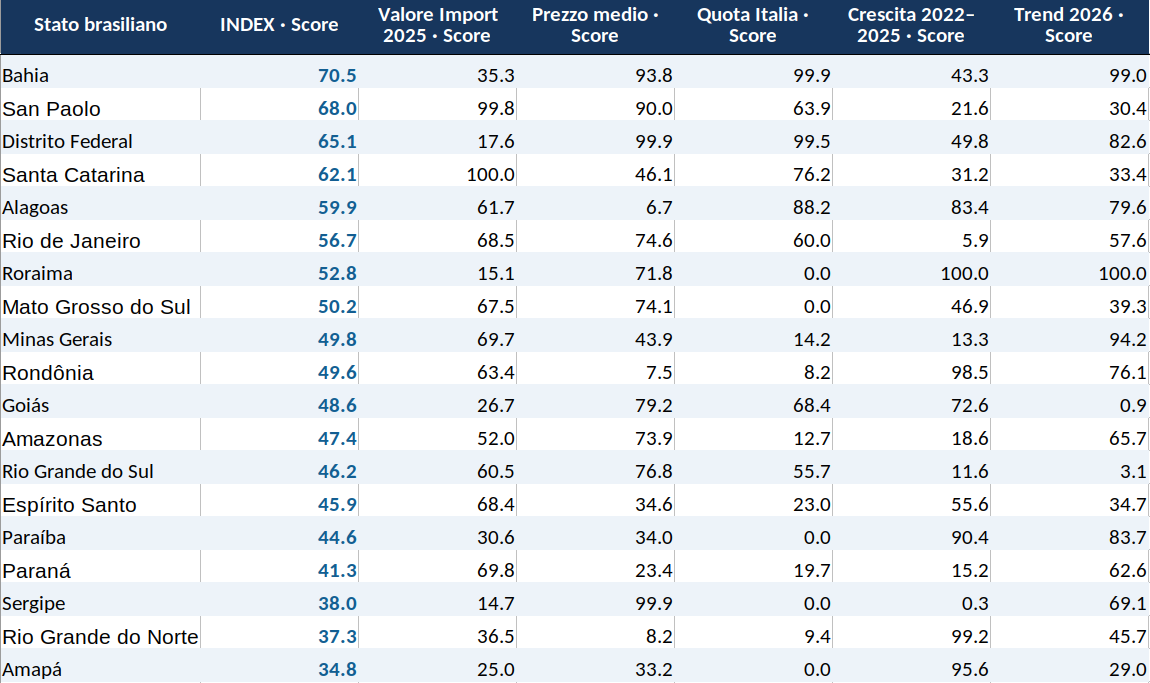
As illustrated in the scoring table below, the ranking based on the composite market potential index differs significantly from a ranking based solely on import value.
Fig. 1 – Brazil: Market Selection for the Furniture and Furnishings Industry
(Regional trade data updated to September 2026)
Source: ExportPlanning
The composite market potential ranking highlights two distinct market profiles.
The first consists of major import hubs, characterized by established demand and substantial import volumes.
The second includes smaller markets that nevertheless demonstrate particularly favorable growth dynamics, price levels, and competitive positioning for Italian suppliers.
Among smaller markets, the highest scores are recorded by Bahia (70.5), the Federal District (65.1), and Alagoas (59.9).
Although these states are not among Brazil's largest import markets in absolute terms, they display an attractive combination of the indicators considered.
Bahia, in particular, stands out for its strong scores in average import prices, Italy's market share, and recent demand growth.
These characteristics suggest promising opportunities for companies specializing in upper-mid-range and premium products.
A different profile emerges for São Paulo (68.0) and Santa Catarina (62.1), whose attractiveness is primarily driven by substantial import volumes.
Rio de Janeiro also ranks among the markets of interest identified by the analysis.
In these states, the scale of demand represents a major competitive advantage, particularly for companies seeking to generate significant sales volumes and strengthen their existing market presence.
This distinction has important strategic implications.
For volume-oriented exporters, Brazil's largest import markets may represent the most natural priorities.
For specialized companies, particularly those operating in premium and high-end segments, smaller states may offer more attractive opportunities when characterized by higher average prices, an established Italian presence, and sustained growth.
Regional Market Selection therefore enables companies to move beyond a market-size-driven approach, identifying different types of commercial opportunities that can be assessed according to each company's positioning and strategic objectives.
Naturally, quantitative rankings should be considered a first screening tool rather than a definitive market entry recommendation.
Imports attributed to a particular state do not necessarily correspond to the final location of consumption, especially where major logistics and distribution hubs are involved.
For this reason, quantitative findings must be complemented by an understanding of distribution channels and the actual geographical distribution of end-market demand.
Expert Commentary: Enzo Aldo Stobbione, Brazil Country Specialist and Founder of Business Matching Global
An analysis like this is extremely valuable, and for a very specific reason. Until recently, anyone seeking to understand where Italian furniture was being sold in Brazil had essentially one national figure to work with. Today, we have twenty-six state-level figures, calculated using a consistent methodology and therefore directly comparable. This provides an essential starting point for any serious market assessment. However, quantitative data must be interpreted and qualified by considering regional characteristics and the structure of distribution channels.I often say that Brazil is not a single market, but rather an archipelago of markets. This ranking provides quantitative evidence of precisely that. Yet interpreting it correctly requires at least two areas of expertise: an understanding of Brazilian customs procedures and a solid knowledge of the country's tax system.
Understanding What State-Level Import Data Actually Measures
The first question we need to ask is what import data attributed to an individual Brazilian state actually represents.
Brazilian trade statistics assign imports to the state where the importing company has its registered tax domicile, rather than necessarily to the state where the furniture is ultimately sold or used.
In a federal country such as Brazil, this distinction is far from trivial.
Import duties are established at the federal level.
n Italian sofa is subject to the same import duty whether it enters Brazil through Santos or Salvador, and the EU–Mercosur agreement reduces that duty in the same way throughout the country.
What the agreement does not address, however, is ICMS, the state-level tax on the circulation of goods and services, which each Brazilian state establishes and administers independently.
For years, Brazilian states have used ICMS incentives to attract importing companies to their territories, offering more favorable tax treatment to businesses that clear goods through their jurisdictions.
his has created a form of interstate tax competition.
Although Brazil's ongoing tax reform is expected to gradually reduce these distortions, they remain a significant feature of the current business environment.
Santa Catarina provides one of the clearest examples. The state alone records €171 million in furniture imports, accounting for almost half of the national total. However, some of these imported products simply pass through Santa Catarina before reaching their final destinations in São Paulo, Minas Gerais, or northeastern Brazil. Minas Gerais, which I know particularly well from my base in Belo Horizonte, offers another instructive example. Despite being landlocked, the state has several inland customs facilities, known as dry ports, located in Confins, Betim, Varginha, Juiz de Fora, Uberaba, and Uberlândia. It also offers a tax regime that allows companies clearing imported goods within the state to defer ICMS payments. Minas Gerais ranks ninth in the Market Selection analysis, records import values comparable to Paraná, and experienced 118% import growth during the first nine months of 2026. t the same time, Italy accounts for less than 1% of its imports.
But how much of that growth reflects actual demand from consumers and businesses in Minas Gerais, and how much is explained by the geographical location of importing companies? The data alone cannot answer this question.Yet the distinction is critical for an Italian exporter deciding whether to appoint a distributor in Belo Horizonte. The Federal District presents almost the opposite situation. Based on the checks carried out, there is no specific tax regime designed to attract importers. It has no seaport and no significant furniture manufacturing industry. As a result, its imports are more closely associated with local consumption. Moreover, it records the highest average import prices in the country. In other words, it represents a small but distinctly premium market.
The second key consideration is market size. The index assigns greater weight to import value, while also taking into account average import prices and growth dynamics. However, when the underlying market is small, percentage growth rates can be particularly pronounced. Bahia ranks first despite recording just €1.4 million in imports. At this level, a sharp increase during the first nine months of 2026, or an Italian market share of 24%, could potentially be driven by a single large project, such as a resort or a residential development furnished through a one-off contract. This is not a limitation of the methodology: rather, it highlights where significant market developments have occurred. For companies targeting substantial sales volumes, the traditional priorities remain São Paulo and Santa Catarina. For high-end manufacturers, however, the ranking of smaller markets can reveal specific niche opportunities.
My conclusion is straightforward. Regional trade data is indispensable: without it, companies risk making strategic decisions based on assumptions or anecdotal evidence. ExportPlanning's Market Selection provides a solid and systematic information base, enabling businesses to move beyond national-level statistics, compare individual territories, and identify commercial opportunities that would otherwise be difficult to detect. Moreover, even when the geographical distribution of imports does not correspond exactly to final consumption, it remains a valuable indicator of a country's logistics organization and distribution structure.
However, interpreting regional data requires an additional layer of expertise. Companies need to understand how much of what a state imports is actually consumed within its territory, and which tax regimes and distribution dynamics may explain changes in trade flows. This is where the added value of professionals with hands-on knowledge of Brazilian customs procedures and taxation becomes essential. Their direct experience, state by state, allows them to interpret, contextualize, and qualify statistical evidence. Regional Market Selection helps identify where further investigation is worthwhile and which questions companies should be asking. And in Brazil, the next question is almost always also a tax-related one. This represents an important competitive advantage: companies entering the market with only national-level data may discover these complexities only after signing an agreement with a distributor in the wrong state.
The value of Regional Market Selection lies in its ability to transform trade data into a geographical map of business opportunities, revealing regional differences and market potential that national statistics alone cannot capture.
It is the combination of data-driven market intelligence and first-hand local market expertise that turns this opportunity map into a practical decision-making tool for internationally active companies.
You may be interested in:

Italian Metalworking Machine Tools: Map of Chinese territories
Published by Mauro Badanelli. .
Industrial equipment Conjuncture Foreign markets Foreign market analysisJiangsu was the leading destination for Chinese imports from Italy in the first nine months of 2026. Zhejiang and Shanghai saw strong growth in the same period [ Read all ]

World Trade September 2026: Growth at Different Speeds
Published by Marzia Moccia. .
Conjuncture Global demand Foreign markets Uncertainty Global economic trendsIl commercio internazionale conferma una crescita sostenuta anche nel terzo trimestre, ma permangono le divergenze settoriali [ Read all ]

Woodworking machinery: Italian exports grow
Published by Mauro Badanelli. .
Internationalisation Industrial equipment Foreign markets Monthly Market Data International marketingNei primi sette mesi del 2026 le esportazioni italiane mostrano un incremento sul 2025, mentre le vendite all'estero dei principali concorrenti calano [ Read all ]