Italian Metalworking Machine Tools: Map of Chinese territories
Jiangsu was the leading destination for Chinese imports from Italy in the first nine months of 2026. Zhejiang and Shanghai saw strong growth in the same period
Published by Mauro Badanelli. .
Industrial equipment Conjuncture Foreign markets Foreign market analysisIn 2025, global trade in metalworking machine tools1 reached €38.7 billion. China ranked as the world’s leading exporter, with €6.9 billion in exports, ahead of Japan and Germany. It was also the world’s second-largest importer, after the United States, with imports totalling €5 billion.
Italy, the world’s fourth-largest exporter in the sector, with €2.3 billion in exports, was also China’s fourth-largest supplier. Chinese imports from Italy amounted to €102 million in 2025, accounting for approximately 2% of China’s total imports in the sector.
China's role among destinations for Italian exports
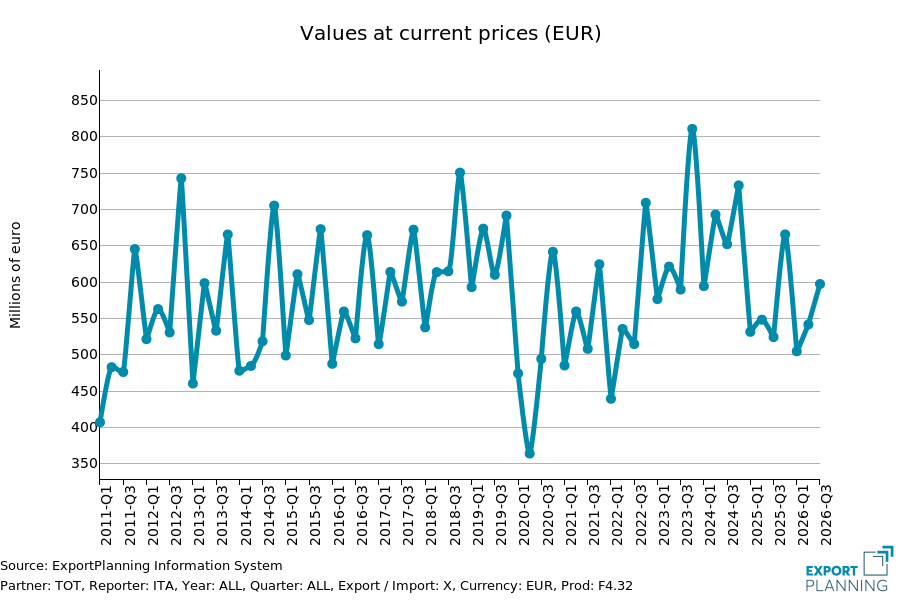
In the first nine months of 2026, Italian exports of metalworking machine tools totalled €1,644.1 million, up 2.5% compared with the same period in 2025. This points to a moderate recovery amid significant quarterly volatility.
Fig. 1 – Italian exports of metalworking machine tools
(quarterly values)
China ranks as the eighth-largest destination market for Italian metalworking machine tool manufacturers. In the first nine months of 2026, Italian exports to China totalled €53 million, down 15% year on year. This decline contrasts with the overall growth in Italian exports, while Italy’s relatively small share of the Chinese market, despite its considerable size, makes a closer look at regional demand particularly worthwhile.
Which Chinese territories account for Italian machine tool imports?
Chinese import declarations for Italian-origin machine tools, recently made available in ExportPlanning, make it possible to analyse imports at a territorial level, covering provinces, autonomous regions and municipalities directly administered by the central government.
This perspective complements the information available from Italian export statistics by providing greater insight into the geographical distribution of imports within the Chinese market.
In the first nine months of 2026, Chinese imports of Italian-origin metalworking machine tools reached a total value of €81.8 million, down 7.3% from €88.3 million in the same period of 20252.
Fig. 2 – Chinese imports of metalworking machine tools from Italy
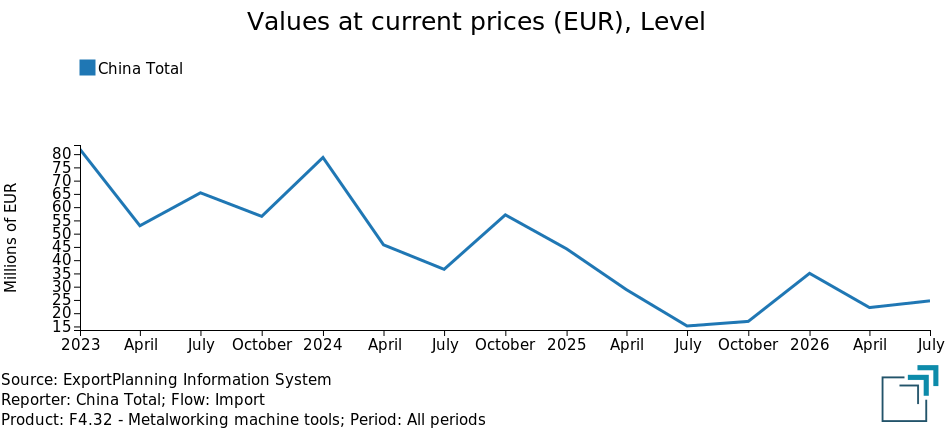
The trend shows that the contraction in Chinese imports from Italy is part of a broader downsizing already visible compared with the levels recorded in 2023 and early 2024. The decline in 2026 is therefore not an isolated phenomenon, but rather forms part of a multi-year trend characterised by a significant reduction in trade flows compared with previous peaks.
Fig. 3 – Chinese imports of metalworking machine tools from Italy: main destination territories
(January–September 2026)
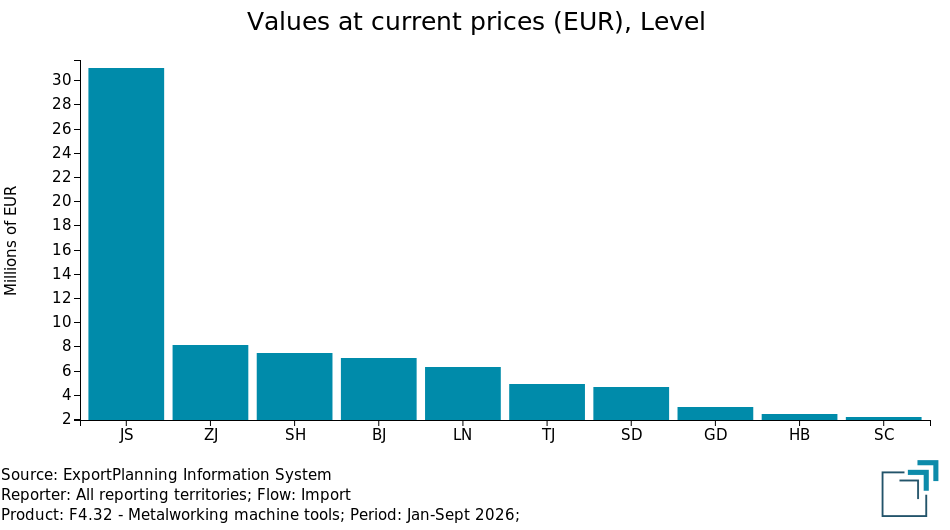
Jiangsu accounts for more than one-third of Chinese imports from Italy
The geographical distribution of Chinese imports of Italian machine tools reveals a strong degree of concentration.
Jiangsu remains the main destination territory, with €31.1 million in the first nine months of 2026, accounting for more than 38% of total Chinese imports from Italy. Compared with €36.6 million in the same period of 2025, Jiangsu recorded a 15.2% decline, while nevertheless maintaining a significant lead over other Chinese territories.
The importance of Jiangsu is consistent with its role as a major manufacturing hub, characterised by a significant presence of industrial activities and mechanical production. The concentration of Italian imports in this territory confirms its commercial importance for Italian machine tool manufacturers.
Zhejiang and Shanghai record strong growth
Behind Jiangsu, particularly positive dynamics are emerging in two other major territories in the Yangtze River Delta.
Zhejiang recorded imports of Italian machine tools worth €8.1 million in the first nine months of 2026, compared with €2.2 million in the same period of 2025, an increase of 267.5%.
Shanghai also recorded particularly strong growth, reaching €7.4 million, compared with €2.7 million in the first nine months of 2025, an increase of 177.5%.
These results are particularly noteworthy when compared with the contraction in imports recorded by Jiangsu and, more generally, by the Chinese market as a whole. The growth in Zhejiang and Shanghai shows that, even in the presence of a decline in aggregate demand, some territories can record a significant increase in purchases from abroad.
It should nevertheless be borne in mind that international trade in machine tools can be characterised by high-value and relatively infrequent transactions. Consequently, particularly large percentage changes may also reflect the execution of individual orders. Monitoring developments in subsequent quarters is therefore necessary to assess whether these increases represent a structural strengthening of demand.
Although these trade flows are still relatively limited, the results suggest that developments in imports should also be monitored beyond China's main industrial hubs in the east.
The particularly large changes should nevertheless be interpreted with caution, given the initial size of the trade flows and the potential impact of individual shipments.
Other major destination areas
Other major Chinese territories for imports of Italian machine tools in the first nine months of 2026 include Beijing, with €7 million (+21.8%), Liaoning with €6.3 million, Tianjin with €5 million and Shandong with €4.6 million (+26.4%).
They are followed by Guangdong, with €3 million (+3.3%), and Hubei, with €2.4 million, which recorded particularly strong growth (+738.8%) compared with the same period of 2025.
Outside the main destination markets, some positive developments can also be observed in territories in central and western China. Sichuan reached €2.1 million (+50.7%), while Ningxia recorded a similar value, with growth of 628.6%.
Chongqing, with €1.8 million (+377.4%), and Henan, with €0.5 million (+135.2%), also recorded significant increases.
Conclusions
The analysis of Chinese imports of Italian machine tools shows how overall market trends can conceal deeply different territorial dynamics.
In the first nine months of 2026, while Chinese imports from Italy declined overall, some major industrial territories recorded particularly strong increases.
Three operational implications emerge for Italian machine tool manufacturers.
Beyond Jiangsu: although Jiangsu remains the key industrial hub, the very strong growth recorded in neighbouring territories such as Zhejiang and Shanghai demonstrates the need to extend commercial networks across the entire Yangtze River Delta.
Monitor inland manufacturing hubs: the expansion recorded in inland provinces such as Hubei, Sichuan and Chongqing points to a shift in industrial investment towards western China, creating new opportunities for the supply of high-tech machinery. However, the relatively limited size of these trade flows calls for continuous analysis to distinguish occasional increases from more persistent growth trends.
Continuous monitoring of customs data: the quarterly variability of orders requires timely analysis of provincial data to identify Chinese districts undergoing technological upgrading at an early stage. The added value of territorial analysis lies precisely in its ability to go beyond aggregated national data, highlighting geographical differences that can help shape the commercial strategies of exporting companies.
From this perspective, the territorial data available through ExportPlanning represent a market intelligence tool for gaining deeper insight into the Chinese market and monitoring the evolution of commercial opportunities.
ExportPlanning is a Market Intelligence system designed to support companies, consultants and aggregators in analysing international markets, providing data, reports and tools to identify foreign markets with the greatest potential and monitor – month by month – developments in markets already served.
Discover more
1. See the list of product categories analysed in the following segment description.
2. The value of imports recorded by Chinese customs is higher than the value of exports to China reported by Italian statistics. This difference is due to the different criteria used in customs data collection. Chinese imports are generally attributed to the country of origin of the goods and valued on a CIF basis, thus including transport and insurance costs up to the point of importation.
Italian exports, on the other hand, are attributed to the declared country of destination and valued on an FOB basis, excluding transport and insurance costs incurred after departure.
Additional differences may arise from trade routes, the involvement of intermediaries located in third countries, and the timing of transaction registration.
The two values should therefore not be considered directly comparable, but rather as complementary perspectives for analysing trade flows.
You may be interested in:

THE EU EXPORTS OF CAPITAL GOODS IN Q3-2026
Published by Marcello Antonioni. .
Metal industry Conjuncture Export Global economic trendsThe growth in European sales of capital goods (+6.9% year-on-year in euro) was driven by Tools and Equipment for ICT and Services and Electrical Engineering [ Read all ]

Woodworking machinery: Italian exports grow
Published by Mauro Badanelli. .
Internationalisation Industrial equipment Foreign markets Monthly Market Data International marketingNei primi sette mesi del 2026 le esportazioni italiane mostrano un incremento sul 2025, mentre le vendite all'estero dei principali concorrenti calano [ Read all ]

IMF WEO October 2026: Divergent Resilience and Persistent Pressures
Published by Alba Di Rosa. .
Macroeconomic analysis Conjuncture Uncertainty IMF Global economic trendsOn October 13, the International Monetary Fund released its latest World Economic Outlook, a key publication assessing the state of the global economy and its growth prospects. Compared with }... [ Read all ]