Market Selection gets an upgrade: regional analysis and presets for smarter, more targeted market selection
ExportPlanning expands its analytical capabilities, enabling businesses to explore commercial opportunities within major international markets.
Published by Luca Surace. .
Marketselection Export markets Internationalisation toolsIdentifying markets with the greatest potential is one of the most important decisions in any international expansion strategy. In large countries, however, national-level data can conceal significant regional differences in demand, economic growth and industrial specialisation. To uncover these opportunities, businesses need more detailed analysis, along with simple, intuitive tools that turn extensive economic and trade data into actionable insights.
To address these needs, Market Selection introduces two major enhancements: regional Market Selection analyses, which enable businesses to explore commercial opportunities within individual countries, and macroeconomic indicator presets, which simplify the analysis setup based on specific business objectives.
From country-level comparisons to regional analysis
Users can now choose the type of Market Selection analysis directly from the tool's starting page. The traditional analysis continues to compare markets worldwide, while the new regional options allow users to examine administrative divisions within four major economies:
- China, covering provinces and regions;
- Brazil, comparing individual states;
- Canada, covering provinces and territories;
- United States, covering states and the federal district.
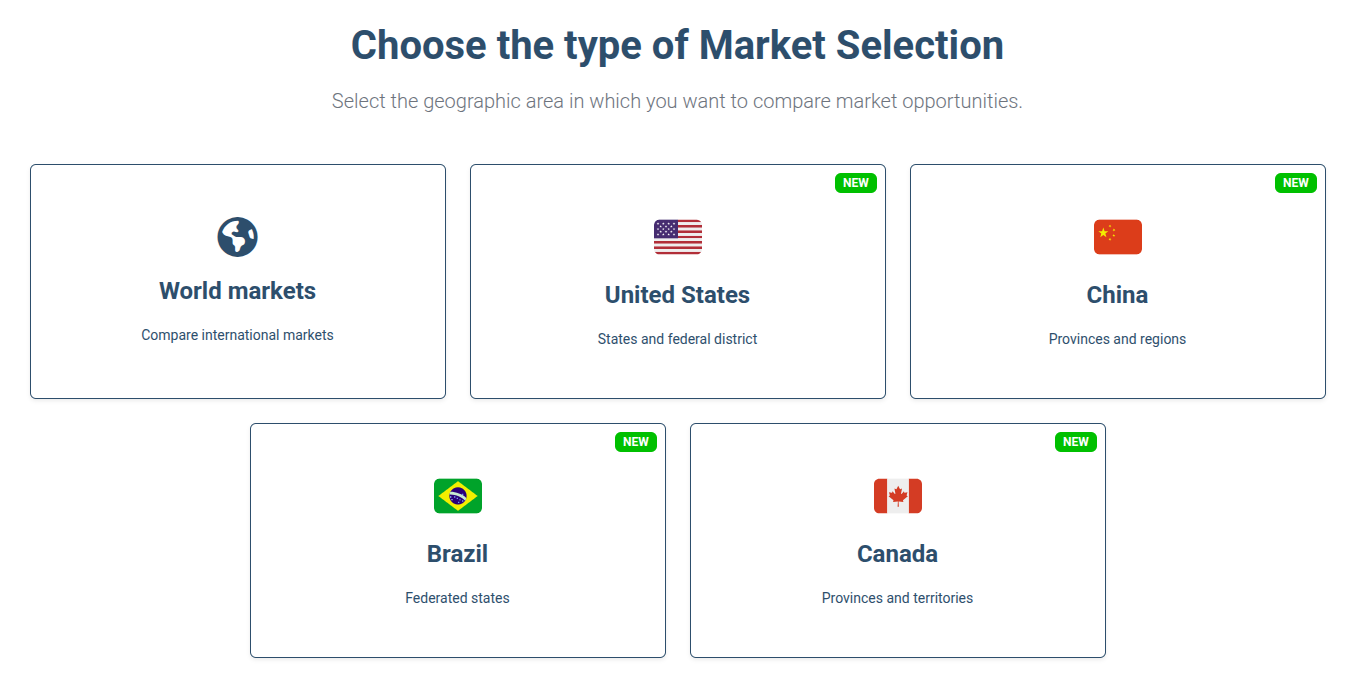
This new perspective makes it possible to look beyond national averages. Businesses can identify regions where demand for their products is strongest, growing most rapidly or supported by more favourable market conditions than elsewhere in the country.
Sector-specific indicators to identify commercial opportunities
Regional Market Selection analyses allow businesses to assess commercial opportunities for individual products, selectable down to the HS6 level. Sector-specific indicators make it possible to compare regions based on the size and growth of their imports, identifying both areas with the strongest demand for foreign products and those where imports are expanding most rapidly.
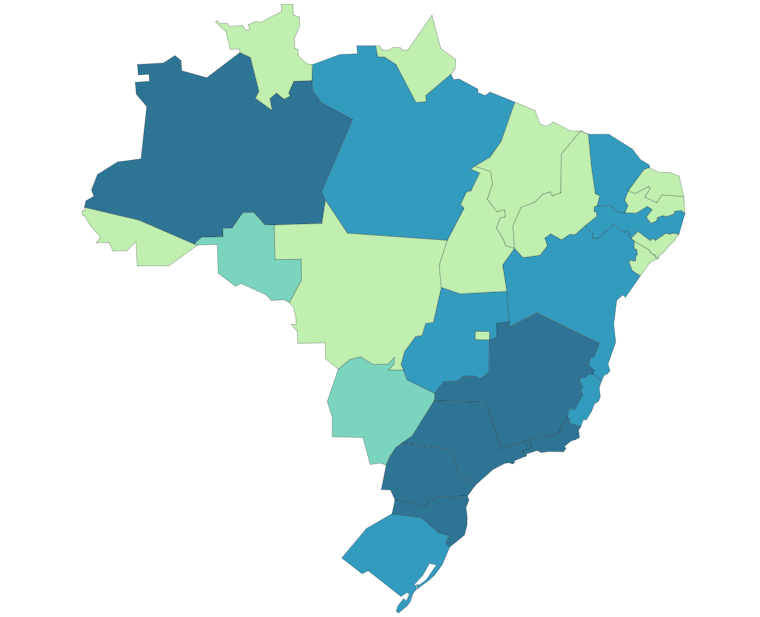
Indicators can be combined and weighted according to business priorities to generate a ranking of the most promising regions. Results are presented through tables and thematic maps, making it easy to visualise the geographical distribution of commercial opportunities.
Brazil: imports of mechanical and optical components and the top 10 states
| Rank | State | Imports (€ million) |
|---|---|---|
| 1 | São Paulo | 3405 |
| 2 | Amazonas | 1437 |
| 3 | Paraná | 802 |
| 4 | Minas Gerais | 741 |
| 5 | Santa Catarina | 696 |
| 6 | Rio de Janeiro | 492 |
| 7 | Rio Grande do Sul | 292 |
| 8 | Bahia | 113 |
| 9 | Espírito Santo | 93 |
| 10 | Goiás | 85 |
Source: ExportPlanning – 2025 data
Understanding local economic conditions
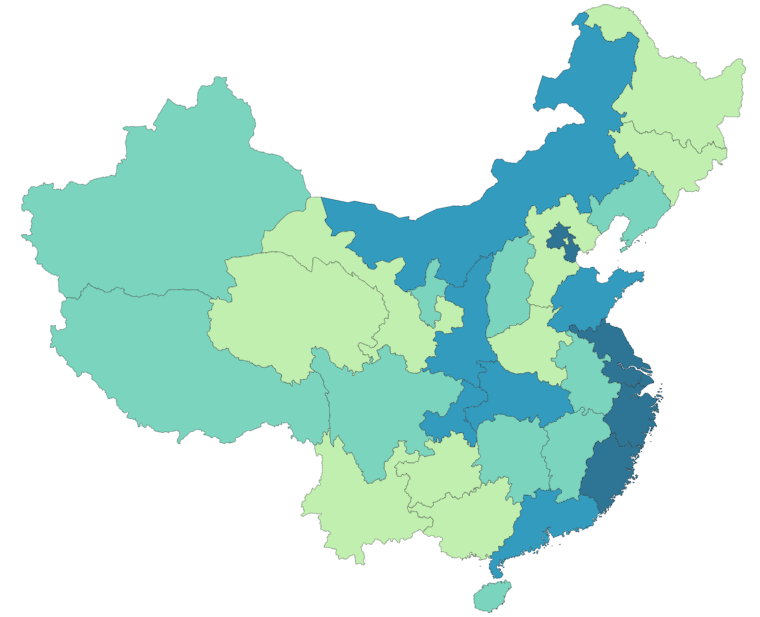
Sector-specific data is complemented by regional macroeconomic indicators, which help assess the size and structural characteristics of individual areas. Depending on the country, available indicators include population, demographic composition, GDP per capita, economic growth and the sectoral composition of value added.
China: regional GDP per capita and the top 10 provinces
| Rank | Region | GDP per capita ($) |
|---|---|---|
| 1 | Beijing | 31,613 |
| 2 | Shanghai | 30,118 |
| 3 | Jiangsu | 22,276 |
| 4 | Fujian | 19,045 |
| 5 | Zhejiang | 18,749 |
| 6 | Tianjin | 18,265 |
| 7 | Guangdong | 15,382 |
| 8 | Inner Mongolia | 15,323 |
| 9 | Hubei | 14,204 |
| 10 | Chongqing | 13,958 |
Source: ExportPlanning – 2024 data
The availability of indicators and reference years may differ across China, Brazil, Canada and the United States, depending on their respective statistical sources. Market Selection accounts for these differences by displaying the data available for each geographical area.
Macroeconomic presets: a guided starting point
Alongside the introduction of regional analyses, ExportPlanning has also improved the user experience of its worldwide Market Selection tool. To make macroeconomic indicator selection easier, six presets have been introduced, allowing users to configure their analysis around specific business objectives.
Users can select the starting point that best matches their needs, depending on whether they want to identify:
- Markets with the strongest demand, prioritising market size;
- High-growth markets, focusing on economic growth prospects;
- More accessible markets, considering market access conditions;
- More reliable markets, placing greater emphasis on economic stability;
- Markets suited to premium products, prioritising purchasing power indicators;
- Balanced analysis, combining different evaluation criteria.
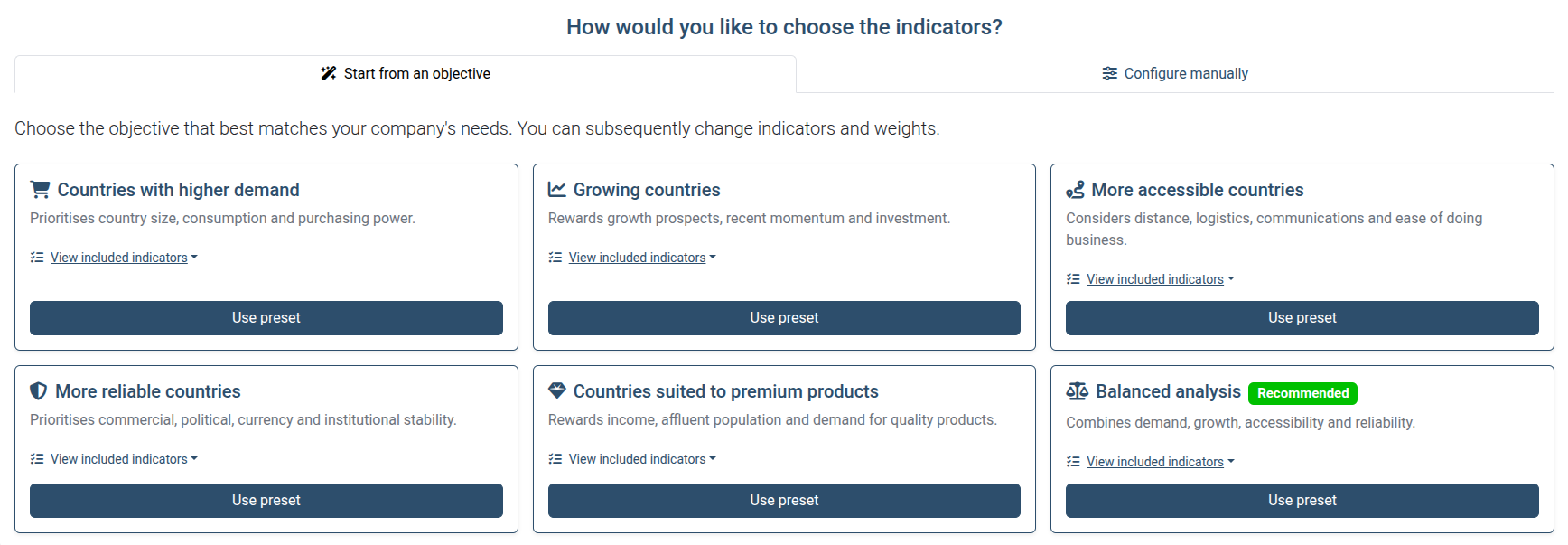
Each preset provides a predefined combination of macroeconomic indicators and weights, allowing users to start their analysis without configuring every parameter from scratch. Settings remain fully customisable: users can adjust the selected indicators and their weights to tailor the analysis to their specific needs. A fully manual configuration option also remains available.
Bringing market intelligence closer to business decisions
The new features are accompanied by several interface improvements designed to make the analytical process clearer and more intuitive, from the initial setup through to exploring the results.
With regional analysis and macroeconomic presets, Market Selection takes another step forward in supporting businesses' international expansion strategies. On the one hand, it enables companies to explore commercial opportunities within major markets, uncovering differences that national-level data cannot reveal. On the other, it makes it easier to navigate economic indicators and build analyses aligned with specific business objectives.
Take advantage of our introductory pricing, available until December 31, 2026!
You may be interested in:

How to identify foreign markets with the greatest potential using Market Selection: the case of boneless hams
Published by Mauro Badanelli. .
Marketselection International marketingIdentifying the foreign markets on which to focus commercial resources is a crucial step in the internationalisation process. The choice cannot be based exclusively on the current size of demand or on}... [ Read all ]

Food Machinery: Leading and Lagging World Markets in Q2 2026
Published by Marcello Antonioni. .
Industrial equipment Conjuncture Export markets Uncertainty Global economic trendsIn Q2 2026 world trade of Food Machinery grew for the 14th consecutive quarter, but with markets that are quite polarized. [ Read all ]

Germany’s electrical-equipment opportunity: where Italian suppliers can win
Published by Marlene Saal. .
Europe Conjuncture Export markets Foreign markets Eurozone Foreign market analysisGermany’s electrification push is creating a substantial, but selective, opportunity for foreign suppliers [ Read all ]