Monthly Market Data for Faster and More Targeted Business Decisions: The Case of Apples
Published by Marzia Moccia. .
Planning Conjuncture Check performance Uncertainty International marketing Made in Italy International marketing
In the current context of international trade, characterized by extreme volatility, as confirmed by the latest IMF World Economic Outlook publication (see IMF WEO April 2026: new shocks for the global economy), the ability to promptly interpret market signals represents a critical success factor for exporting companies. In this scenario, traditional analytical tools – often based on annual data or backward-looking analyses – are increasingly inadequate to support fast and informed decision-making.
There is therefore a growing need for continuous, granular, and “product-specific” monitoring of foreign markets, capable of capturing demand and competitor trends almost in real time.
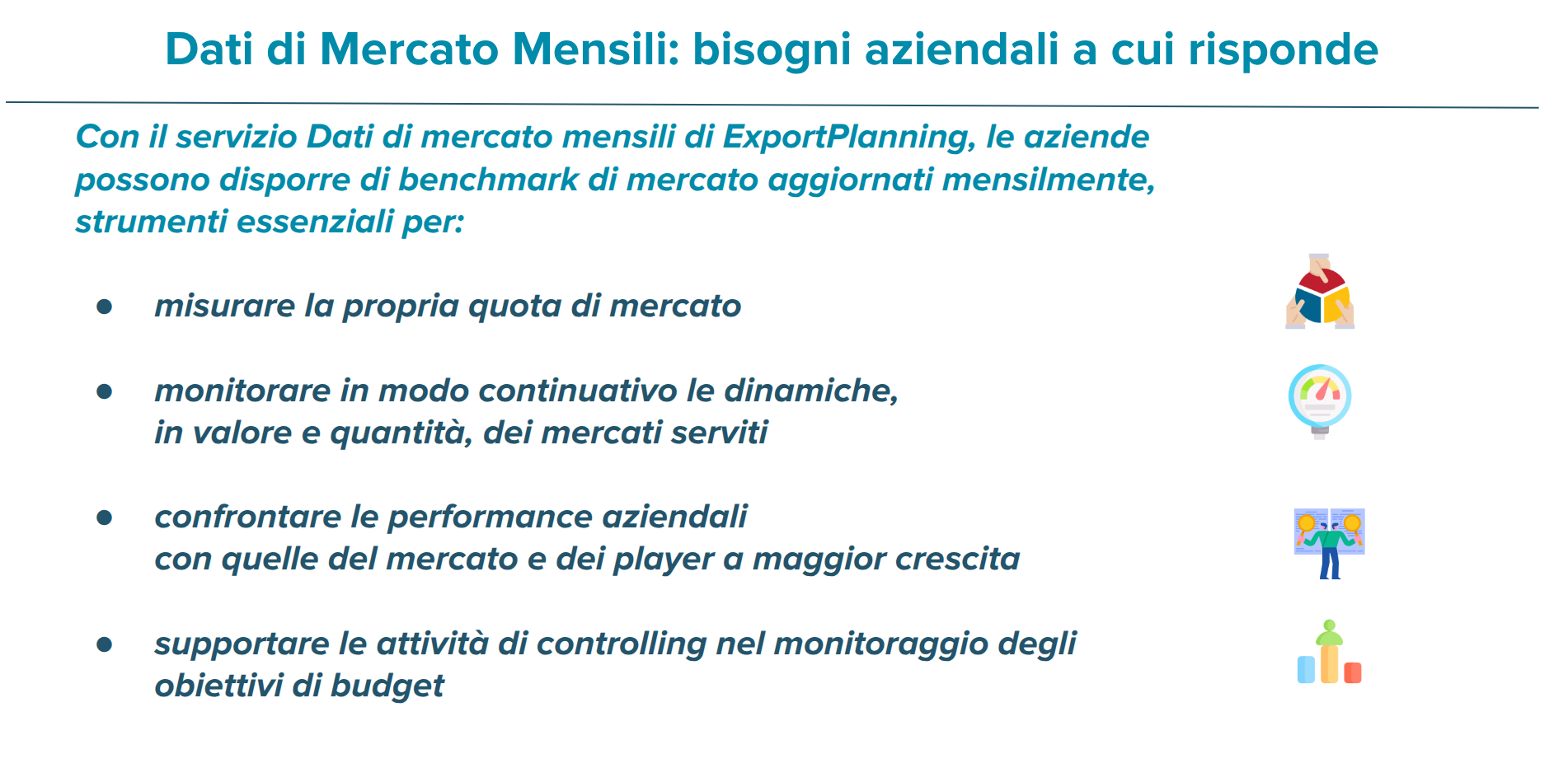
This approach concretely enables a range of activities for exporting companies.
Even the most structured exporting companies – equipped with advanced information systems and a rich set of internal data – often face a structural limitation: company data explain what is happening within the firm, but not what is happening in the market.
This is precisely where the need emerges for an external, objective, and continuously updated benchmark, built on the same products and markets in which the company operates.
Without this benchmark, several key management questions become difficult to address objectively:
- What is my market share and how is it evolving over time?
- Is the reference market growing or slowing down compared to my sales?
- Which competitor countries are growing faster? And at what price positioning?
- Are the budget targets consistent with actual market trends?
These are seemingly simple questions, yet strategically decisive. Without a structured comparison with constantly updated market data, the risk is to misinterpret company performance: confusing a loss of competitiveness with a general demand slowdown, or – conversely – overestimating positive results that are actually below the market growth rate.
It is precisely in response to these needs that the service On Demand ExportPlanning for Monthly Market Data Supply fits in, allowing exporting companies to access high-frequency updated information on demand conditions across their target markets.
This is not just about “having more data”, but about having an objective and timely reference to correctly interpret company dynamics and make faster, more informed decisions in a highly uncertain and evolving environment.
A case study: Italian apple exports
A particularly interesting field to apply this type of monitoring is the agri-food sector and, specifically, the apple segment. As highlighted in the article The international success of Italian apples: the boom in the Brazilian market , Italian apples confirm themselves as one of the most solid excellences of the national agri-food sector, with a growing international reach.
In recent years, Italian apples have strengthened their presence in foreign markets, reinforcing the competitive positioning of Made in Italy and significantly contributing to the global value of fruit and vegetable exports.
In this context of strong international openness and increasing global competition, monthly monitoring of market data plays a particularly relevant role, translating the previously described analytical areas into practice.
In the case of apples, a data-driven approach allows these dimensions to be translated into operational indicators:
Market growth performance by target geographies: Germany, Brazil, Spain, and the United Kingdom
The table below shows the total value of apple imports in 2025 for some key international markets:
Tab.1 - Apple imports in selected markets
| Country | Million € (Imports 2025) |
Million Kg (Imports 2025) |
Change 25/24 Value € (%) |
Change 25/24 Volume Kg (%) |
|---|---|---|---|---|
| Germany | 552 | 481 | 1.3 | -5.6 |
| United Kingdom | 306 | 217 | 5.1 | -2.2 |
| Brazil | 257 | 241 | -7.2 | -0.5 |
| Spain | 207 | 216 | 7.6 | 2.3 |
Source: ExportPlanning Information System
The analysis shows that the four markets experienced different dynamics. Spain is the only case with growth in both value and volume. Germany and the United Kingdom, despite a contraction in volumes, show an increase in average values, indicating premiumization effects. Brazil shows the opposite trend, with a decline in value alongside relatively stable volumes.
The aggregated data becomes even more meaningful when analyzed on a monthly basis, allowing a more precise understanding of intra-annual dynamics.
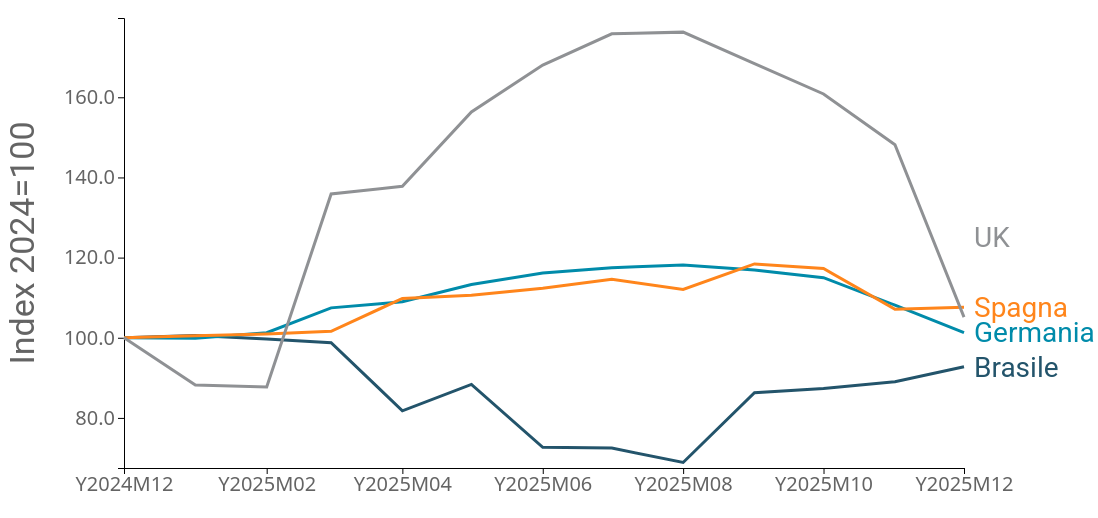
Import dynamics in selected markets
(annual cumulative – last 12 months, index 2024=100)
Source: ExportPlanning Information System
First, we observe the strong seasonality characterizing the British market: the country significantly reduces its apple imports during the domestic production season (October–December). This type of seasonality is not observed in the other markets analyzed.
A second relevant aspect concerns the evolution of the Brazilian market, where the weakness in foreign demand was mainly concentrated in the first part of the year, followed by a gradual recovery.
The German market, on the other hand, shows a more persistent weakness.
Measurement of Italy’s market shares
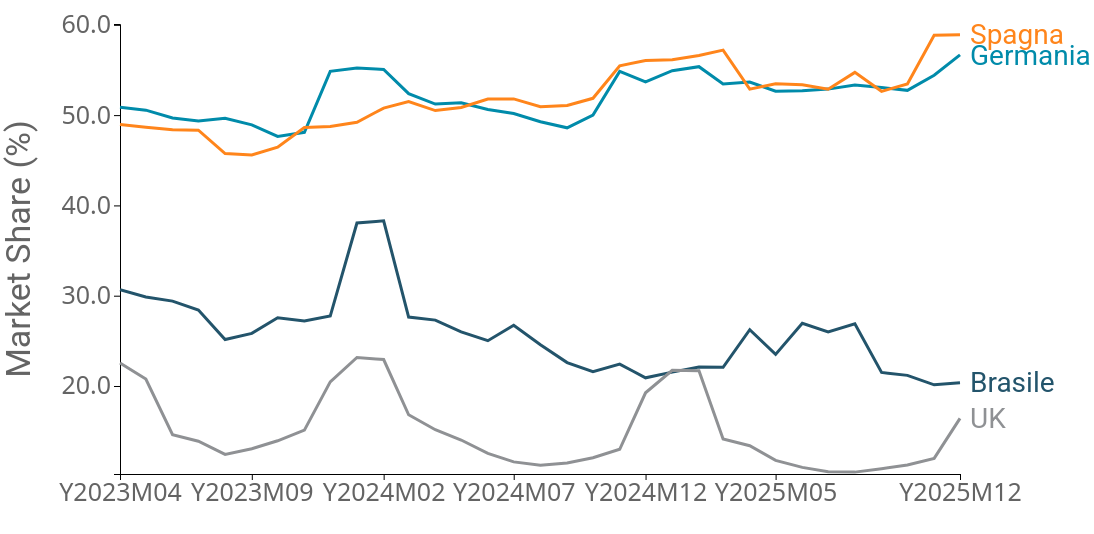
For Italian exporters, the positioning in Germany and Spain confirms a strong leadership, with market shares above 50%, and further strengthening in recent months.
The competitive context appears more complex in Brazil and the United Kingdom, where Italy’s market share remains overall stable, net of some seasonal dynamics, particularly evident in the UK market.
Italy’s market share evolution
(annual cumulative – last 12 months)
Source: ExportPlanning Information System
Across all analyzed markets, the competitive environment remains highly dynamic, with significant movements among the main exporting countries competing with Italy.
Comparison with the most dynamic competitor countries and price positioning
In the Brazilian market: despite a 9.6% decline in Italian exports, in line with the overall market contraction, Portugal shows strong growth. However, Italy maintains a more premium price positioning at €1.2/kg, compared to around €1/kg for other exporters.
In the UK market: Italian exports declined by 10%, in line with most exporters. France is the only player showing growth. Italy remains among the highest price positions, alongside France.
In the German market: Italian exports outperformed overall market growth, with France and the Netherlands also showing dynamic trends.
In the Spanish market: Italian export growth also exceeded market growth. Portugal remains dynamic but with a significantly lower price positioning (€0.5/kg vs €1.2/kg for Italy).
Overall, in the past year, Italy’s positioning has strengthened, particularly in mature markets, where increasing signs of premiumization are emerging.
In a context characterized by high competitive dynamism and heterogeneous performance across markets, it becomes crucial for Italian operators to strengthen their selective market presence, adapting commercial strategies to local specificities and continuously monitoring demand trends and competitor dynamics.
For an apple exporter, having access to updated monthly import data in key target markets allows the timely identification of demand growth or contraction signals, emerging opportunities, and potential saturation risks. In this context, integrating company data with a
Continuous monitoring also makes it possible to clearly distinguish between market dynamics and company performance, promptly capturing demand shifts and development opportunities. At the same time, it enables a more objective analysis of international competition and competitor positioning, strengthening
In this framework, monitoring is not just an informational tool but a real support for decision-making processes, enabling a timely interpretation of market changes and a faster adaptation of commercial and competitive strategies.

You may be interested in:

Machinery: International Sales Results to July 2026
Published by Marcello Antonioni. .
Industrial equipment Conjuncture Monthly Market Data Global economic trendsIn July Machinery exports by EU companies remained in positive territory, but with significant differences across sectors [ Read all ]

World Trade: Increasingly Polarized Growth – July 2026 Update
Published by Marzia Moccia. .
Conjuncture Foreign markets Uncertainty Global economic trendsWorld trade continues to grow in 2026, but behind the resilience of the aggregate figures, disparities across sectors and geographic regions are widening [ Read all ]

Monthly market data: a planning tool in a context of growing commercial uncertainty
Published by Mauro Badanelli. .
Planning Conjuncture Foreign markets Global economic trendsThe case of textile machinery in India shows how to turn monthly market data into Competitive Intelligence [ Read all ]