Safety glass for aircraft, ships and space: a mapping of global production
Published by Mauro Badanelli. .
Intermediate goods Global demand Competitor analysis International marketingSafety in modern transportation also relies on components such as the glazing systems installed on board aircraft, ships, and other special-purpose vehicles. In this context, glass surfaces do not merely provide visibility and comfort; they also serve as structural and protective elements, required to withstand mechanical stresses, thermal variations, accidental impacts and particularly demanding operating conditions.
To meet these requirements, two main types of safety glass are used: tempered glass and glass consisting of bonded sheets (hereinafter referred to as laminated glass). The former is characterized by high resistance to impacts and thermal shock, while the latter combines multiple glass panes joined by plastic interlayers which, in the event of breakage, retain the fragments, preventing the dispersion of shards and providing an additional level of protection.
The evolution of manufacturing technologies and the progressive strengthening of international safety standards—from FAA and EASA aviation regulations to IMO requirements for the maritime sector, as well as European standards for rail transport—have contributed to the growing adoption of tempered and laminated glass in high-performance transportation equipment.
The use of these types of safety glass is extensive and includes applications in:
- Civil and military aircraft1;
- Ships and marine vessels2;
- Rail vehicles3;
- Earthmoving machinery and special industrial vehicles4;
- Military and security vehicles5;
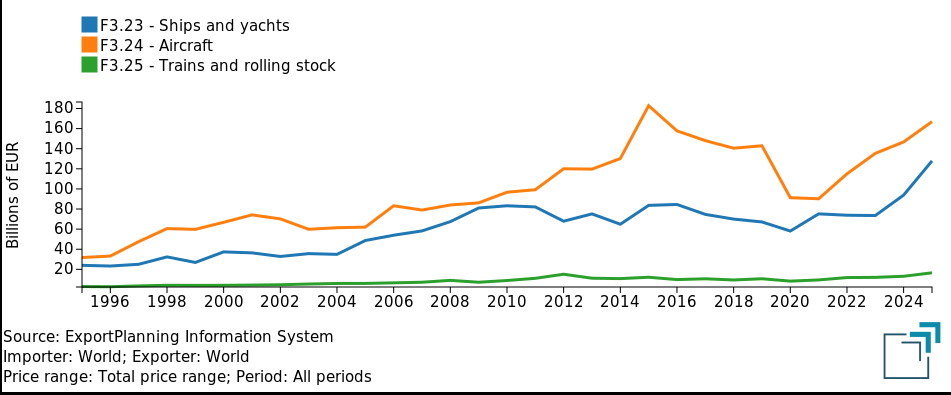
Analyzing the market dynamics of safety glass intended for these applications provides a better understanding of the strategic role played by a component that contributes significantly to the reliability and safety of the most advanced means of transportation, whose development in world trade is illustrated in the chart below.
Fig.1 - World exports of the main end-use sectors for safety glass
Source: ExportPlanning
Tempered Safety Glass
Tempered glass is used where high mechanical strength, resistance to thermal shock, and protection against accidental impacts are required, but where the ability to retain fragments after breakage is not necessary—a feature that instead distinguishes laminated glass.
In the most advanced applications, tempered glass is rarely used on its own. The technological trend is toward multilayer glazing systems, in which one or more tempered panes are combined with polymer interlayers, functional coatings, and sometimes heating elements or integrated sensors. This approach makes it possible to simultaneously meet requirements for impact resistance, post-breakage safety, insulation, and optical quality, which are particularly demanding in the aerospace, maritime, and railway sectors.
The global production of tempered safety glass used in aircraft, ships, and other vehicles (excluding automobiles and tractors), identified by CN code 700711.90, reached a value of 367.8 million euros. During the period 2019–2025, the sector recorded a compound annual growth rate (CAGR) of -1.8% at constant prices (i.e., net of inflationary and exchange-rate effects
Leading producing Countries
China is the largest producer of tempered safety glass, with an estimated production value of 86.2 million euros last year. The country also leads in terms of trade balance for this product, recording a value of +76.1 million euros in 2025, corresponding to a normalized trade balance (NTB)6 of +0.88, indicating a strong specialization in the sector.
The United States ranks second among producers in this segment, with an estimated production value of 76.8 million euros last year. However, the country's trade balance is negative (-15.2 million euros), corresponding to an NTB of -0.19, indicating dependence on imports for this product.
Italy is the third-largest producer of tempered safety glass, with production reaching 38.9 million euros in 2025. The Country records a trade surplus of +16.2 million euros (the world's second-largest trade surplus in 2025), corresponding to a normalized trade balance (NTB) of +0.42.
Other European Countries
Europe is well represented among the leading producing Countries in the sector. In addition to Italy, the top ten positions include the Netherlands, Germany, France, Turkey and Belgium. The Netherlands ranks fourth among producers, with a production value of 38.7 million euros in 2025 and a trade balance of -0.2 million euros. Significant production levels are also recorded in Germany (27.4 million euros), France (26.9 million euros) and Turkey (19.5 million euros). It is worth noting that among the countries mentioned, only Turkey records a positive trade balance (+11.8 million euros, corresponding to an NTB of +0.62).
The list of European countries among the top 15 producers is completed by the United Kingdom (11th place), Poland (12th place), and Spain (15th place). Among these countries, only Poland records a positive trade balance: +5.5 million eurs (corresponding to an NTB of +0.22).
Other Producing Countries
Other Asian and North American economies also feature among the world's top 15 producing Countries. Japan ranks 10th, with an estimated production value of 13.8 million euros and a trade balance of -1.3 million euros, corresponding to an NTB of -0.10. South Korea ranks 14th, with estimated production of 10.9 million euros last year and a trade balance of +8 million euros (corresponding to an NTB of +0.64).
Mexico and Canada also occupy leading positions. In particular, Mexico ranks 8th, with estimated production in 2025 of 15.7 million euros and a trade balance of +1.4 million euros (NTB equal to +0.07).
Leading Producing Countries of Tempered Safety Glass (2025 data)
| Production | Trade Balance | |||
| # | Country | Mln € | Mln € | Norm. (-1/+1) |
| 1 | China | 86.2 | + 76.1 | +0.88 |
|---|---|---|---|---|
| 2 | United States | 76.8 | - 15.2 | -0.19 |
| 3 | Italy | 38.9 | + 16.2 | +0.42 |
| 4 | Netherlands | 38.7 | + 0.2 | 0.00 |
| 5 | Germany | 27.4 | - 12.1 | -0.27 |
| 6 | France | 26.9 | - 6.2 | -0.19 |
| 7 | Turkey | 19.5 | + 11.8 | +0.62 |
| 8 | Mexico | 15.7 | + 1.4 | +0.07 |
| 9 | Belgium | 14.5 | - 0.4 | -0.02 |
| 10 | Japan | 13.8 | - 1.3 | -0.10 |
| 11 | United Kingdom | 13.6 | - 1.5 | -0.09 |
| 12 | Poland | 13.0 | + 5.5 | +0.22 |
| 13 | Canada | 11.0 | - 19.5 | -0.63 |
| 14 | South Korea | 10.9 | + 8.0 | +0.64 |
| 15 | Spain | 9.9 | - 8.1 | -0.47 |
Source: ExportPlanning - Data Hub - Annual Trade Data, Ulisse Datamart
Laminated Safety Glass
Laminated glass, consisting of bonded sheets, is now the preferred solution for the most critical transportation applications thanks to its ability to maintain its integrity even after breakage. Plastic interlayers (typically PVB, ionoplast, or EVA) retain the glass fragments, reducing risks to passengers and operators and ensuring residual protection even after an impact.
The global production of laminated safety glass used in aircraft, ships, and other vehicles (excluding automobiles and tractors), identified by CN code 700721.80, reached a value of 228.2 million euros. During the period 2019–2025, estimated production recorded a CAGR of -4.6% at constant prices.
Leading Producing Countries
The United States is the leading producer of laminated safety glass, with an estimated production value of nearly 100 million euros last year. The country is a net exporter of this product, recording a trade balance of +20.2 million euros in 2025, corresponding to a normalized trade balance (NTB) of +0.24, indicating specialization in the sector.
Germany ranks second, with estimated production of 40.8 million euros in 2025. However, the country's trade balance is negative (-14 million euros), corresponding to an NTB of -0.29.
China is the third-largest producer of laminated safety glass, with estimated production of 34.3 million euros in 2025. China's leadership in terms of trade balance for this product category should also be emphasized, with a value of +30 million euros last year (the world's leading country by trade balance in 2025), corresponding to an NTB of +0.86.
Other European Countries
Among other European Countries, Italy and France rank respectively 4th and 5th among the world's leading producers of laminated safety glass, with estimated production values of EUR 27.5 million and 16.6 million euros in 2025. Italy also records a trade surplus of +6.7 million euros (NTB equal to +0.23), confirming the country's productive specialization in this segment. France, by contrast, records a trade surplus of only 0.4 million euros.
Among European economies, Turkey, the United Kingdom and the Netherlands follow in the ranking, occupying the 7th, 8th, and 9th positions respectively among the world's leading producing countries. While Turkey records a positive trade balance of +10.9 million euros (reflecting significant specialization, with an NTB of +0.80), the United Kingdom and the Netherlands show negative trade balances (-3.7 million euros and -9.2 million euros respectively), making them dependent on imports of laminated safety glass.
Among the other European Countries included in the ranking of the top 15 producers, Switzerland and Poland also stand out for their positive trade balances. Switzerland records a surplus of +5.7 million euros, corresponding to an NTB of +0.51, while Poland's trade balance amounts to +3.9 million euros (NTB equal to +0.45).
Other Asian Countries
In addition to China, among Asian economies the positions of Malaysia and Japan are noteworthy, ranking 6th and 10th globally in terms of production value. In particular, Malaysia's production value last year is estimated at 16 million euros. Both countries also display a high degree of productive specialization, with NTB values of +0.80 and +0.46 respectively. Finally, Israel ranks 12th among producers in the sector, with estimated production of 8.4 million euros and a positive trade balance of +6 million euros, corresponding to an NTB of +0.86.
Leading Producing Countries of Laminated Safety Glass (2025)
| Production | Trade Balance | |||
| # | Country | EUR Mn | EUR Mn | Norm. (-1/+1) |
| 1 | United States | 99.9 | + 20.2 | +0.24 |
|---|---|---|---|---|
| 2 | Germany | 40.8 | - 14.0 | -0.26 |
| 3 | China | 34.3 | + 30.0 | +0.86 |
| 4 | Italy | 27.5 | + 6.7 | +0.23 |
| 5 | France | 16.6 | + 0.4 | +0.02 |
| 6 | Malaysia | 16.0 | + 4.8 | +0.75 |
| 7 | Turkey | 15.6 | + 10.9 | +0.80 |
| 8 | United Kingdom | 14.0 | - 3.7 | -0.24 |
| 9 | Netherlands | 12.9 | - 9.2 | -0.39 |
| 10 | Japan | 11.8 | + 4.8 | +0.46 |
| 11 | Mexico | 11.7 | + 5.4 | +0.48 |
| 12 | Israel | 8.4 | + 6.0 | +0.86 |
| 13 | Belgium | 8.3 | - 0.3 | -0.04 |
| 14 | Switzerland | 7.3 | + 5.7 | +0.51 |
| 15 | Poland | 7.0 | + 3.9 | +0.45 |
Source: ExportPlanning - Data Hub - Annual Trade Data, Ulisse Datamart
Conclusions
The mapping of global production confirms, for both types of safety glass examined, a strong concentration of manufacturing activity in the hands of a limited number of players.
Production leadership in tempered safety glass firmly belongs to China, while the United States, despite ranking second in terms of production, shows structural dependence on foreign supplies. In the laminated safety glass segment, by contrast, the United States holds the leading production position, supported by a clear degree of specialization in the sector. China, ranked third behind Germany, is also characterized in this segment as the Country with the largest trade surplus.
In general, European Countries tend to display dependence on imports for these products, with the notable exceptions of Turkey and Poland. Strong productive specialization, on the other hand, characterizes some Asian economies, including Malaysia and South Korea.
Italy ranks among the leading producing Countries in both sectors (3rd place for tempered safety glass and 4th place for laminated safety glass). Italy's leadership is also reflected in its productive specialization, which is particularly pronounced in tempered safety glass.
1) In the civil and military aircraft sector, safety glass is used, for example, for cockpit windshields, front and side cockpit windows, helicopter glazing systems, business aircraft and special-mission aircraft windows, and transparent components subject to bird-strike resistance requirements.
2) On ships and marine vessels, safety glass may be used for bridge windows, front bridge glazing, panoramic windows on cruise ships, passenger ferries, yachts and mega-yachts, transparent railings and barriers, as well as structural glass flooring and walkways.
3) On trains, safety glass is used, for example, for locomotive windshields, side windows of high-speed trains, passenger access doors, internal safety partitions, and panoramic glazing systems.
4) Safety glass is installed in the cabins of earthmoving machinery, mining equipment, cranes and port machinery, airport vehicles, construction-site vehicles, and forestry machines.
5) Safety glass is used in a wide range of military and security vehicles, including armored vehicles, tactical vehicles, military vessels, security cabins, and cash-in-transit vehicles.
6) The “simple” trade balance (Exports minus Imports) is highly influenced by market size. The normalized version, on the other hand, allows for more meaningful comparisons: between different countries; between sectors of different sizes; and over time.
The normalized trade balance (measured by the formula [Exports − Imports] / [Exports + Imports] and hereafter referred to by the acronym "NTB") is a widely used indicator in international competitiveness studies and trade specialization analyses.
The NTB indicator can assume values ranging from -1 to +1:
- +1 → exports only, no imports (maximum surplus);
- 0 → exports equal imports;
- -1 → imports only, no exports (maximum deficit).
- positive NTB values (and increasing values over time) indicate strong specialization of a country in a given sector or product;
- negative NTB values (and decreasing values over time) indicate import dependence and lack of specialization;
- NTB values close to zero indicate a balanced situation.
You may be interested in:
World Trade Trends: International Trade Results in Q2 2026 (Preliminary Estimates)
Published by Marcello Antonioni. .
Home items Fashion Food&Beverage Metal industry Intermediate goods Electronics Chemicals Industrial equipment Conjuncture Automotive Global demand Industries Global economic trendsStrengthening dynamics, driven by AI applications, and the green and digital transitions [ Read all ]
In the plastics processing machinery sector, Italy maintains its role as technological leader
Published by Mauro Badanelli. .
Industrial equipment Competitor analysis Foreign markets International marketingAs highlighted in a previous article dedicated to the plastics processing machinery industry, Italy plays a leading role among the world's major technology suppliers. In fact, Italy ranks third worl}... [ Read all ]
Advanced Technology Products: Overview and Dynamics of Global Technological Leadership
Published by Marcello Antonioni. .
Global demand Competitor analysis High-tech International marketingChina and the United States are competing for global technological leadership; Europe is catching up, showing some interesting areas of specialization [ Read all ]