Export 2026-2029: ExportPlanning updates its forecast scenario
Published by Marzia Moccia. .
Conjuncture Export markets Uncertainty IMF Global economic trendsFor exporting companies, the ability to promptly interpret the evolution of international markets is now a key competitive factor. In a global context characterized by rapid changes and growing uncertainty, relying exclusively on consolidated year-end data risks becoming a “rear-view mirror” of ongoing dynamics: useful for describing what has already happened, but less effective in promptly identifying new demand signals and emerging opportunities across different markets.
The new ExportPlanning forecasting scenario integrates the evolution of the macroeconomic context with updated data on global trade flows for the first half of 2026, providing companies with a more timely and reliable view of international markets. It offers concrete support to anticipate demand shifts, identify new opportunities, and guide export development strategies with greater awareness.
We will therefore examine the main changes that have occurred in the international framework compared with the April forecast scenario, as well as the outlook for global trade in goods for the current year.
The dollar has entered a new appreciation phase
Source: PricePedia
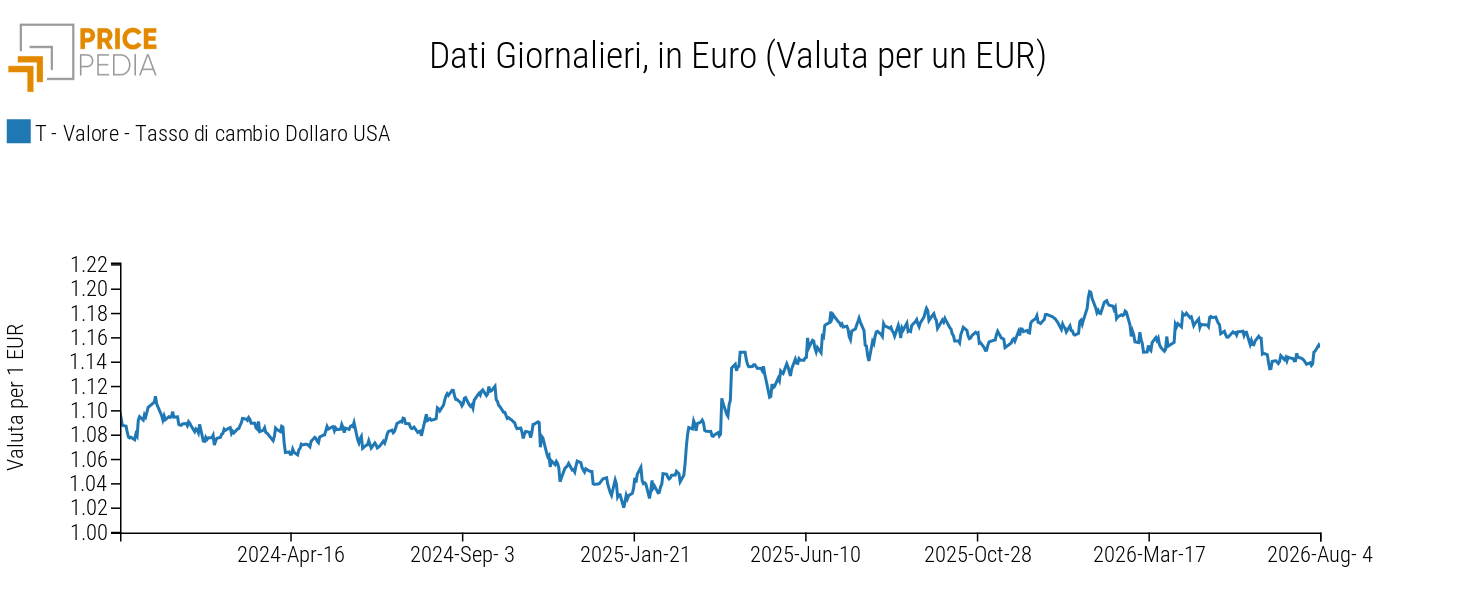
With the intensification of tensions in the Gulf region, the USD/EUR exchange rate recorded a shift in trend compared with the strong depreciation path that had begun at the start of 2025. The US dollar has once again taken on its traditional role as a safe-haven currency, strengthening against the euro: the exchange rate moved from an average of 1.18 in February 2026 to 1.14 in July.
This change improves the outlook for euro-denominated exports in the second half of the year. A weaker euro than previously expected reduces the adverse exchange-rate effect on the competitiveness of European exporting companies, supporting export growth dynamics.
Inflation expectations are rising
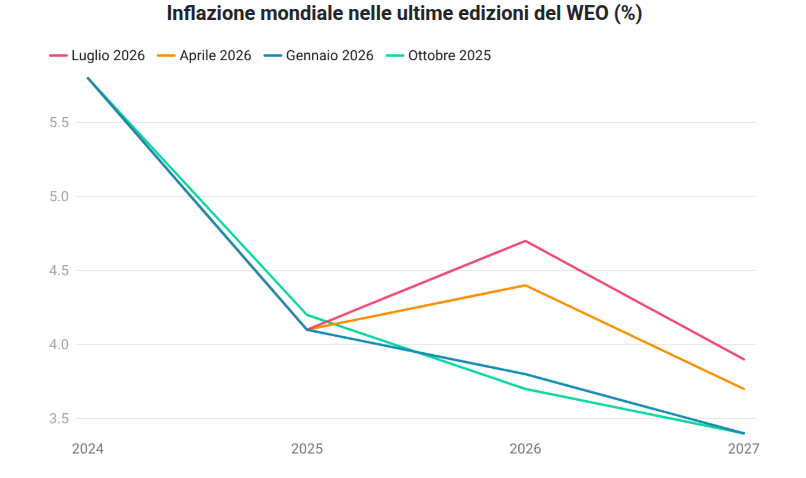
On the price front, the IMF expects inflationary dynamics to accelerate, with global price growth reaching 4.7% in 2026, mainly driven by higher energy and food prices. This represents an upward revision of 0.3 percentage points for 2026 and 0.2 percentage points for 2027 compared with the April 2026 scenario, reflecting more persistent inflationary pressures (see the article IMF WEO Update July 2026: a (precarious) balance between war and technology). Despite accelerating compared with previous expectations, inflation remains significantly below the peaks recorded in 2022.
Source: ExportPlanning elaboration based on IMF data
Global trade proves highly resilient, but growth is becoming more polarized
As highlighted in the article Is global trade becoming increasingly resilient?, despite the complex international environment, global trade in goods has so far demonstrated significant resilience, maintaining a stronger growth profile than expected. Data updated to the first half of 2026 show that global goods trade has not lost momentum, further strengthening its growth trajectory during the second quarter of the year.
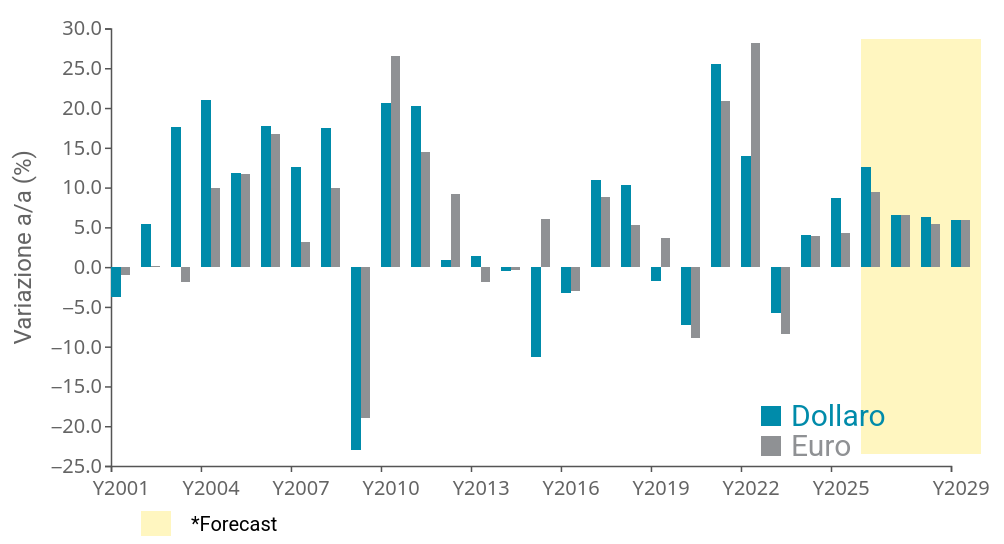
The updated scenario developed by the ExportPlanning forecasting model therefore points to more favorable prospects for international trade growth over the 2026–2027 period, also due to price dynamics. In particular, global trade in goods is expected to grow by 12.6% in dollar terms and 9.4% in euro terms in 2026, supported by the resilience of global demand and by the impact of rising price dynamics on the nominal growth of trade flows.
Source: ExportPlanning
Behind the overall figure, however, lies a strong polarization of results at sector level, with trade growth concentrated in a number of leading industries.
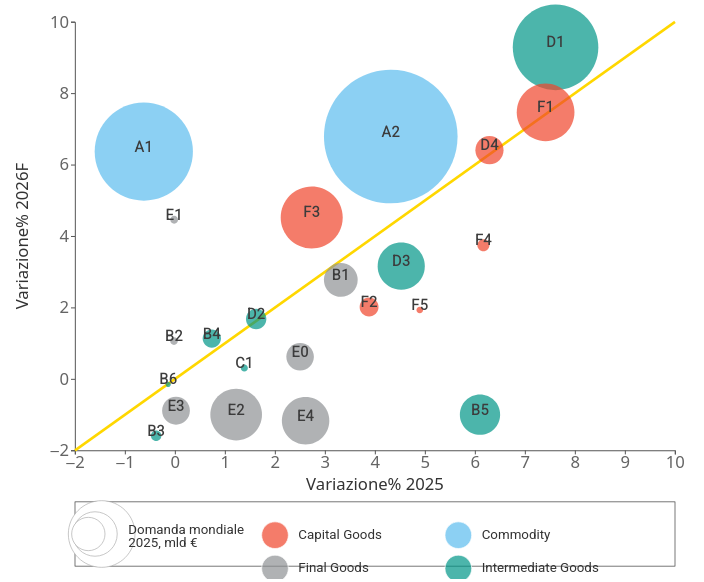
The following chart shows the main industries involved in international trade in goods, positioned according to the euro-denominated growth rates of global demand recorded in 2025 (X-axis) and estimated for 2026 (Y-axis). This representation provides a concise and immediate view of foreign demand evolution, highlighting the main growth patterns and changes in the expansion pace of different sectors.
The diagonal line (shown in yellow) represents a key interpretative benchmark: industries positioned along the line show a growth rate broadly in line with 2025; those below the line indicate a slowdown, while those above it signal an acceleration in global demand dynamics. The size of each bubble is proportional to the total value of trade generated by the industry in 2025.
Fig.1 – 2026 Scenario: global demand map by industry in euro terms
Source: ExportPlanning
In 2026, the growth of international trade is expected to continue being driven by technology-related goods and strategic investment sectors. In particular, a significant contribution is expected from demand for ICT goods (F1-D1), supported by the development of Artificial Intelligence applications, as well as from investments linked to the digital and green transitions (D4). These factors are complemented by the nominal contribution of raw materials (A), supported both by higher prices and by the role of gold as a safe-haven asset in a context of high uncertainty.
Conversely, a marked slowdown is expected for the Consumer Goods sector (E – shown in grey in the chart), with the weakest dynamics anticipated especially for Home System (E3) and Fashion System (E2), sectors more exposed to demand normalization following the strong post-pandemic recovery phase.
Demand for Capital Goods remains on a positive path, with growth estimated at around 2% per year in euro terms for the (F2-F5 and F4) sectors. This pace is lower than in 2025, but remains positive.
Conclusions: navigating uncertainty
The updated scenario therefore confirms an overall favorable outlook for international trade in goods, while at the same time highlighting increasing selectivity in growth opportunities.
In this context, the ability to promptly understand market evolution is becoming an increasingly important factor in guiding export strategies. Having access to updated scenarios enables companies not only to respond to ongoing changes, but also to anticipate new drivers of international demand and allocate resources more effectively toward markets with greater development potential.
To explore international market prospects in greater depth and access ExportPlanning forecasting scenarios, companies can enter the Report environment and consult updated estimates by Product and across 150+ Markets.
You may be interested in:

THE EU EXPORTS OF CAPITAL GOODS IN Q3-2026
Published by Marcello Antonioni. .
Metal industry Conjuncture Export Global economic trendsThe growth in European sales of capital goods (+6.9% year-on-year in euro) was driven by Tools and Equipment for ICT and Services and Electrical Engineering [ Read all ]
IMF WEO October 2026: Divergent Resilience and Persistent Pressures
Published by Alba Di Rosa. .
Macroeconomic analysis Conjuncture Uncertainty IMF Global economic trendsOn October 13, the International Monetary Fund released its latest World Economic Outlook, a key publication assessing the state of the global economy and its growth prospects. Compared with }... [ Read all ]

Hollow glass machinery: global trade set to accelerate in 2026
Published by Mauro Badanelli. .
Industrial equipment Conjuncture Foreign markets Global economic trendsThe global trade in machinery for the production and processing of hollow glass1 has shown a marked reversal in the first seven months of 2026, compared with the weakness that characterised the 2022–2}... [ Read all ]