Germany’s electrical-equipment opportunity: where Italian suppliers can win
Germany’s electrification push is creating a substantial, but selective, opportunity for foreign suppliers
Published by Marlene Saal. .
Europe Conjuncture Export markets Foreign markets Eurozone Foreign market analysisThis article was prepared in collaboration with Marlene Saal, an internationalization consultant specializing in the German market.
Marlene Saal is an independent market research analyst specializing in international markets, industry trends and competitive intelligence.She supports companies and organizations with data-driven research, market analysis and strategic insights for business development and internationalization.
The German market has gone through a challenging three-year period, marked by two consecutive years of recession, weak industrial demand and increasing competitive pressure on the manufacturing sector. Even in 2025, despite a modest recovery in GDP, industrial production continued to contract.
Yet within this broader context, one sector has moved—and continues to move—in the opposite direction: that linked to electrification and the development of the electricity grid, supported by the structural momentum of the energy transition and significant infrastructure investment.
Germany’s electrification push is creating a substantial, but selective, opportunity for foreign suppliers. In ExportPlanning’s current 2026-2029 forecast scenario, imports across eight electrotechnical product groups rise from €58.2 billion in 2025 to €76.9 billion in 2029, equivalent to a compound annual growth rate of 7.2%. These figures measure German imports, not total industry sales. For Italian manufacturers, the question is therefore not whether Germany is attractive in general, but where its import demand overlaps with Italian product strength and a viable route to buyers.
Market analysis
The headline conceals a concentrated market. Motors, generators and transformers, together with wires, cables, switches, plugs, sockets and electrical panels, are expected to generate 67.5% of the absolute import increase through 2029. Their scale makes them important demand pools, but the categories are too broad to guide market entry on their own. Suppliers must identify the specific product and customer problem inside each group.
Recent data also suggest that demand is stronger than nominal trade values imply. In H1 2026, imports increased by 5.7% at current prices but by 8.3% at constant prices. The latter is an aggregate demand and volume proxy, not a count of units, but it indicates that expansion was not simply price-driven.
Germany’s grid pipeline provides a tangible demand driver. Transmission and distribution network investment and expenditure totaled €29.7 billion in 2024, compared with €37.6 billion planned for 2025.
At European level, transformer and cable prices and lead times nearly doubled in 2025 versus 2021-2022. This can open space for additional qualified capacity, but it does not lower buyers’ technical, quality or delivery requirements.
Within this landscape, ExportPlanning’s electricity distribution and control apparatus category stands out as a focused opportunity. The category covers seven high-voltage product groups, including insulated cables above 1,000 volts as well as switching, protection and control equipment. German imports are forecast to expand from €2.0 billion in 2025 to €2.9 billion in 2029, a 10.5% compound annual rate. Together with Germany’s grid investment pipeline, this gives the category a combination of above-market growth and clear procurement relevance.
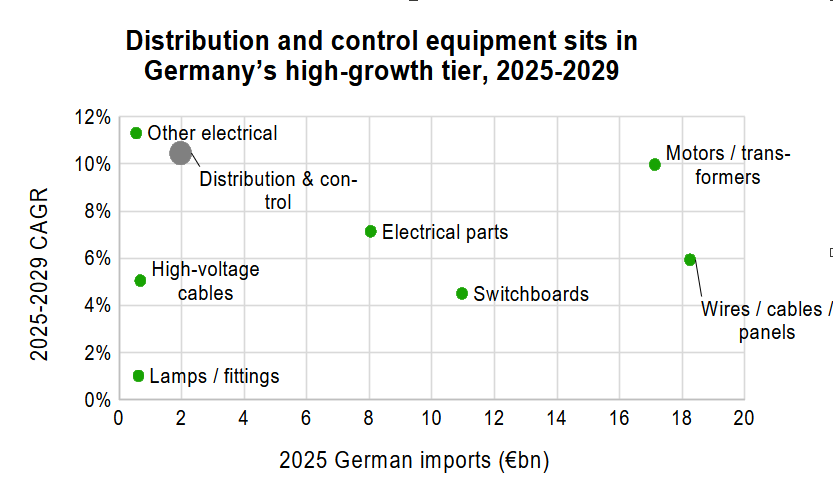
Source: Estimates based on ExportPlanning forecasts
Italian competitive positioning
Italy is not entering Germany from scratch. It was the sixth-largest foreign supplier across the eight analyzed electrical-equipment groups in 2025, with imports of €3.3 billion and a 5.5% share. In H1 2026, imports from Italy grew by 7.5%, ahead of the total market’s 5.8%. This gives Italian suppliers an existing foothold, but performance will still vary by product and buyer segment.
The stronger signal emerges at the product level, particularly in electricity distribution and control apparatus, where Italy is already well positioned in the German market. After a decline in market share in 2024, Italy regained ground in 2025, returning to a 9.4% share of German imports in this product segment. Italy is currently the fifth-largest supplier, confirming its strong competitive position and suggesting further potential for Italian companies in the product family highlighted by the demand analysis.
Electricity Distribution and Control Equipment: Trade Partners in the German Market
(2025, euros)
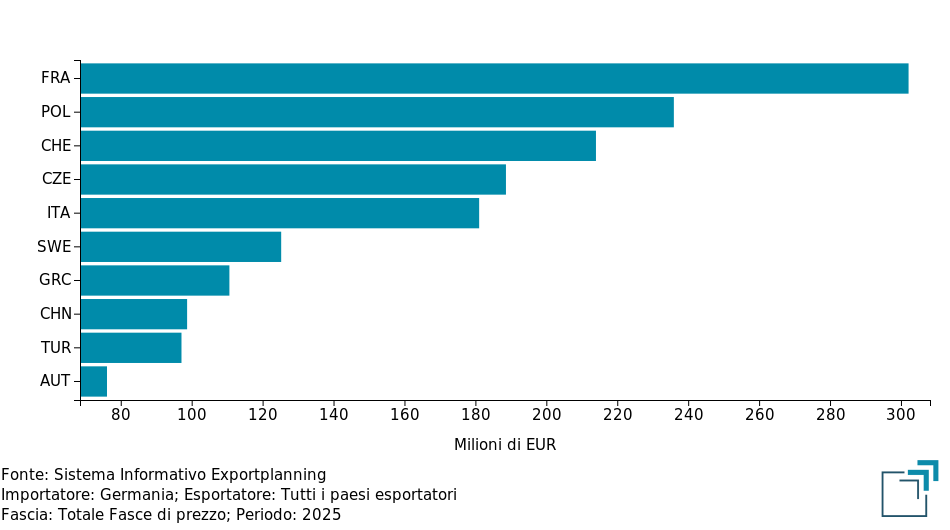
Source: ExportPlanning
Risks and opportunities for Italian companies
The data point to a focused opportunity for Italian suppliers rather than a broad advantage across electrical equipment. Companies should start with a subproduct: its exact classification, application, standards and small group of relevant buyers. Electricity distribution and control equipment may be the clearest starting point statistically, but market access will differ among cables, finished equipment and components.
Suppliers of complete grid equipment may need to qualify directly with utilities or engineering contractors. Component manufacturers may gain faster access through German OEMs, panel builders or system integrators, while more standardized products may fit specialist distribution. The channel must follow the product; finding a distributor is not a market-entry strategy on its own.
EU market access is only the starting point. German customers will often expect a buyer-ready technical dossier, relevant test evidence, credible delivery capacity, German-language documentation and a workable after-sales response. Major grid procurement is process-led: 50Hertz conducts tenders above €100,000 through Ariba, while Amprion uses SAP Ariba for supplier onboarding, screens whether a supplier’s portfolio matches current needs and may request category-specific questionnaires and certificates.
In practice, buyers will also look at delivery reliability, technical responsiveness, traceability and local service. Partnerships can be as important as direct sales: a German contractor or OEM can provide market access and references, while the Italian partner contributes specialist capacity or product expertise.
Conclusions
Germany offers Italian manufacturers a sizeable and expanding import opportunity, but the opportunity is not uniform. Electricity distribution and control equipment stands out because German demand is growing and Italy is already gaining ground. For Italian manufacturers, the challenge in the coming years will therefore be to capitalize on their existing competitive advantage, adapting their offering and commercial processes to the specific characteristics of German demand. In a market characterized by high technical requirements and structured procurement procedures, product competitiveness, buyer qualification, and the ability to effectively access and serve the relevant supply chain will become complementary and decisive factors in capturing the potential generated by Germany’s energy transition.
You may be interested in:
THE EU EXPORTS OF CAPITAL GOODS IN Q3-2026
Published by Marcello Antonioni. .
Metal industry Conjuncture Export Global economic trendsThe growth in European sales of capital goods (+6.9% year-on-year in euro) was driven by Tools and Equipment for ICT and Services and Electrical Engineering [ Read all ]

Woodworking machinery: Italian exports grow
Published by Mauro Badanelli. .
Internationalisation Industrial equipment Foreign markets Monthly Market Data International marketingNei primi sette mesi del 2026 le esportazioni italiane mostrano un incremento sul 2025, mentre le vendite all'estero dei principali concorrenti calano [ Read all ]

IMF WEO October 2026: Divergent Resilience and Persistent Pressures
Published by Alba Di Rosa. .
Macroeconomic analysis Conjuncture Uncertainty IMF Global economic trendsOn October 13, the International Monetary Fund released its latest World Economic Outlook, a key publication assessing the state of the global economy and its growth prospects. Compared with }... [ Read all ]